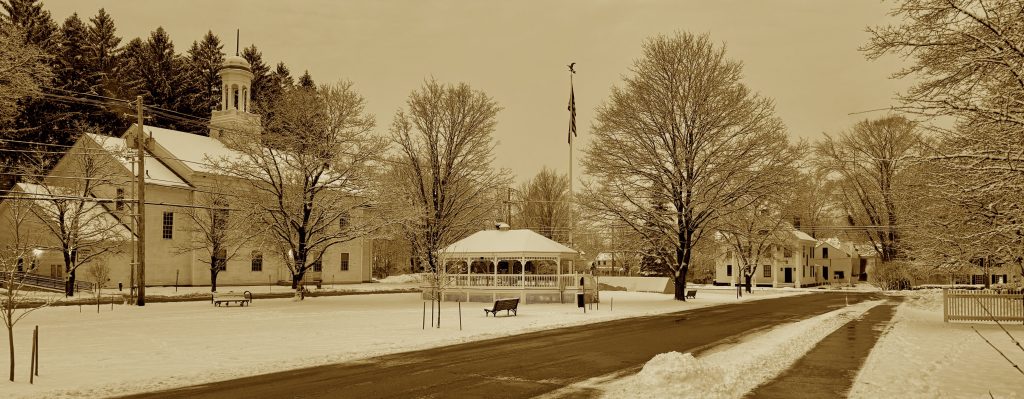
The Town Common (formally Washington Square) has been the physical and symbolic center of Walpole since the eighteenth-century. Laid out as a shared open space, it served many of the functions essential to early New England town life: a place for military drills, public meetings, recreation, celebration, and the everyday mixing of neighbors. Its broad, grassy expanse has long embodied the community’s traditions of civic participation and common use.
By the late nineteenth-century, the Common had become a lively focus of organized recreation. Tennis courts appeared in 1883, and baseball games drew enthusiastic crowds—occasionally too enthusiastic, as suggested by an 1884 complaint about the players’ “noisy and profane” language. In response to increasing activity, the town established regulations to protect the space, prohibiting cannon fire and circus exhibitions on the Common (a street sign posted on the northern end reads “Keep Horses Off Common”). These rules reveal both its popularity and the community’s desire to balance enjoyment with preservation.
The twentieth-century added new layers of meaning. A fund for a village Christmas tree began in 1920, and in 1935 a spruce was planted at the north end of the Common that is still illuminated each winter. Just a few years earlier, in 1921, construction had begun on the War Memorial, honoring the men of Walpole, North Walpole, and Drewsville who served in World War I. The monument was later updated to include veterans of all subsequent conflicts, and flanked by two 75mm Krupp mountain cannon, it remains a solemn anchor at the edge of this shared green.
The Town Common continues to serve its historic purpose: a gathering place at the center of village life, ringed by some of Walpole’s most distinguished buildings and alive with seasonal events, quiet conversations and everyday passersby. Its long, evolving history reflects the town’s commitment to shared space and the belief that a community is strengthened by the places where people naturally come together.

