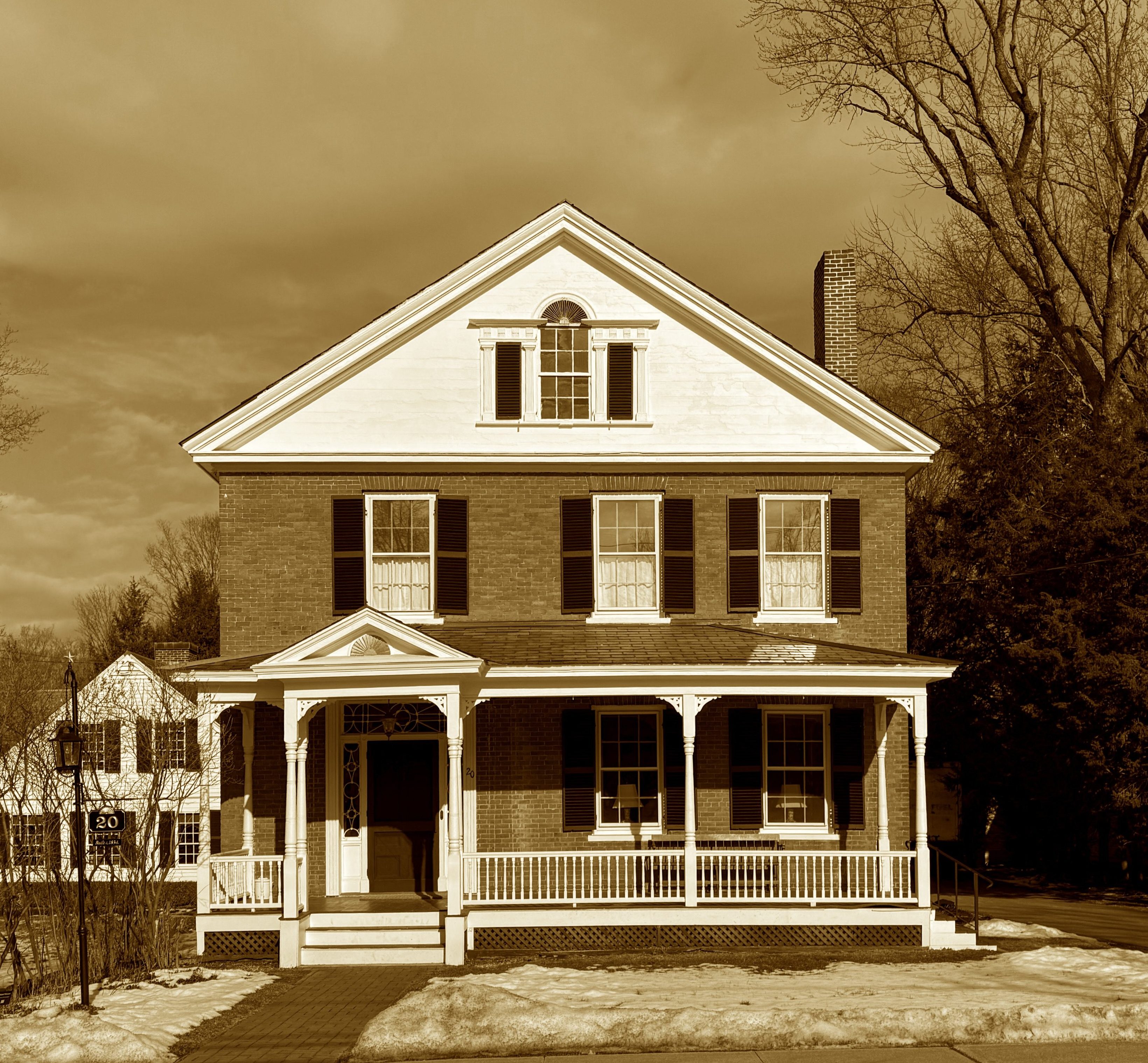

In the early nineteenth-century, much of the block on which the Aaron Howland House stands was part of an extensive tract owned by Dr. Ebenezer Morse (1785–1863) and his wife, Esther Crafts Morse (1791–1879). The Morses were prominent early residents, and part of their landholdings encompassed nearly the entire area bounded by Main Street, Turnpike Road (the diagonal section of today’s Main Street), Elm Street, and Westminster Street.
They sold this large parcel, minus the previously established Christopher Lincoln lot on the north and the Stephen Rice and Susan Bellows Robeson lots along Elm Street, to Nathaniel Holland (1788–1835). The original tavern on the premises was owned by John Crafts about 1793. Nathaniel Holland next operated the tavern, and the deed from the 1823 deed from the Morses to Holland describes the transfer as including the “buildings thereon,” specifically noting that the property was “the same premises Holland now occupies as a tavern,” amounting to about three acres. The only exclusion was an existing lease for the installation and maintenance of hay scales, a standard feature for weighing loads in a community centered around agriculture and transport.
In 1833, Holland sold the tavern property to George Huntington, who continued to run the tavern stand. At that time, the tavern faced Main Street on the site now occupied by the Irving Oil gas station. Huntington soon began subdividing the land, selling off lots both along Westminster Street and to the north of the tavern on Main Street. These subdivisions created the house sites we know today at 20, 16, 14, 10, and 8 Westminster Street, laying the groundwork for the neighborhood that would grow up around the future Aaron Howland House.

