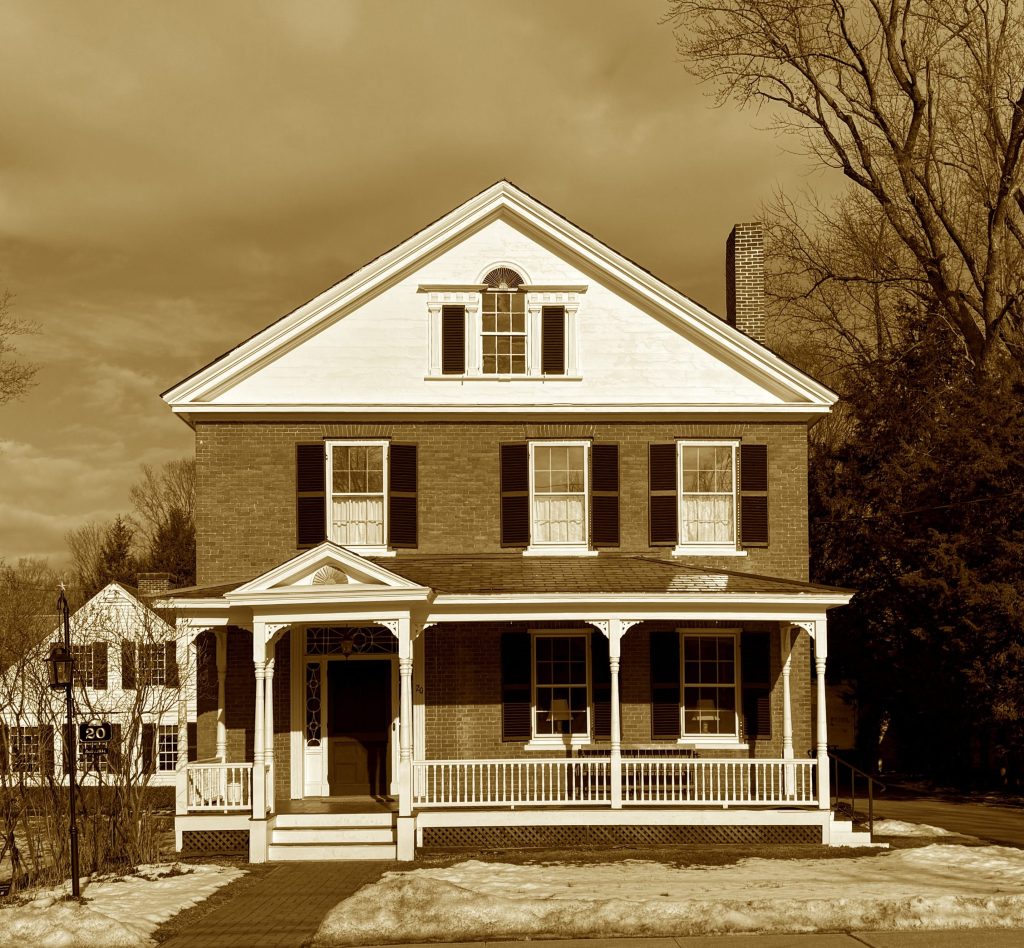
The Aaron Howland House: An Exemplary Greek Revival Residence
The Aaron Howland House stands as a quintessential example of the Greek Revival style that became popular in the early decades of the nineteenth century. This architectural style, which drew inspiration from the classical forms of ancient Greece, was particularly influential in shaping the American architectural landscape during this period. The Howland House, with its clean lines, symmetrical proportions, and classical detailing, embodies the key elements of this style.
Many of the architectural details of the Aaron Howland House are derived from the influential pattern books published by Asher Benjamin (1773-1845), one of the most prominent architects and authors of the time. Benjamin’s work was instrumental in disseminating Greek Revival design principles to builders and craftsmen throughout the United States, making sophisticated architectural styles accessible to a wide audience. His books provided detailed illustrations and instructions on creating structures that captured the essence of Greek architecture while adapting to American needs.
Asher Benjamin’s pattern books that likely influenced the Aaron Howland House include:
- The Country Builder’s Assistant (1797): Benjamin’s first book introduced classical design elements to American builders, emphasizing proportion and ornamentation.
- The American Builder’s Companion, co-authored with Daniel Raynerd (1806; 3rd edition, 1816): This book expanded upon his earlier work, offering more comprehensive designs for builders to emulate, including elements specific to Greek Revival.
- The Rudiments of Architecture (1814): This guide further refined Benjamin’s instructions, focusing on essential architectural components and their applications in residential design.
- The Architect, or Practical House Carpenter (1830): A pivotal work that emphasized practical building techniques, this book provided builders with the tools to create elegant and functional Greek Revival structures.
- The Practice of Architecture (1833): This publication illustrated the application of Greek Revival details in both public and private buildings, promoting the style as versatile and suitable for various types of architecture.
- The Builder’s Guide (1838): Benjamin’s guide served as a manual for builders looking to incorporate the most current Greek Revival trends into their designs, ensuring the style’s widespread use.
- The Elements of Architecture (1843): In one of his final works, Benjamin summarized his architectural teachings, focusing on Greek-inspired elements that were both aesthetically pleasing and structurally sound.
The Aaron Howland House reflects the influence of these pattern books in its overall design and in specific details such as the entryway, columns, and window frames. By following Asher Benjamin’s principles, the house not only adheres to the aesthetic ideals of Greek Revival but also serves as a testament to the era’s emphasis on adapting classical forms for American use, creating a timeless and historically significant architectural work.
Greek Revival Architecture: 1825 – 1860
By the late eighteenth century, interest in classical architecture surged in both Western Europe and the United States. Initially, the focus was on Roman models, evident in Early Classical Revival homes, particularly in the southern regions of the East Coast, such as Virginia. These Roman influences became a foundation for American architectural taste. However, as the nineteenth century progressed, a shift occurred. Archaeological discoveries and investigations increasingly highlighted ancient Greece as the cultural and architectural forerunner to Rome. This new fascination redirected attention to Grecian models, with their emphasis on symmetry, proportion, and simplicity.
This interest in Greek architecture was bolstered by the cultural and political climate in America. Following the War of 1812, there was a growing sentiment against British influence, prompting a desire for architectural styles that reflected American ideals and independence. Greek Revival, with its connection to democracy and the classical ideals of ancient Greece, offered an appealing and symbolic alternative. This convergence of factors led to the rise of what is now recognized as Greek Revival architecture, which became a defining style in the early to mid-nineteenth century.
Greek Revival was particularly popular among the first generation of American-born architects, such as Benjamin Latrobe, Robert Mills, William Strickland, Thomas U. Walter, and Ithiel Town. These architects embraced the “Grecian Style” as they sought to establish a distinctly American architectural identity. The style spread rapidly, aligning with the country’s westward expansion. Architectural guides published by influential figures like Asher Benjamin and Minard Lafever further facilitated its popularity, making Greek Revival elements accessible to local builders and carpenters throughout the nation.
The style manifested in various forms, but the classic structure of the Parthenon was a primary influence. One notable example was the Bank of the United States in Philadelphia (1818), which drew inspiration from this iconic temple. The association of Grecian architecture with such public buildings helped to establish a sense of economic stability and security, making it a symbol of prosperity and national strength. As a result, Greek Revival became known as the “National Style,” and it was adopted widely for public buildings, including courthouses, churches, banks, and town halls.
In the northern United States and New England, Greek Revival adapted to local needs, giving rise to the side-passage, gable-front house. This design became a popular vernacular form, characterized by Grecian-inspired features such as molded doorways, window frames, and columns supporting porch roofs. These elements, while simplified for practical use, captured the elegance and idealized aesthetics of Greek architecture. The versatility and broad appeal of Greek Revival made it one of the most pervasive architectural styles of the time, symbolizing a connection to the ideals of democracy, stability, and cultural refinement that ancient Greece represented to nineteenth-century Americans.
The Howland House: A 190-Year Legacy of Preservation and Architectural Significance
The Howland House, with its over 190-year history, stands as a testament to architectural excellence and careful preservation. Over its long history, the property has had only nine owners, contributing significantly to its remarkable state of preservation. The house exemplifies Greek/Classical Revival style, featuring a front-gable design and iconic six-over-six double-hung windows.
Exterior Features
- Roof and Foundation: The house is topped with a slate roof and features a simple drip mold. It rests on a sturdy granite foundation, supported by fieldstone.
- Chimneys: There are four chimney columns positioned along the exterior walls, enhancing the symmetrical design and providing a classical aesthetic.
- Architectural Details: The Howland House showcases several Asher Benjamin design elements, including a Palladian window set into the pediment, adding elegance and light to the upper façade. The front door, which is square-headed, is framed by side and transom lights with original lead muntins, all in pristine condition.
- Porches: The full-width entry porch is a later Victorian addition, dating to around 1900. It includes period-appropriate Victorian details, while the original columns from the front porch have been repurposed for the side porch, preserving a link to the house’s original design.
Interior Features
- Flooring and Walls: The house retains its original wood floors, featuring random-width planks, and much of the original plasterwork remains intact.
- Fireplaces: The fireplaces are designed with functional ingenuity; they have perforated tubes installed in the sides, which can be pulled out to circulate more hot air than the fireplaces alone provide.
- Doors and Moldings: Throughout the house, doors are framed with crisp moldings and adorned with bull’s eye corner blocks, reflecting the attention to detail characteristic of the period. The formal front parlor includes inside shutters, a refined touch consistent with its historic charm.
- Brickwork and Structural Details: The brick walls of the house are constructed three or four courses thick, laid in a common bond pattern, ensuring stability and durability. The roof structure includes a pegged and mortised ridge pole, showcasing traditional craftsmanship and construction methods of the era.
The Howland House stands not only as a piece of architectural history but also as a symbol of careful stewardship over nearly two centuries. Its blend of Greek Revival features, later Victorian enhancements, and well-preserved details make it a significant and cherished part of the town’s heritage.
 Aaron Howland House