Introduction
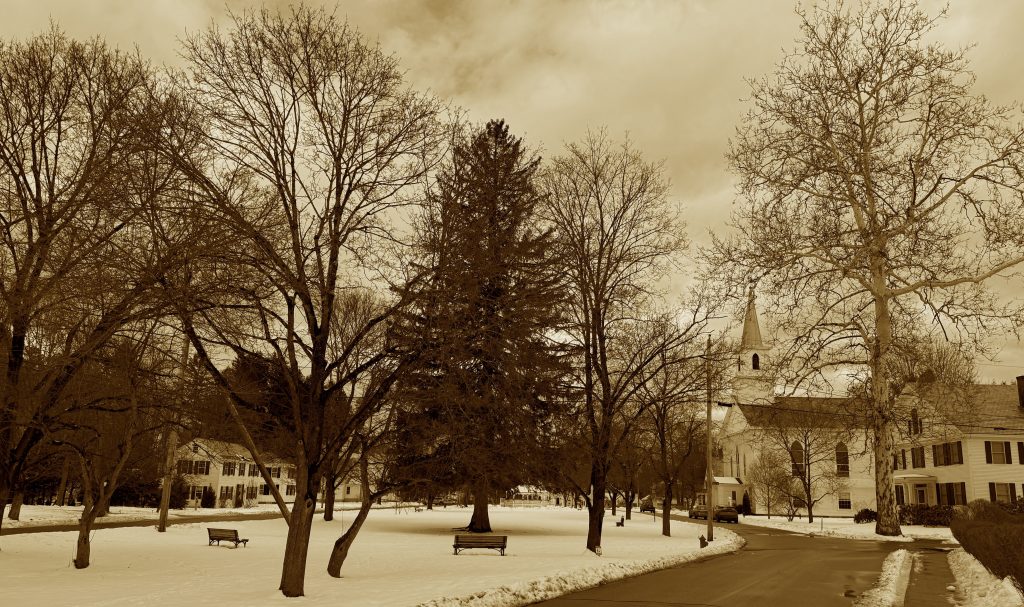
Welcome to Walpole, New Hampshire—a village whose quiet streets and dignified buildings offer one of the most intact windows into the aspirations of early nineteenth-century New England. As you begin this walking tour, you’ll notice a recurring architectural language: bold pediments, columned porticos, crisp white façades, white clapboard siding and simple, harmonious proportions. These are the hallmarks of Greek Revival architecture, the style that flourished in the United States during the early decades of the 1800s and shaped Walpole’s appearance at the moment when the town was entering its greatest era of prosperity.
In communities across New England, Greek Revival architecture embodied far more than decorative taste; it expressed the values and ambitions of a young republic. Americans looked to ancient Greece as the birthplace of democracy, and in adopting its forms they aligned their civic buildings, churches, and homes with ideals of self-governance, rational order, and integrity. In Walpole, this architectural vocabulary helped signal the town’s confidence in its future and its belief in the virtues of citizenship, learning, and public life. These same ideals also shaped the intellectual currents of the era, ideas that would later prompt New Englanders to look beyond institutions and outward forms, toward nature, conscience, and the inner life, themes we will return to at the close of this tour.
The Greek Revival style also marked a moment when the United States sought to define its own cultural identity. By choosing Greek prototypes instead of British ones, towns like Walpole expressed a compelling desire for independence and cultural maturity. The crisp geometry and restrained ornament that characterize so many of the village’s buildings announce a community grounded in order, stability, and enlightened aspirations. Yet even as Walpole embraced these rational forms, New England’s landscape—its rivers, fields, and distant mountains—remained a powerful source of meaning alongside the built environment. These are qualities that appealed strongly to New England towns engaged in trade, agriculture and civic improvement.
At the same time, Greek Revival’s adaptability made it ideal for the expanding settlements of the Connecticut River Valley. Builders could translate its clear forms into everything from grand meetinghouses to modest dwellings, giving Walpole a unified visual character that has endured for nearly two centuries. As we walk through the village, you’ll see how this style contributed to Walpole’s distinct sense of place—a village where democratic ideals are expressed in everyday buildings, where simplicity creates beauty, and where the architecture mirrors New England’s long history of community life, public responsibility and cultural ambition.
On this tour you will encounter a range of architectural styles, among them the earlier, more formal Georgian and Federal styles, and the later Romantic expressions of the Italianate, Gothic and Queen Anne styles. Each contributes its own chapter to Walpole’s architectural story. Yet despite these variations, the village’s overall character remains firmly rooted in the Greek Revival. Its clean lines, balanced proportions, and democratic symbolism form the prevailing visual language of the streetscape, giving Walpole a remarkable sense of cohesion even as individual buildings reflect changing tastes over time.
This tour highlights not only individual buildings, but also the people whose lives, beliefs, and aspirations they embody, revealing how architecture, landscape, and ideas together shaped Walpole’s enduring character. We hope you will appreciate how Greek Revival ideals helped shape Walpole into one of the region’s most charming and historically significant villages.
Begin Your Tour
Each listing begins with a brief overview of the site and its significance, followed by additional details for those who wish to read further. If time is limited, the opening paragraph provides the essentials. Begin the tour at the Aaron Howland House at 20 Westminster Street.
20 Westminster Street — Aaron Howland House
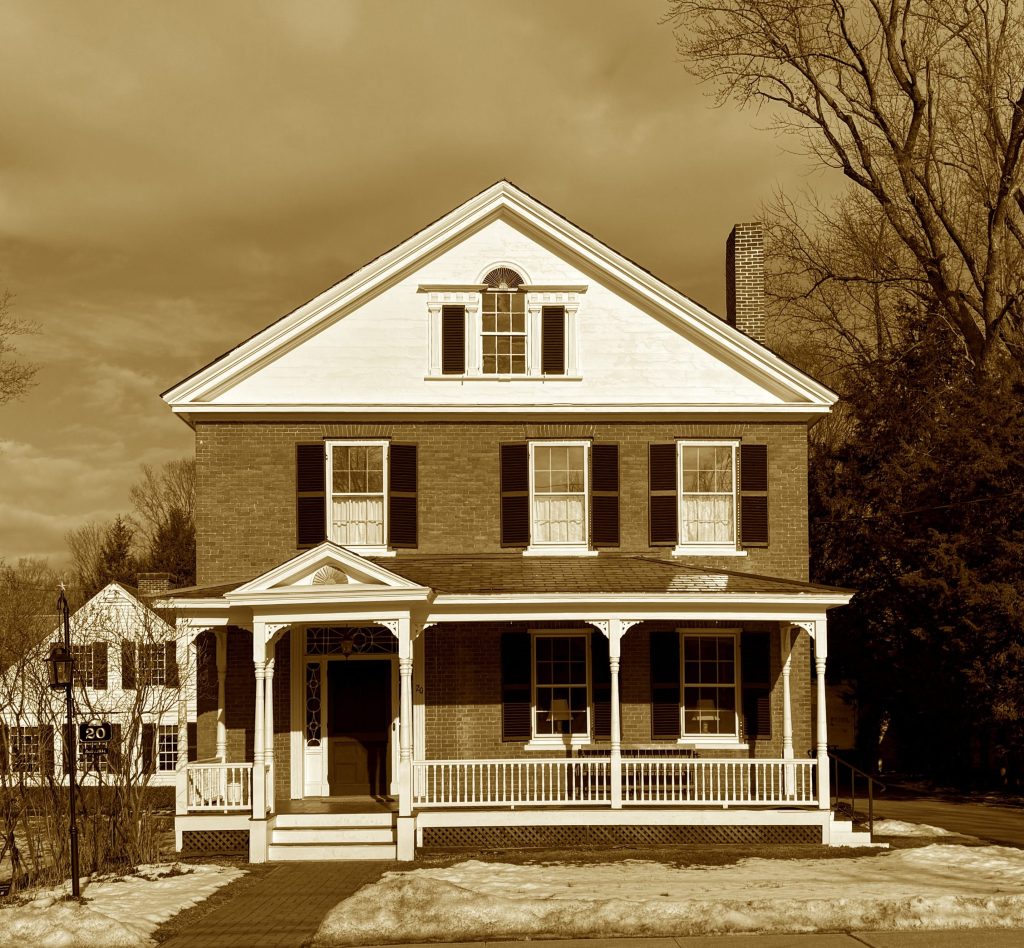
Built in 1834 by master craftsman Aaron P. Howland, this distinguished brick residence is one of Walpole’s finest expressions of Greek Revival architecture. Its prominent siting near the junction of Westminster Street and Main Street places it at the historic crossroads of the village’s transportation, commerce and civic life. Architectural details inspired by Asher Benjamin, most notably the pedimented façade with a Palladian window, reflect Howland’s skill and the ambitions of early nineteenth-century Walpole. Later owners, including stagecoach entrepreneur Otis Bardwell, former owner Jennie Spaulding, and preservationist Guy H. Bemis, link the house to successive chapters of the town’s economic, social, and preservation history.
The Aaron Howland House, built in 1834 by master craftsman Aaron P. Howland (1801–1867), is among the most architecturally distinguished residences in Walpole. Standing near the meeting point of Westminster Street and Turnpike Road (now Main Street), the two oldest and most important transportation corridors in the village, the house occupies a strategic position in Walpole’s early street network. The house is not simply a refined example of Greek Revival design; it is also a material testament to Walpole’s role as a crossroads community shaped by travel, commerce and the flow of ideas through the Connecticut River Valley.
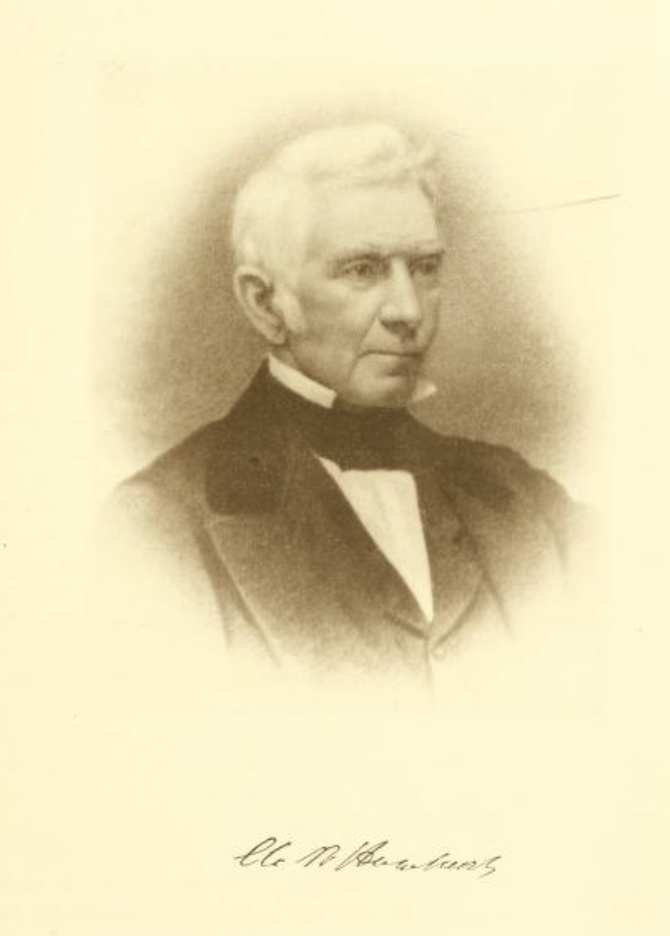
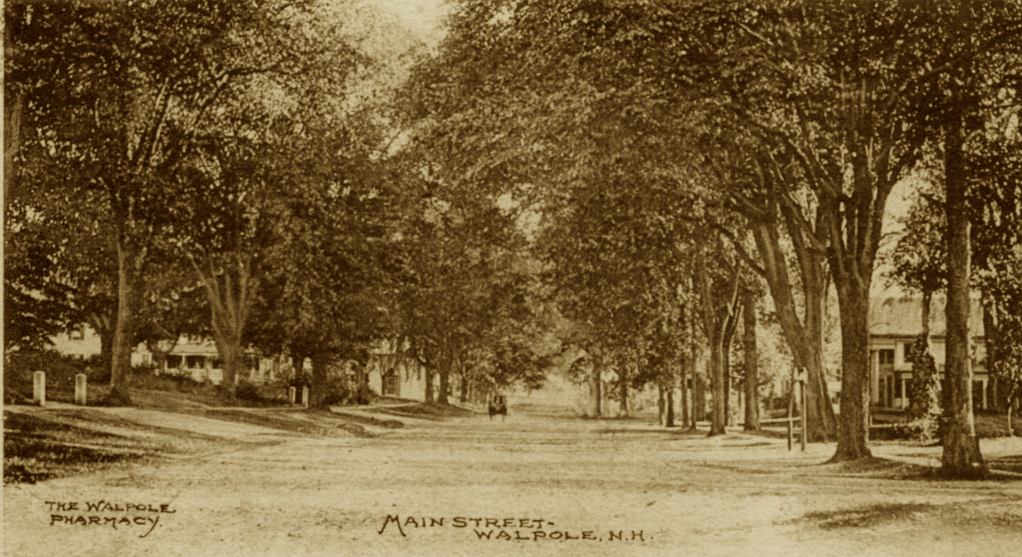
Long before the house existed, its site occupied a strategic position within Walpole’s early street network. Westminster Street led directly to one of the region’s earliest bridges across the Connecticut River (built in 1807), which was a critical eighteenth-century crossing that linked New Hampshire with Vermont and with trade routes leading deep into western New England and New York. Main Street, originally the Charlestown–Walpole Turnpike, carried steady north–south traffic through the growing village. For a brief period Westminster Street was also known as Depot Street, because it led directly from the village to the railroad depot and railyard by the Connecticut River (built circa 1849), a reminder of Walpole’s important mid-nineteenth-century rail connections and of how successive transportation technologies reshaped the same civic landscape.
These roads formed the crossroads of the commercial and civic heart of Walpole. By the 1830s, when Aaron P. Howland erected his elegant brick dwelling just steps from their convergence, the village had become a minor regional hub, supporting stage lines, taverns, small industries, and a concentration of professional and civic life. The Howland House emerged from this context: a refined brick landmark rising along the same transportation network that would later shape the fortunes of some of its most prominent owners.
Howland’s craftsmanship is unmistakable. The warm Connecticut River Valley brick provides the backdrop for a façade grounded in the principles of the Greek Revival, then at the height of fashion. Like many skilled builders of his generation, Howland drew inspiration from the pattern books of Asher Benjamin, whose architectural guides democratized classical design for American towns and helped translate abstract civic ideals into everyday buildings.
The front-gabled façade is crowned by a bold pediment enclosing a Palladian window, a design flourish that appears again in several other Howland-attributed houses across Walpole. The main entrance, framed by fluted pilasters and a transom with sidelights, a detail echoed in the nearby William Buffum House on Main Street, further cementing Howland’s stylistic fingerprint.
Inside, the house retains original random-width floors, crisp moldings, and folding interior shutters in the parlors and stair hall—features both practical and elegant. Fireplaces equipped with perforated heating tubes illustrate early experimentation with improved home heating in the decades before central furnaces.
Howland sold the house in 1842 to Anson Dale (1798-1853), who made a fortune in the California gold-fields and later lost it by speculating in Cheshire Railroad stock. His tumultuous career reflects the volatility of mid-nineteenth-century ventures that touched even small New England towns. His story underscores how even refined houses like this one were enmeshed in the risks and opportunities of a rapidly changing national economy.
The next owner, Otis Bardwell (1792–1871), ties the house directly to Walpole’s transportation economy—an economy shaped by the very roads that passed its door. Before purchasing the Howland House, Bardwell had lived for 25 years in the “Historic House” at 11 Old North Main Street, Walpole’s oldest surviving dwelling. During that period, he prospered as a stagecoach operator, eventually becoming the proprietor of several major stage and mail lines serving the Connecticut River Valley. His livelihood depended on the infrastructure of Main Street and Westminster Street, whose steady flow of passengers, mail, and freight made Walpole an important node in regional travel before the arrival of railroads.
Bardwell’s later roles as the first president of the Walpole Savings Bank and as an administrator of local trusts cemented his place among Walpole’s civic leaders. His ownership gives the Howland House a direct connection to the era when movement, communication, and enterprise shaped village life.
The property next passed from Bardwell’s heirs to Alfred W. Burt (1817-1891), a cabinetmaker, and later to his son George F. Burt (1852-1915), whose heirs sold it in 1895 to Jennie M. Spaulding (1863–1929). The deed conveyed ownership solely to Jennie, an uncommon assertion of women’s property rights at a time when married women were still navigating restrictive legal norms.
During the ownership of Jennie and her husband Frank A. Spaulding, the house took on its early-twentieth-century appearance. Around 1900, they added the broad Victorian portico that now spans the front façade.
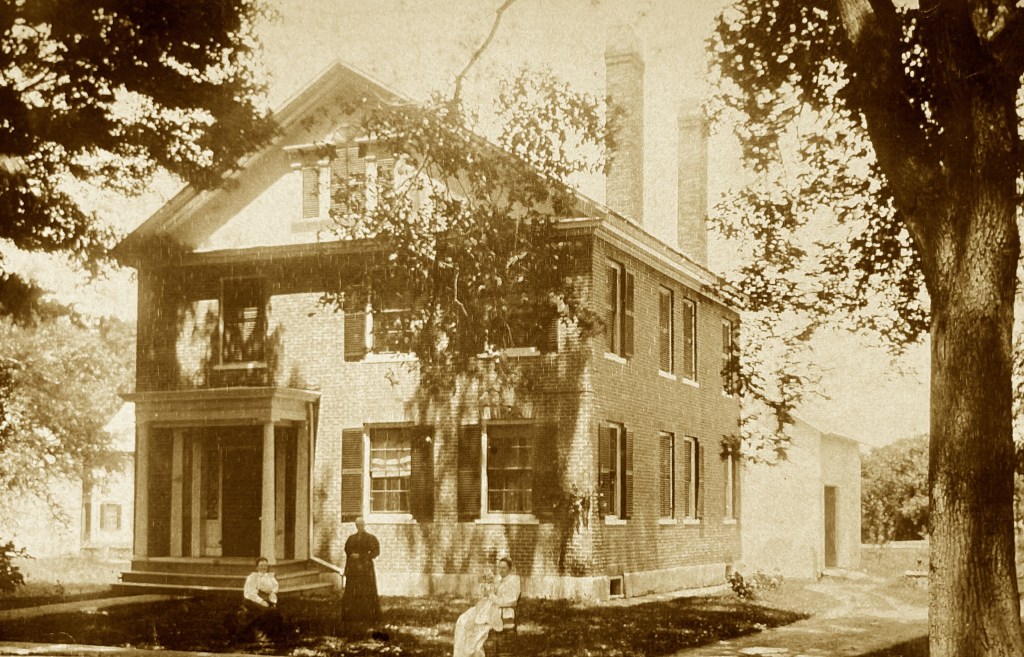
Rather than discarding Howland’s original entrance columns, the Spauldings moved them to a side porch, preserving a tangible link to the house’s first architectural moment. The side porch has since been re-built and the old columns are now in storage in the barn loft, awaiting their next chapter as a planned garden feature.
Jennie and Frank’s son Russell S. Spaulding inherited the residence, demonstrating a continuity of stewardship into the early twentieth-century.
In 1938, the house entered a new phase when it was purchased by Guy H. Bemis (1900–1996) and Marion K. Bemis (1907–1991). Widely known as “Mr. Walpole,” Bemis devoted much of his life to documenting and preserving the village’s architectural heritage. That the Howland House remained so intact into the late twentieth-century is due in no small part to the Bemises’ careful and appreciative occupancy. Their tenure connects the house to Walpole’s modern preservation movement and to the twentieth-century effort to value history as a foundation for community identity.
Why This House Matters: A Microcosm of Walpole’s History
The Aaron Howland House is far more than an elegant Greek Revival dwelling. It stands at the intersection—literally and figuratively—of nearly two centuries of Walpole’s evolution.
- Its architecture embodies the ambitions of early nineteenth-century America, grounded in classical ideals adapted for a growing New England village.
- Its location, near the junction of Westminster Street and Main Street, ties it to the transportation network that shaped Walpole’s prosperity, from early river crossings to bustling turnpike traffic.
- Under Otis Bardwell, the house becomes part of the story of stage lines, mail routes, banking, and the vibrant pre-railroad economy of the Connecticut River Valley.
- Under Jennie Spaulding, the house reflects shifting social norms and the expanding role of women as independent property holders.
- Under Guy Bemis, the property becomes a touchstone of community memory and architectural preservation.
These layers make 20 Westminster Street one of the most richly contextualized historic homes in Walpole. It offers not only architectural beauty but also a window into the lived experiences, ambitions, and economic forces that shaped the village from the 1760s through the twenty-first-century. It stands as a natural starting point for understanding Walpole as a community: how it grew, how it prospered, and how its residents have continually valued and preserved the built environment of their shared past. Together, these layers establish a foundation of civic confidence and public life upon which later generations would reflect more deeply on memory, meaning, and place.
Walk East on Westminster Street to see the Business District

In the early nineteenth century, much of the block where the Aaron Howland House now stands was part of a large tract owned by Dr. Ebenezer and Esther Crafts Morse, spanning most of the area bounded by Main, Turnpike, Elm and Westminster Streets. They sold the property, minus a few existing lots, to Nathaniel Holland, who operated a tavern on the site. Holland’s tavern property, including its buildings and roughly three acres, was sold to George Huntington in 1833, who continued the tavern operation and began subdividing the land. His sales of house lots along Westminster Street and north of the tavern on Main Street created the parcels that would eventually host 20, 16, 14, 10, and 8 Westminster Street. These subdivisions established the neighborhood that would later include the Aaron Howland House.
In the early nineteenth-century, much of the block on which the Aaron Howland House stands was part of an extensive tract owned by Dr. Ebenezer Morse (1785–1863) and his wife, Esther Crafts Morse (1791–1879). The Morses were prominent early residents, and part of their landholdings encompassed nearly the entire area bounded by Main Street, Turnpike Road (the diagonal section of today’s Main Street), Elm Street, and Westminster Street.
They sold this large parcel, minus the previously established Christopher Lincoln lot on the north and the Stephen Rice and Susan Bellows Robeson lots along Elm Street, to Nathaniel Holland (1788–1835). The original tavern on the premises was owned by John Crafts about 1793. Nathaniel Holland next operated the tavern, and the deed from the 1823 deed from the Morses to Holland describes the transfer as including the “buildings thereon,” specifically noting that the property was “the same premises Holland now occupies as a tavern,” amounting to about three acres. The only exclusion was an existing lease for the installation and maintenance of hay scales, a standard feature for weighing loads in a community centered around agriculture and transport.
In 1833, Holland sold the tavern property to George Huntington, who continued to run the tavern stand. At that time, the tavern faced Main Street on the site now occupied by the Irving Oil gas station. Huntington soon began subdividing the land, selling off lots both along Westminster Street and to the north of the tavern on Main Street. These subdivisions created the house sites we know today at 20, 16, 14, 10, and 8 Westminster Street, laying the groundwork for the neighborhood that would grow up around the future Aaron Howland House.
16 Westminster Street — Griswold Place
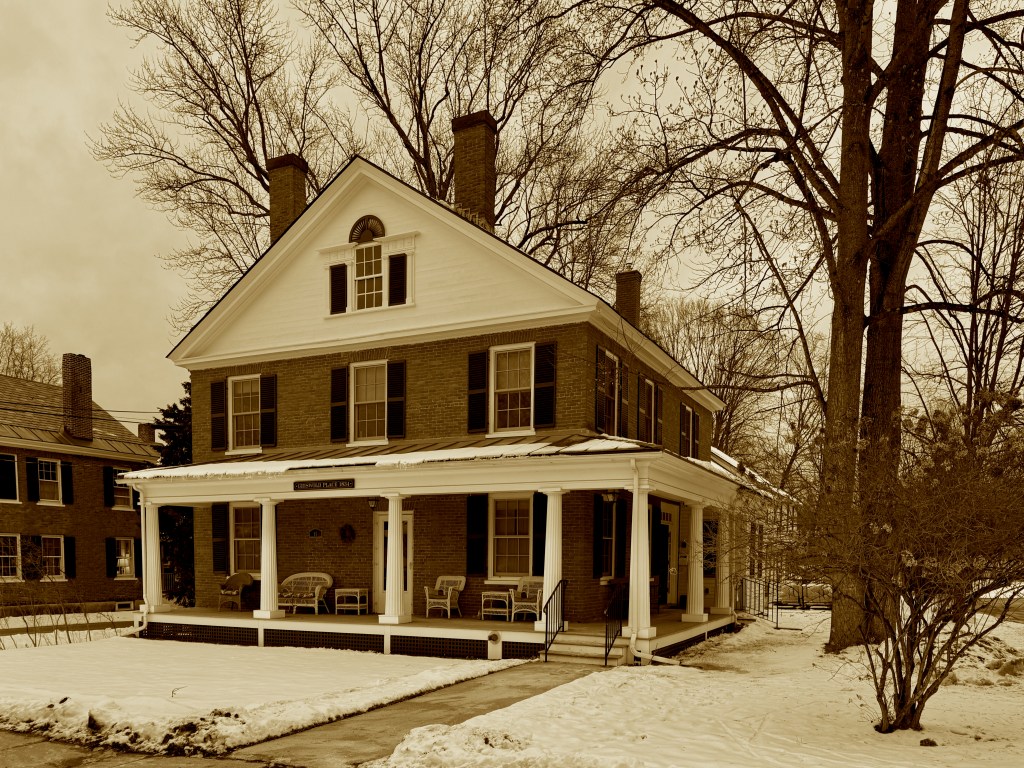
Built around 1834 for tailor Jonathan Weymouth, this refined brick house is a close architectural companion to the neighboring Aaron Howland House and is widely attributed to Howland’s hand. Its pedimented front gable with a Palladian window, along with its balanced proportions and restrained Greek Revival detailing, reflects the ambitions of the inhabitants of early nineteenth-century Walpole. Later known as the Rodney Wing House and today as Griswold Place, the building has adapted to changing uses, including service as an annex to the Walpole Inn during the town’s heyday as a regional destination. Now owned by The Walpole Foundation, it continues to serve the community while preserving the historic character of Westminster Street.
Just east of the Aaron Howland House stands 16 Westminster Street, identified in the 1959 Historic American Buildings Survey as the Rodney Wing House. At the time of the survey, the house was owned by Chester R. Wing (1900-1984), but today it is known as Griswold Place, in honor of Henry Griswold (1833-1889), who acquired the property in 1874. The house was built around 1834 for Jonathan Weymouth, a tailor, one of the skilled tradespeople who shaped Walpole’s early nineteenth-century village economy.
Although no builder is documented, the house is almost certainly the work of master builder Aaron P. Howland. Its architectural kinship to 20 Westminster Street next door is unmistakable. The most distinctive feature is the Palladian window set within a pediment-like front gable, a trademark element of Howland’s Walpole houses. The clean brickwork, classical proportions, and restrained Greek Revival detailing further reinforce the connection to the village’s mid-1830s building surge.
Over the decades, the property passed through numerous owners, adapting to community needs. In the early twentieth-century it served as an annex to The Walpole Inn, the large hotel that once stood across the street at 11 Westminster Street (demolished in 1962). During this period, the house provided additional lodging for visitors, supporting the busy hospitality trade that helped make Walpole a favored regional destination along Connecticut Valley transportation routes.
The house has been converted into a mixed-use structure (offices and apartments) and is owned by The Walpole Foundation, the nonprofit dedicated to preserving historic properties and open space for the long-term benefit of the town. Under the Foundation’s stewardship, Griswold Place continues to serve the community while retaining the architectural character that links it to Aaron P. Howland and the early development of Westminster Street as a cohesive civic streetscape.
14 Westminster Street — Tin Shop Lot

Known historically as the Tin Shop Lot, this narrow parcel reflects Walpole’s nineteenth-century village economy rooted in skilled trades and everyday commerce. Acquired by Aaron P. Howland in 1833 and defined by a distinctive lot line established in 1835, the site was long occupied by a tin shop serving essential household and industrial needs. Over time, successive tenants produced and repaired stoves, pipes, cookware, pumps, and other metal goods vital to daily life. Though modest in scale, the site preserves the story of the artisans and small businesses that sustained Walpole as a working village.
14 Westminster Street occupies what was historically known as the Tin Shop Lot. In 1833, George Huntington, proprietor of the nearby village tavern, sold this parcel to Aaron P. Howland. At the time, the purchase included land that later became the Village Tavern lot at 10 Westminster Street. Two years later, in 1835, Howland conveyed the western 19 feet of the property to Susan Jones, establishing the narrow lot line that survives today.
Throughout much of the nineteenth century, the site was occupied by a tin shop, a utilitarian yet essential village enterprise. Such shops fabricated and repaired household goods including stove and pipework, gutters, lanterns, and cookware, services vital to both domestic life and local industry. The building was frequently leased and passed through a succession of tenants, rather than remaining in the hands of long-term owner-operators.
By the 1870s, the business operating here had expanded its offerings considerably. Advertisements from the period list ranges, furnaces, stoves, pumps, lead pipe, kitchen furnishings, and tin, copper, and sheet-iron ware, reflecting the era’s growing domestic technology and the central role of metalworking trades in village life.
In the late twentieth century, the property entered a very different chapter as the home of the much-loved Murray’s restaurant, a breakfast and lunch spot that operated here for more than thirty years. Although Murray’s closed in 2014, it remains fondly remembered by generations of Walpole residents.
The tin shop site at 14 Westminster Street thus preserves an important strand of Walpole’s economic and social history, illustrating the long continuity of small-scale enterprise and service that has shaped the village center.
10 Westminster Street — Village Tavern

This prominent parcel was part of the historic Village Tavern property and has long been a hub of changing commercial life in Walpole. During the nineteenth century it housed a boot and shoe shop, meat market, furniture store, oyster saloon, drug store, and even a dancing hall, reflecting the evolving needs and tastes of the village. Fires, changing ownership, and shifting enterprises continually reshaped the building while preserving its role as a center of activity. Under the stewardship of The Walpole Foundation, the site continues its mixed-use tradition with a restaurant at street level and apartments above, anchoring the vitality of Westminster Street.
The property at 10 Westminster Street occupies part of what was once the Village Tavern lot, a lively commercial block that evolved continually as Walpole’s needs changed. In 1842, Aaron P. Howland sold the property to merchants William C. Sherman (1807–1884) and Amherst K. Maynard (1821–1884). Only a few years later, in 1851, Sherman sold his interest to Maynard, who transformed the building into a boot and shoe establishment. Maynard’s shop was typical of mid-nineteenth-century village manufacturing: the salesroom was on the ground floor, while the stock was produced upstairs, making the building both a workshop and a storefront. Maynard’s declining health forced him to liquidate his business in 1873.
A fire in 1877 marked a turning point in the building’s commercial life. After the fire, George F. Chandler and Fred A. Lebourveau (1854-1934) opened a meat market, reflecting the rise of specialized food shops in small towns during this period. By 1879, the building had shifted uses again, becoming a furniture store, with an oyster saloon in the basement.
Under John C. Howard, who purchased the property after 1885, the building continued to diversify. A dancing hall operated on the upper floor, while the ground floor hosted a drug store between 1894 and 1898. Through the early twentieth-century the storefronts continued to change: during the 1920s, the building housed a jewelry shop, followed later by the Peck Drug Store, remembered by many longtime residents.
In the modern era, the property was acquired by The Walpole Foundation, ensuring its continued use in support of the village center. In honor of the benefactor who helped finance the restoration, the building bears a plaque identifying it as the “Leslie S. Hubbard Block.” The ground floor is now home to Rancho Viejo, a Mexican restaurant, while the upper stories provide rental apartments, continuing the building’s long tradition of flexible, mixed-use commercial life.
8 Westminster Street — Old Fire House

Built in the early 1950s on the site of a former livery stable, this modest mid-century building reflects Walpole’s transition from horse-powered services to modern municipal infrastructure. It served for decades as the town’s fire station during a period of civic modernization. As emergency services outgrew the site, the building was retired from public use and later acquired by The Walpole Foundation. Adaptively reused as commercial space, the former firehouse marks the evolution of Westminster Street from nineteenth-century service corridor to a mixed residential, commercial, and civic streetscape.
The building at 8 Westminster Street stands on a parcel sold in 1952 by Mrs. Emma Graves (1863-1961) specifically for the construction of a new Walpole fire station. At the time, the site was occupied by an old livery stable, a reminder of the era when horses and wagons were essential to village life and when Westminster Street served as an active service corridor just off Main Street. Mrs. Graves late husband, Russell George Graves (1862-1943) had owned the livery stable and reportedly kept 32 horses there. Having the new firehouse set back from the road was a practical choice, allowing trucks to maneuver easily and reducing noise and visual impact on the street.
The resulting mid-century building served the town’s fire department for decades, representing an important moment in Walpole’s civic modernization. As equipment grew larger and emergency services became more centralized, the fire department eventually relocated to more suitable quarters elsewhere in town.
Following its decommissioning, the building was acquired by The Walpole Foundation. The former firehouse was converted into commercial space, and it is now home to financial advisor Edward Jones, while the structure retains the clean, utilitarian lines typical of small, mid-twentieth-century municipal buildings.
The site marks the transition between Westminster Street’s nineteenth-century residential and commercial buildings and the civic improvements of the twentieth-century, an illustration of how the village has continued to evolve while maintaining its historic character.
11 Westminster Street — Site of The Walpole Inn
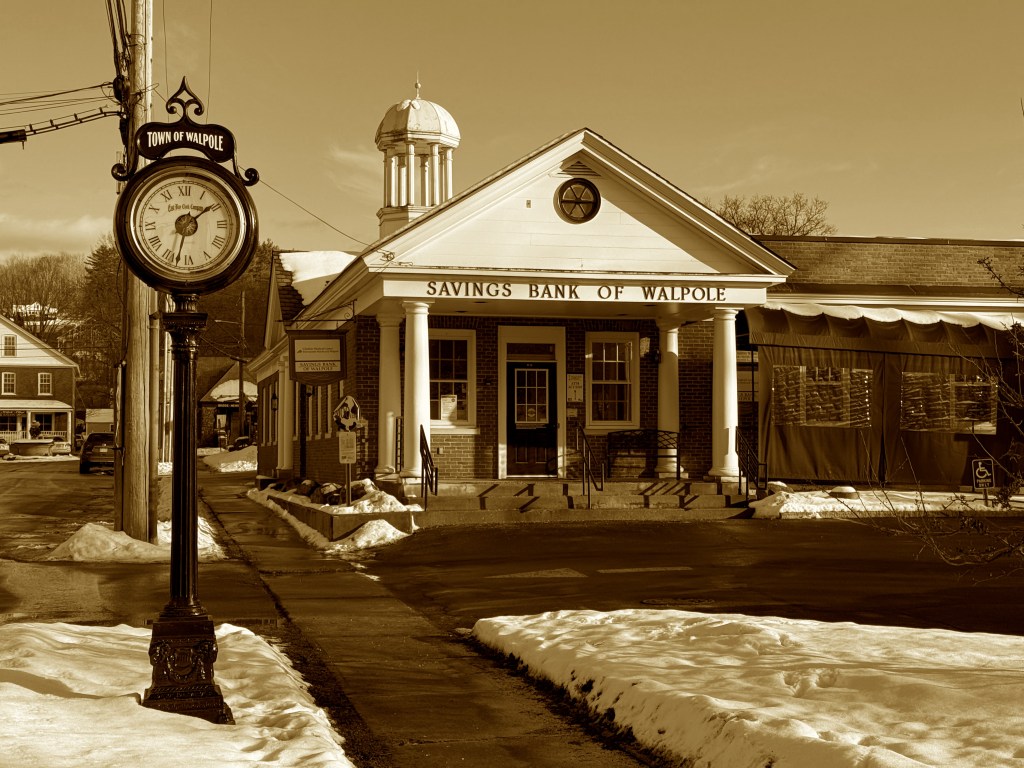

Originally developed around 1841 as a substantial private residence for William Mitchell, this prominent site later became one of Walpole’s most important landmarks. In 1902, Copley Amory transformed the house into The Walpole Inn, expanding it into a popular destination while also advancing modern village infrastructure through new water and sewer systems. For decades, the Inn served travelers, summer residents and social life in Walpole before falling into decline. Although the building was demolished in 1962, the site continues to serve the community as the home of the Savings Bank of Walpole and the Dartmouth-Hitchcock Clinic, carrying forward its long civic role.
The parcel at 11 Westminster Street was originally developed around 1841 when James L. Mitchell (1817-1880), a prosperous hotelier based in New York City, built a large house here for his father, William Mitchell (1788-1881). Mitchell was the owner of the “Hotel Brunswick” in New York City and had the means to build a substantial and comfortable dwelling in Walpole for his father’s retirement.
Although built by someone experienced in hospitality, the house initially served as a single-family residence, reflecting both its scale and its rural setting just off the village’s Main Street. Over the ensuing decades, the property passed through several private owners, each contributing to the architecture and character of the building.
In 1902, the property was purchased by Copley Amory (1866-1960), a scion of a prominent Boston family. Copley Amory came from a well-documented mercantile and socially prominent New England lineage: the extended Amory, Sullivan, Coffin, and related families of Boston long maintained business, estate, and social ties, with records going back to the seventeenth and eighteenth centuries.
Under Amory’s ownership, the house was completely remodeled and converted into The Walpole Inn. Porches were added, new wings constructed (including an east wing and a rear wing), and a stable was removed to make way for modern accommodations. Early in its life as an inn, the property was quite active: the main house served as the core lodging, while a nearby building was acquired as an annex to house overflow guests; its barn became a garage as automobile travel became more common.
But Amory’s influence on Walpole extended beyond hospitality. As he developed the Inn, he also launched major civic infrastructure projects: in 1903 he was one of seven Walpole men granted a charter to create the Walpole Water & Sewer Company to supply pure water to the village for domestic use, manufacturing and fire protection. He laid sewer lines along Westminster Street and down to the river, laying the groundwork for modern municipal services.
The transformation of the Mitchell house into The Walpole Inn under Copley Amory reflects more than a change of use; it marks a phase of modernization, linking the village’s nineteenth-century architecture and commerce to the evolving demands of the early twentieth-century.
The Inn operated for decades, drawing visitors, summer residents, and travelers. According to local histories, in its peak years the lawn was used for dancing, and the annex accommodated guests at high demand. The property at one time even featured a swimming pool below grade and lawns used for bowling.
By the mid-twentieth-century the building had fallen into disrepair. In 1962, the house was razed when the property was taken over by the Savings Bank of Walpole, which built a new facility on the site. Later, the site was acquired by The Walpole Foundation, ensuring that the property would remain under local stewardship and serve community needs. The Savings Bank of Walpole maintains a branch here, and a majority of the office space is now home to the Dartmouth-Hitchcock Clinic, which has been providing medical services to the community since 1982.
While the original inn no longer stands, its memory and the significant contributions of both the Mitchell and Amory families to Walpole’s built and civic environment remain central to understanding the village’s evolution.
51 Main Street — Jake’s Market & Deli — Site of Craft’s Tavern / Hotel Wentworth / The Dinsmore / Red Mill Inn

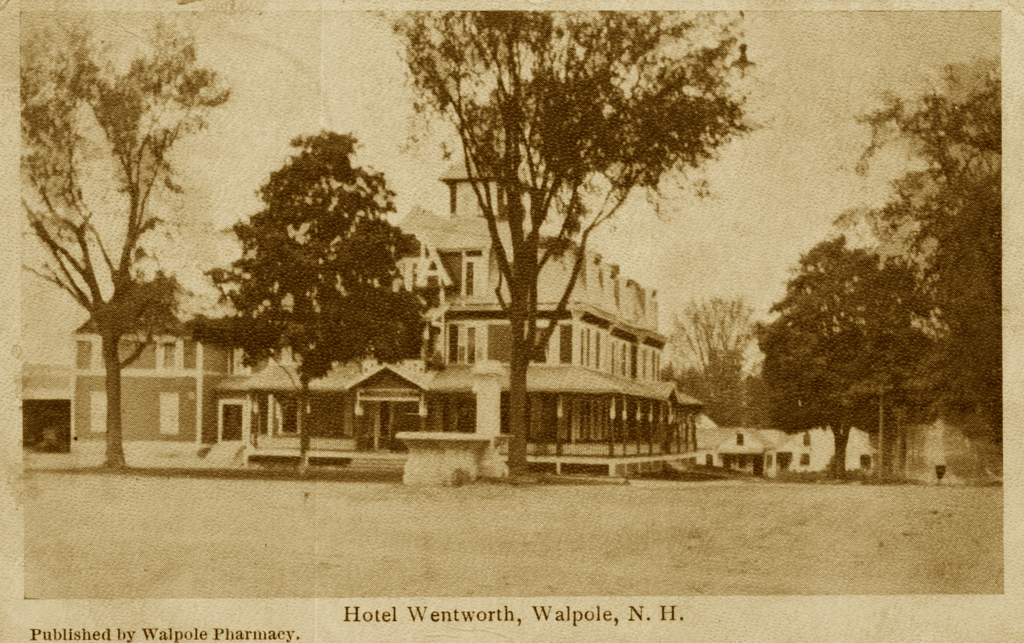
This busy corner has been a center of travel and commerce in Walpole since the early nineteenth century. First established as Craft’s Tavern before 1793, and later known as The Hotel Wentworth, it served as a major stagecoach stop on routes linking Boston, the Connecticut River Valley, and northern New England. Closely associated with stage operator Otis Bardwell, the tavern provided lodging, meals, and stabling at a time when Walpole was a vital transportation crossroads. Although the original building is gone, today’s market and filling station continue the site’s long tradition of serving travelers and the village alike.
The busy commercial corner at 51 Main Street, now home to Jake’s Market & Deli and the adjacent Irving Oil filling station, has been a hub of travel and activity in Walpole for nearly two centuries.
An inn stood on this site by the late eighteenth century, first known as Craft’s Tavern, which was in operation by 1793. During the early nineteenth century, as stagecoach traffic increased through the Connecticut River Valley, the tavern became one of Walpole’s most important public houses. In 1838, the property was leased by George Huntington to Justus W. Brown, and during this period it became known as the Hotel Wentworth, one of the most prominent stage stops in the region.
Walpole was a key crossroads on stage routes linking Boston with Burlington, Vermont, and Hanover, New Hampshire, while also connecting smaller river-valley towns to these main lines. Passengers, mail, freight, and news all passed regularly through the village, bringing steady business to its inns and taverns.
A central figure in this network was Otis Bardwell (1792–1871), a Walpole entrepreneur and stage driver who operated several stage and mail lines through the village. Under his direction, establishments such as Craft’s Tavern and the Hotel Wentworth prospered, providing travelers with meals, lodging, and stabling for horses. These inns also served as important social centers, hosting meetings, celebrations, and informal gatherings.
In the early twentieth century, the hotel was renamed The Dinsmore, and by the 1920s it was known as the Red Mill Inn. As automobile travel replaced stagecoaches and railroads reshaped regional transportation, the old hotel declined. By 1950, the building was demolished and replaced by a Gulf Oil service station. The concrete-block structure built at that time to house automobile service bays survives today, repurposed as Jake’s Market & Deli.
Though the original tavern and hotel no longer stand, this corner continues its long tradition of service to travelers, echoing its historic role as one of Walpole’s principal centers of hospitality, commerce, and movement.
Turn around and walk West past 20 Westminster Street
22 Westminster Street
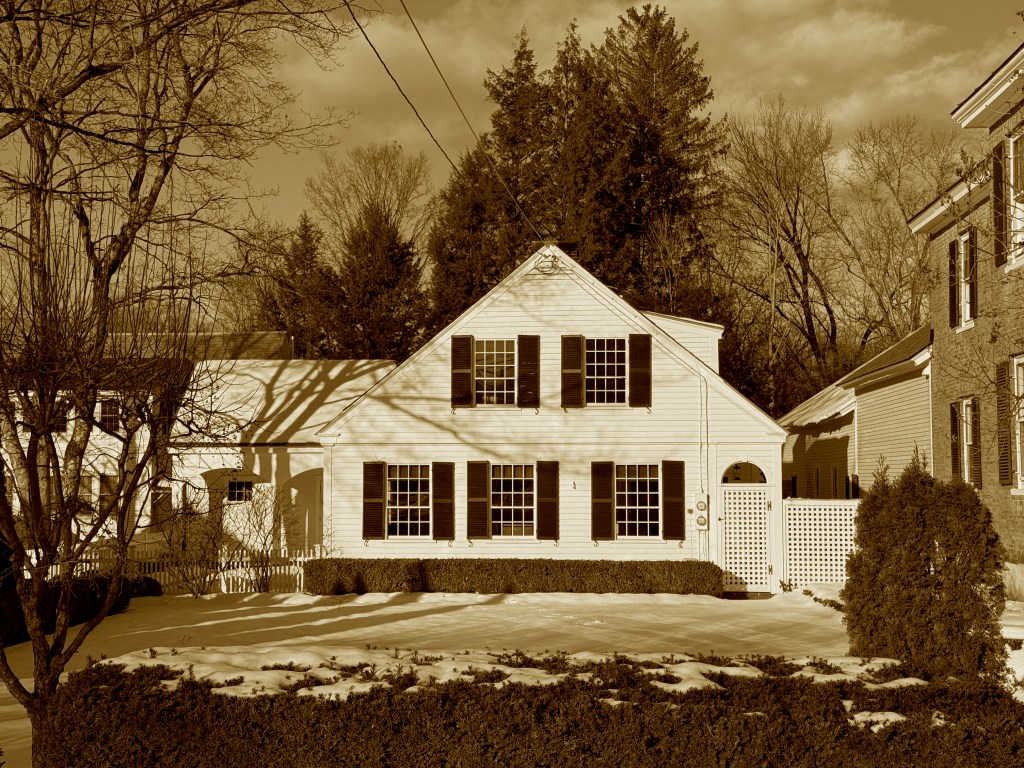
Originally built around 1790 in neighboring Westmoreland, this house was carefully dismantled and relocated to Walpole about 1940 by P. Lucile Tucker (Hawley) Bragg. Reassembled on Westminster Street, the timber-frame structure retains the proportions and character of a late eighteenth-century New England dwelling. Local lore surrounding its placement, reportedly positioned deliberately close to the neighboring Aaron Howland House, adds a human dimension to its history. The house contributes an earlier architectural layer to the streetscape, linking Westminster Street to the region’s colonial building traditions and personal village stories.
22 Westminster Street has a unique story. It was originally built circa 1790 in Westmoreland, New Hampshire, and was disassembled and relocated to Walpole around 1940 by P. Lucile Tucker (Hawley) Bragg (1884-1953), then the owner of 24 Westminster Street next door. She had purchased it from Robert Moore of Westmoreland. The move was a significant undertaking, carefully transporting the timber-frame structure and reconstructing it on its new lot.
According to local lore, Mrs. Bragg was not particularly fond of Guy H. Bemis, then the owner of 20 Westminster Street (the Aaron Howland House). She positioned the relocated house as close as possible to Mr. Bemis’ property, much to his dismay. Reportedly he was incensed about it. Relations between the parties must have thawed, because years later Marion Bemis is identified as the “Informant” on Mrs. Bragg’s death certificate.
The house itself retains the character of its late-eighteenth-century origins, with timber-frame construction and traditional proportions typical of New England homes of the period. Its presence on Westminster Street adds a layer of historical intrigue to the block, illustrating both the region’s architectural heritage and the personal stories that shape the village’s social landscape.
24 Westminster Street — Susan Bellows Robeson House

Built around 1821 for Susan Bellows Robeson, granddaughter of Col. Benjamin Bellows, Walpole’s founder, this refined house is considered the town’s earliest example of Greek Revival architecture. Modest in scale yet elegant in proportion, it reflects both changing architectural tastes and the aspirations of Walpole’s early nineteenth-century families. The home is closely associated with Susan Robeson’s strength of character and civic spirit, remembered in local tradition at the time of her death. Later owned by antiques dealer and preservation-minded P. Lucile Tucker (Hawley) Bragg, the house continues to embody the layered personal and architectural history of Westminster Street.
Built circa 1821 for Susan Bellows Robeson, daughter of Colonel Joseph Bellows (1744-1817) and granddaughter of Colonel Benjamin Bellows (1712-1777), Walpole’s founder, this refined house is widely regarded as the town’s earliest example of Greek Revival architecture. Modest in scale yet formal in expression, it marks a clear departure from the earlier Colonial houses nearby and reflects Walpole’s early embrace of national architectural trends.
The house is distinguished by its temple-like front façade, dominated by a full-height portico with tall classical columns supporting a triangular pediment. The smooth, white exterior finish, strong cornice line, and symmetrical window placement emphasize order, proportion, and restraint, all hallmarks of the Greek Revival style. Unlike later, more elaborate examples, this early version is intentionally restrained, translating monumental classical forms into a dignified village residence suited to a small household.
Designed and built by Levi Hubbard (1764–1831), the house was intended for Susan Bellows Robeson (1780–1860), eldest daughter of Colonel Joseph Bellows (1744-1817) and granddaughter of Colonel Benjamin Bellows (1712-1777), Walpole’s founder. Recently widowed at the time of construction, Susan Robeson managed the household while raising two children alongside four stepchildren from her husband Major Jonas Robeson’s earlier marriage, embodying both independence and civic responsibility.
Local tradition preserves a vivid story of her character. On the night of her death, as Walpole prepared a torchlight procession in support of Abraham Lincoln’s election, every house around the Common was to be illuminated. When told her windows were dark so she might rest more comfortably, Susan replied:
Let every pane of glass in every window of this house be lighted at once if there are candles enough in town to do it.
She died before morning.
In the twentieth century, the house entered a new chapter when it was purchased in 1932 by P. Lucile Tucker (Hawley) Bragg (1879–1953), a schoolteacher and antiques dealer who sold and displayed items from the barn on the property.
The Susan Bellows Robeson House stands as a landmark of architectural transition on Westminster Street, linking Walpole’s founding families, early Greek Revival design, and generations of residents whose lives shaped the village’s civic and cultural identity.
Excursus: Colonel Benjamin Bellows (1712-1777), Founder of Walpole
297 Main Street — Benjamin Bellows Homestead

Col. Benjamin Bellows (1712–1777) was the central figure in the founding of Walpole, New Hampshire. A surveyor by trade, he secured the original grant for “Number 3” in 1736, organized the first proprietors and led early settlers in establishing the community, serving as militia colonel, magistrate, and principal landholder. His homestead, while outside the village center, remained prominent through successive owners, including Copley Amory, who preserved and enhanced the property in the early twentieth century. Later the house became The Stagecoach Inn and is now The Bellows Walpole Inn. Bellows’ leadership and vision laid the foundations for Walpole’s enduring civic and social life.
Col. Benjamin Bellows was the central figure in the founding and early development of Walpole, New Hampshire. Born in Lancaster, Massachusetts, in 1712, he began his career as a surveyor and became well known on the colonial frontier for his skill in land assessment and his relations with Indigenous communities. His surveying work for the colonial government brought him into the upper Connecticut River Valley, where he recognized the agricultural promise of the region’s fertile intervale lands.
In 1736, Bellows received the original grant for what was then known as “Number 3,” the third in a chain of strategically placed settlements intended to secure the Massachusetts frontier. He organized the first proprietors, oversaw early surveys and lot divisions, and led the initial group of settlers who established the community. As Walpole grew, Bellows emerged as its most influential figure: serving as militia colonel, magistrate and principal landholder. His leadership during periods of frontier conflict, when fortified houses and coordinated defense were essential, helped ensure the settlement’s survival.
Since Bellows’ original homestead stands on the outskirts of town, it lies too far from the village center to be included in this walking tour. If time allows, drive north to 297 Main Street. The house is visible from the road.
The property remained significant long after Bellows’ death in 1777. In the late nineteenth and early twentieth centuries it entered a new phase when it became the residence of Copley Amory (1890-1964) of Boston, who owned the estate for thirty-five years (he also owned The Walpole Inn on Westminster Street). A member of a prominent Boston family, Amory invested heavily in the preservation, improvement, and adornment of the historic homestead, ensuring that the house and grounds retained their stature as one of Walpole’s most distinguished properties. His stewardship represents an early example of the interest urban elites took in the preservation and enhancement of New England’s historic rural properties.
Following the Amory era, the house evolved with changing community needs. It was operated for a time as The Stagecoach Inn, providing lodging and hospitality, and later served as a nursing home, a role that reflected mid-century adaptations of large historic houses for institutional use. Currently the property operates as The Bellows Walpole Inn, offering lodging, dining and an event venue. Its modern function continues a centuries-long tradition of the homestead serving as a prominent and welcoming presence in the life of the town.
By the time of his death, Bellows had laid the essential foundations for the enduring New England community we explore today. His descendants would continue to shape local and national history, but Col. Benjamin Bellows remains the energetic founder whose efforts transformed a remote frontier tract into a thriving village.
Turn Right (North) on Elm Street
15 Elm Street — Stephen Rice House
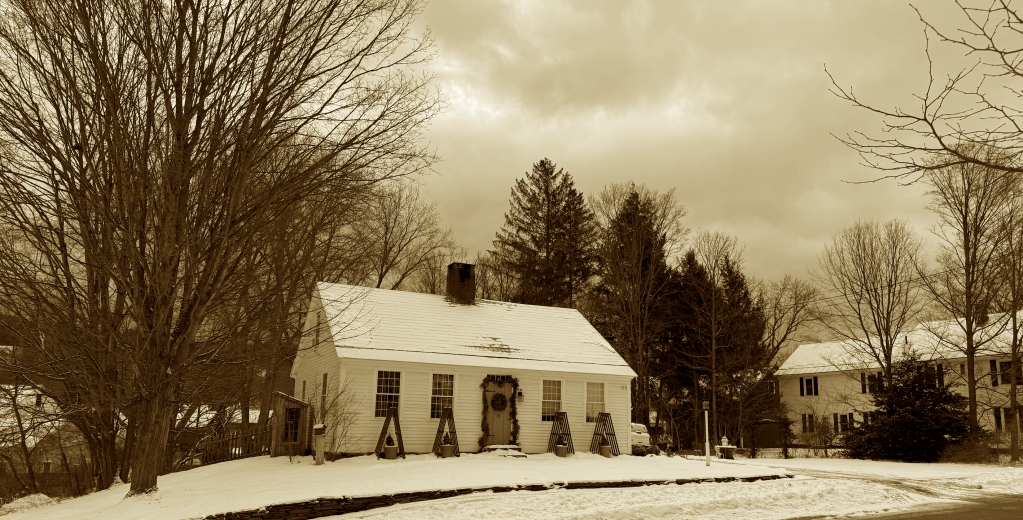
15 Elm Street is a modest, well-preserved early–nineteenth-century Cape, distinguished by its low profile, central chimney, symmetrical façade, and simple doorway—features typical of Walpole’s post-Federal rural domestic architecture and suggesting practical craftsmanship rather than display.
This kind of early-nineteenth-century Cape is one of Walpole’s most enduring house forms. Compact, efficient, and well-proportioned, such houses were built to meet everyday needs rather than to announce status. Constructed of white painted clapboard, their simplicity reflects a building tradition grounded in function, local materials and continuity rather than fashion.
Stephen Rice acquired the lot in 1818, lost and regained it amid financial trouble, and died insolvent by 1846, leaving a tangled estate settled by others. Over the next century the house passed through a succession of owners whose occupations—master carpenter, merchant-tailor, farmer, cabinetmaker, undertaker—trace the changing and often precarious working lives that sustained Walpole.
15 Elm Street stands not just as a representative house form, but as a reminder that modest buildings often witnessed complex personal histories marked by effort, adaptation, and uncertainty behind their calm and orderly exteriors.
14 Elm Street — Howland–Schofield House
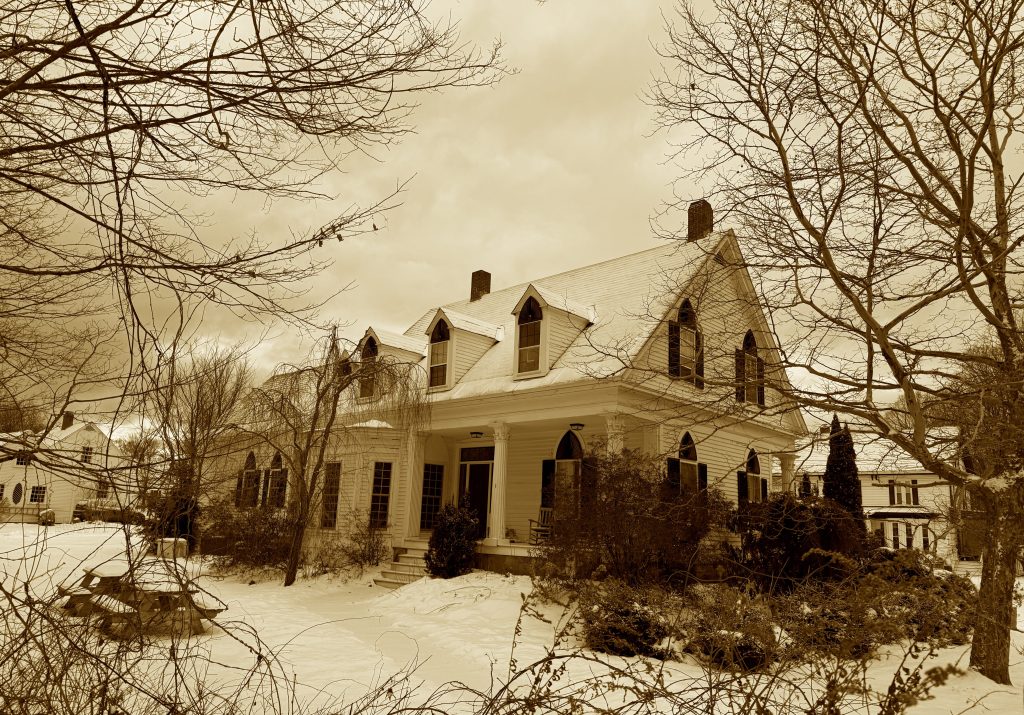
Built in 1844 by master builder Aaron P. Howland for his own family, this distinctive residence showcases an unusual blend of Greek Revival and Gothic Revival design. Classical elements, including a double front portico with Corinthian columns inspired by Asher Benjamin, are paired with pointed-arch pediments that give the house a picturesque Gothic character. The craftsmanship reflects Howland’s experimentation and confidence at the height of his career. The house continues its legacy of creativity as the home of Florentine Films, linking Walpole’s architectural heritage to nationally significant storytelling.
Dating from 1844, the Howland–Schofield House is one of Walpole’s most architecturally distinctive residences, reflecting the creative range of local builder Aaron P. Howland. This 1½-story home blends elements of both the Greek Revival and the Gothic Revival, two styles that were coming into vogue in New England during the mid-nineteenth-century. The result is an eclectic design that demonstrates Howland’s willingness to combine tradition with emerging tastes.
The house’s double front portico, supported by ornate Corinthian columns, showcases the classical influence. These columns closely follow the plates published by architectural pattern-book author Asher Benjamin, whose guidebooks were widely used by New England builders seeking to reproduce fashionable Greek Revival details. In contrast to these classical features, the house also incorporates unmistakable Gothic Revival motifs. Most striking are the pointed-arch Gothic pediments repeated above the portico and echoed across the numerous windows and dormers. This rhythmic use of pointed arches gives the house a picturesque, vertical emphasis, softening the classical symmetry with a touch of romantic flair.
The main entrance door bears a strong resemblance to the doorway at 20 Westminster Street, the Aaron Howland House, suggesting that Howland favored the design enough to adapt it here. Aaron P. Howland and his family lived in the Elm Street house for many years before his widow sold the property in 1884 to George P. Porter (1834-1923). A later owner, Norman Schofield (1908-2002), lends his name to the house’s modern designation among the records of the Library of Congress, Historic American Buildings Survey. Schofield had purchased the property from P. Lucile Tucker (Hawley) Bragg, who noted:
It was the superior and unusual construction of the house with its attractive Gothic windows and detail that tempted me to see just what I could make of it. The fact that the house was built by Aaron P. Howland for his own family undoubtedly accounted for its superior construction. The cellar walls are unusually thick and the cellar itself is divided into three separate rooms. The outside walls of the house are of brick covered over with wood, while the chimney at the back of the house has built into it on the second floor a complete outfit for smoking meat.
This historic residence has taken on a new and notable role: it serves as the offices and production studio of Florentine Films, the documentary film company led by Ken Burns, whose work has brought national attention to American history and culture. The building’s preservation and active use add a contemporary chapter to its long and varied story.
The Howland–Schofield House can be compared with three mid-nineteenth-century residences in nearby Bellows Falls, Vermont: 9 School Street (built circa 1852), 107 Atkinson Street (built circa 1847) and 126 Atkinson Street (built circa 1849), which together display a strikingly consistent architectural vocabulary. Among other features, the most notable is the repeated use of Gothic Revival pointed-arch louvered transoms applied to the window heads, a highly distinctive motif that appears in virtually identical form on all four buildings. These pointed-arch louvered transoms, with their sharply peaked arches and radiating fan-shaped infill, are not common stock trim but appear to be purpose-designed elements, suggesting a single builder or designer rather than coincidental stylistic borrowing.

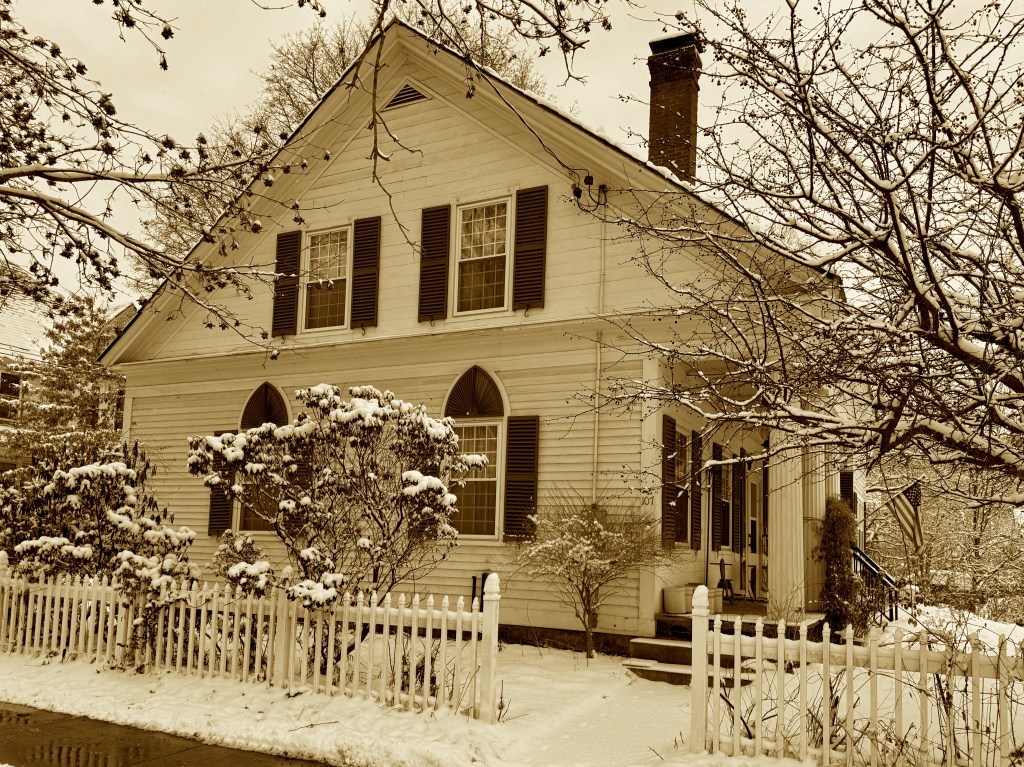

Beyond this signature detail, the buildings share closely related massing and proportions: two-story, gable-front or gable-dominant forms; symmetrical façades; narrow clapboard siding; flushboard tympanum; and restrained classical trim combined with Gothic accents. Window placement and scale are consistent across the group, as is the careful balance between vertical emphasis and domestic restraint. Porches are modest and subordinate to the main block, reinforcing the primacy of the gabled form.
These similarities strongly suggest that all four houses were designed and constructed by Aaron P. Howland. The repetition of such a specific ornamental feature across multiple buildings in close geographic proximity points to a recognizable stylistic signature rather than a generalized fashion. Assuming Howland was the builder, these houses collectively help define his body of work and underscore his role as one of the most accomplished and stylistically confident nineteenth-century builders in the Connecticut River Valley.
Return to Westminster Street
36 Westminster Street — St. John’s Episcopal Church
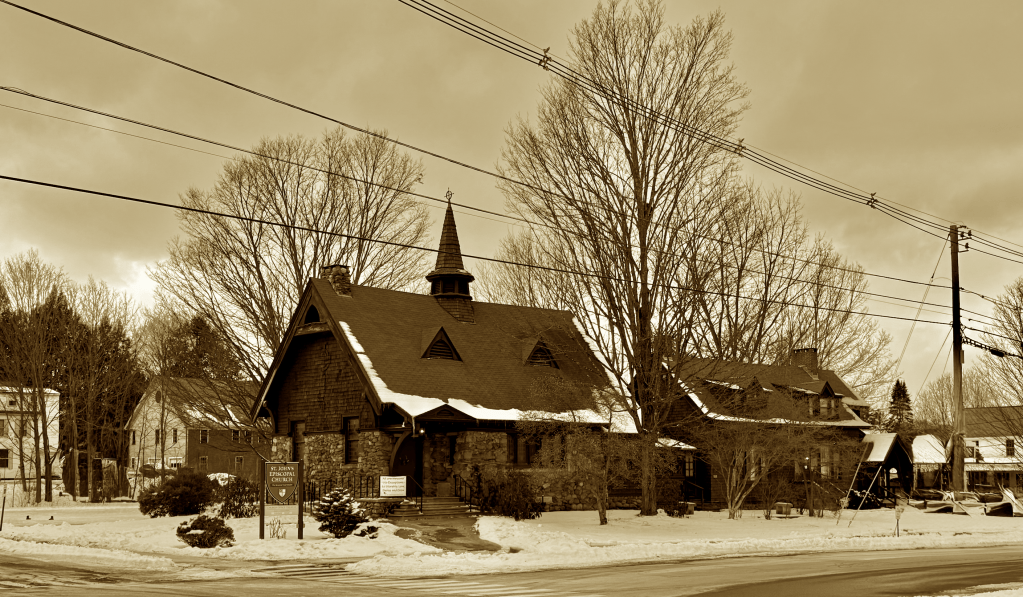
St. John’s Episcopal Church, built in 1902–1903, occupies a site long central to Walpole’s community life. Originally home to a village schoolhouse, the church was built through the generosity of Hudson E. Bridge, who donated the land in memory of his young daughter Katherine. Designed by the prominent St. Louis firm Mauran, Russell & Garden, the building blends Arts and Crafts and Gothic Revival influences in a carefully crafted structure. Consecrated in 1903, St. John’s serves as both a memorial and an enduring architectural landmark, reflecting the impact of summer residents and local philanthropy on Walpole’s civic and spiritual landscape.
This site has been a center of community life in Walpole for more than two centuries. The first building here was a village schoolhouse erected in 1807. Designed with three classrooms and an expansive second-floor exhibition hall, it served younger students from the village until 1854, when the new elementary school opened on School Street behind The Walpole Academy. After its educational use ended, the building found a second life as R. L. Ball’s shoemaker’s shop, a reminder of the small trades that once supported daily life in Walpole. The old schoolhouse was eventually demolished to make way for the present church.
The land for St. John’s Episcopal Church was a gift from Hudson E. Bridge (1858-1934), presented to the parish on August 1, 1902, as a memorial to his young daughter Katherine Bridge (1897–1900). Katherine died at the age of three, and her photograph is still displayed inside the church on the west end of the south wall; it remains a poignant reminder of the personal loss that shaped the church’s origins.
Hudson E. Bridge was a member of a prominent midwestern industrial family. The Bridges were influential in St. Louis, where they helped establish one of the nation’s largest hardware firms, H. E. & A. F. Bridge Company, descended from the well-known Bridge & Beach Manufacturing Company. Although the family’s primary business interests were centered in Missouri, they maintained connections to New England, and Hudson Bridge spent extended periods in Walpole. His gift of land reflects the pattern of affluent summer residents shaping Walpole’s civic landscape in the early twentieth-century.
The church building was designed by the distinguished St. Louis architectural firm Mauran, Russell & Garden, which was uniquely qualified to execute this building. John Lawrence Mauran was a nationally recognized architect, Ernest Russell contributed significantly to the firm’s ecclesiastical work, and William DeForest Garden had New England roots that may have helped connect the firm to the Walpole commission.
The partnership was known for adapting Arts and Crafts and Gothic Revival influences into refined, well-crafted buildings, qualities that are evident in St. John’s Church.
Groundbreaking took place in 1902, and construction moved swiftly. The first service was celebrated in 1903, followed by the laying of the cornerstone. The formal consecration occurred on September 5, 1903, led by The Rt. Rev. William Woodbury Niles, D.D., Bishop of the Episcopal Diocese of New Hampshire. Bishop Niles (1832–1914) was a respected scholar and church leader, serving as bishop from 1870 until his death. He oversaw a period of significant growth in the diocese, supporting the establishment of churches in both rural and urban communities.
St. John’s stands as both an architectural landmark and a memorial woven into the personal history of one family and the broader story of Walpole’s development at the turn of the twentieth-century.
Turn Right (West) on Westminster Street
40 Westminster Street — Holland House

Built around 1833 on land owned by John Bellows, this house originally reflected the transitional Federal-to-Greek Revival style typical of the period. Over the decades, it was altered with a third floor addition and other updates, transforming it into a larger, more flexible residence. In 1907, Mary Holland established it as The Holland House, a small lodging that welcomed visitors to Walpole’s summer community. Converted into apartments, the building preserves layers of architectural and social history, from its early nineteenth-century origins to its role in early twentieth-century village hospitality.
Built around 1833, this house stood on land owned at the time by John Bellows (1768–1840), who also owned the adjoining property at 48 Westminster Street (see that entry below for more on Bellows). While the architect or builder is not known, the house’s original form likely reflected the transitional Federal-to–Greek Revival idiom common in Walpole during the 1830s, characterized by straightforward massing and restrained detailing.
Bellows’ widow, Anna Hurd Langdon Bellows (1781–1860), sold the property in 1854, and in the decades that followed the house was significantly altered by later owners. The most dramatic change was the addition of a full third floor, which reshaped the original roofline and expanded the interior living space. Other updates over the nineteenth and early twentieth centuries further evolved the structure from a modest early residence into a more flexible, multi-use house.
In 1907, a subsequent owner, Mary Holland (1858–1937), established the property as The Holland House, a small lodging house that quickly became a favored stopping place for visitors arriving to open or preparing to close their summer homes in and around Walpole. Its position on Westminster Street, close to the village center yet slightly removed from Main Street, made it an inviting and convenient waypoint.
Following its period as a guest house, the building continued to adapt to changing needs and has since been converted into apartments. Even so, the house retains elements of its layered history: an 1830s core, substantial nineteenth- and twentieth-century alterations, and its brief but memorable early-twentieth-century life as one of Walpole’s modest seasonal lodgings.
43 Westminster Street — Stephen Rowe Bradley House

Built around 1808 for lawyer and legislator Francis Gardner, this Federal-style house later became the home of Vermont statesman Stephen Rowe Bradley. Instrumental in Vermont’s entry into the Union, Bradley lived here from 1817 to 1830, making the house a hub of family, legal, and political activity. Its 2½-story frame, hip roof, and well-proportioned Federal details reflect the elegance and symmetry of the style favored during the early republic. The property’s later use by the New Hampshire Asylum for the Insane and its return to private ownership underscores its enduring prominence in Walpole.
43 Westminster Street is on the National Register of Historic Places, and is a distinguished example of Federal-style architecture in Walpole. The house was built circa 1808 for Francis Gardner (1771-1835), a lawyer and state legislator, and later became the home of Stephen Rowe Bradley (1765–1830), a Vermont lawyer, judge and politician.
Bradley played a key role in Vermont’s entry into the United States as the fourteenth state in 1791, representing the independent Vermont Republic in negotiations over its boundaries. He resided at this house from 1817 to 1830, during which time it served as both a family home and a center of legal and political activity.
The large 2½-story frame house features a hip roof, two interior brick chimneys, and a white clapboard exterior. Its well-proportioned Federal-style details reflect the architectural ideals of the early republic, emphasizing symmetry, restraint, and elegance. The house remained prominent in Walpole’s civic life through the nineteenth-century: in the late 1800s, it was owned by the New Hampshire Asylum for the Insane, before returning to private hands in 1913 when acquired by Henry K. Willard of the extended Bradley family.
The Stephen Rowe Bradley House remains a striking example of early nineteenth-century architecture and a tangible link to both Vermont and New Hampshire history, commemorating the life of a man central to the formation of the United States’ northeastern boundaries.
48 Westminster Street — John Bellows House

Built in 1833 by John Bellows upon his return to Walpole after a successful business career in Boston, this house overlooks the Connecticut River and showcases a striking Greek Revival temple-front portico that wraps three sides. Its long ell connecting to the barn blends Federal-era refinement with emerging Greek Revival details, reflecting the architectural transition of the 1830s. Bellows, a prominent businessman and civic leader, was remembered by his son as a man of intellect, integrity,and public spirit. The house stands as both an elegant example of its era and a testament to the Bellows family’s influence on Walpole.
According to The Bellows Genealogy, or John Bellows, the Boy Emigrant of 1635 and His Descendants, by Thomas Bellows Peck, John Bellows (1768-1840), son of Joseph Bellows and a grandson of Col. Benjamin Bellows, had removed from Walpole to Boston, becoming head of the firm of Bellows, Cordis & Jones, an importer of English dry goods, who managed to retire at the age of fifty with an ample fortune. He was president of Manufacturers’ and Mechanics’ Bank of Boston, and served a number of years as an alderman. He resided in Boston on Tremont Street.
His fortunes turned during a fiscal crisis in 1830, and in June 1833 he returned to Walpole and built this house on the brow of the hill overlooking the Connecticut River. The house features a Greek portico that wraps around three sides, giving the structure a strong temple-front presence characteristic of the period. The long ell connecting the house to the barn retains a blend of Federal-era refinement and emerging Greek Revival detailing, illustrating the architectural transition underway in Walpole during the 1830s.
An address by John Bellow’s son, Rev. John Nelson Bellows (1805-1857) gave this description of him:
He was a man of superior intellect, generous sentiments, and spotless integrity. Lavish in the education of his children, stern in his family government, proud and modest, tender at heart but ashamed of his sensibility, full of public spirit, unsurpassed in sharpness of wit and readiness of repartee — dignified and scrupulous in his costume and manners elegant in the neatness of his style and his handwriting, admirable as a letter writer, and excellent talker, fond of speculation and argument, a keen man of business — a philosopher in his sorrows and disappointments though easily annoyed by trifles, John Bellows (whom a thorough education would have made a very remarkable man) deserves this tribute of affectionate respect from his children, and the grateful remembrance of his fellow citizens of Boston.
Return to Elm Street; turn Right (South)
34 Elm Street — Town Hall
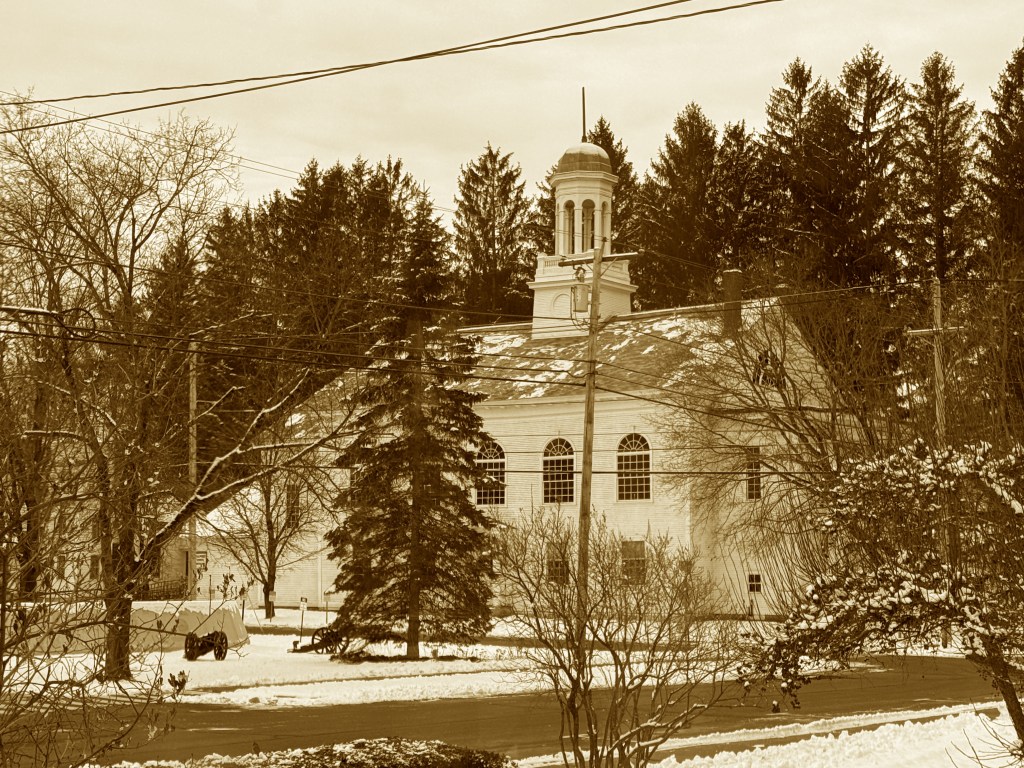
Walpole’s Town Hall has been the village’s center of civic life for over two centuries. The original Prospect Hill Meetinghouse (1792) building was moved to the village common in the 1820s and served as a combined town and church space until 1844. After the old structure was destroyed by lightning in 1917, the current building was designed by Boston architect James Purdon. The Town Hall continues to host town offices, meetings, and community gatherings, linking modern Walpole to its longstanding tradition of local governance.
Walpole’s Town Hall, located at 34 Elm Street, has long been the center of civic life in the village. Its story begins with the Prospect Hill Meetinghouse, completed in 1792. In the 1820s, this building was dismantled and moved to the village common, where it continued to serve as both a place for town meetings and church services until 1844, when control officially passed to the town.
The original building endured for decades, witnessing the growth and evolution of the community. Tragically, in 1917, the old Town Hall was struck by lightning and destroyed by fire. The replacement building you see today was designed by James Purdon (1873-1966) of Boston, reflecting early twentieth-century architectural sensibilities while maintaining the Town Hall’s central role in civic life.
The Town Hall continues to house town offices, meetings, and public and private gatherings, linking the modern village to its long history of self-governance and community involvement. The site embodies both Walpole’s early colonial civic traditions and its adaptation to the architectural and functional needs of the twentieth-century.
Town Common — Washington Square
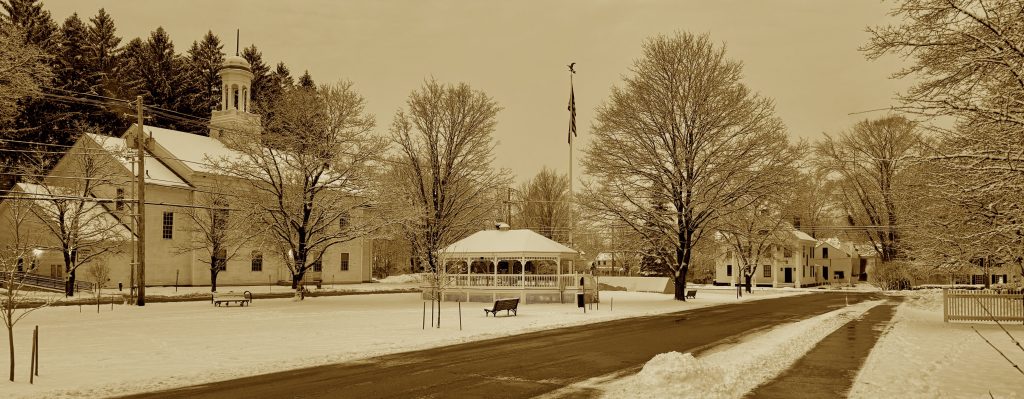
Washington Square, Walpole’s Town Common, has served as the village’s physical and symbolic center since the eighteenth century. Originally a shared open space for military drills, meetings, and everyday social interaction, it later hosted recreational activities like tennis and baseball while remaining carefully regulated to preserve its character. In the twentieth century, the Common gained new commemorative features, including the War Memorial and the village Christmas tree, connecting past and present. Surrounded by historic buildings, it continues to be a gathering place for seasonal events, civic functions and daily life, embodying the town’s enduring commitment to community and shared space.
The Town Common (formally Washington Square) has been the physical and symbolic center of Walpole since the eighteenth-century. Laid out as a shared open space, it served many of the functions essential to early New England town life: a place for military drills, public meetings, recreation, celebration, and the everyday mixing of neighbors. Its broad, grassy expanse has long embodied the community’s traditions of civic participation and common use.
By the late nineteenth-century, the Common had become a lively focus of organized recreation. Tennis courts appeared in 1883, and baseball games drew enthusiastic crowds—occasionally too enthusiastic, as suggested by an 1884 complaint about the players’ “noisy and profane” language. In response to increasing activity, the town established regulations to protect the space, prohibiting cannon fire and circus exhibitions on the Common (a street sign posted on the northern end reads “Keep Horses Off Common”). These rules reveal both its popularity and the community’s desire to balance enjoyment with preservation.
The twentieth-century added new layers of meaning. A fund for a village Christmas tree began in 1920, and in 1935 a spruce was planted at the north end of the Common that is still illuminated each winter. Just a few years earlier, in 1921, construction had begun on the War Memorial, honoring the men of Walpole, North Walpole, and Drewsville who served in World War I. The monument was later updated to include veterans of all subsequent conflicts, and flanked by two 75mm Krupp mountain cannon, it remains a solemn anchor at the edge of this shared green.
The Town Common continues to serve its historic purpose: a gathering place at the center of village life, ringed by some of Walpole’s most distinguished buildings and alive with seasonal events, quiet conversations and everyday passersby. Its long, evolving history reflects the town’s commitment to shared space and the belief that a community is strengthened by the places where people naturally come together.
38 Elm Street — River Valley Church
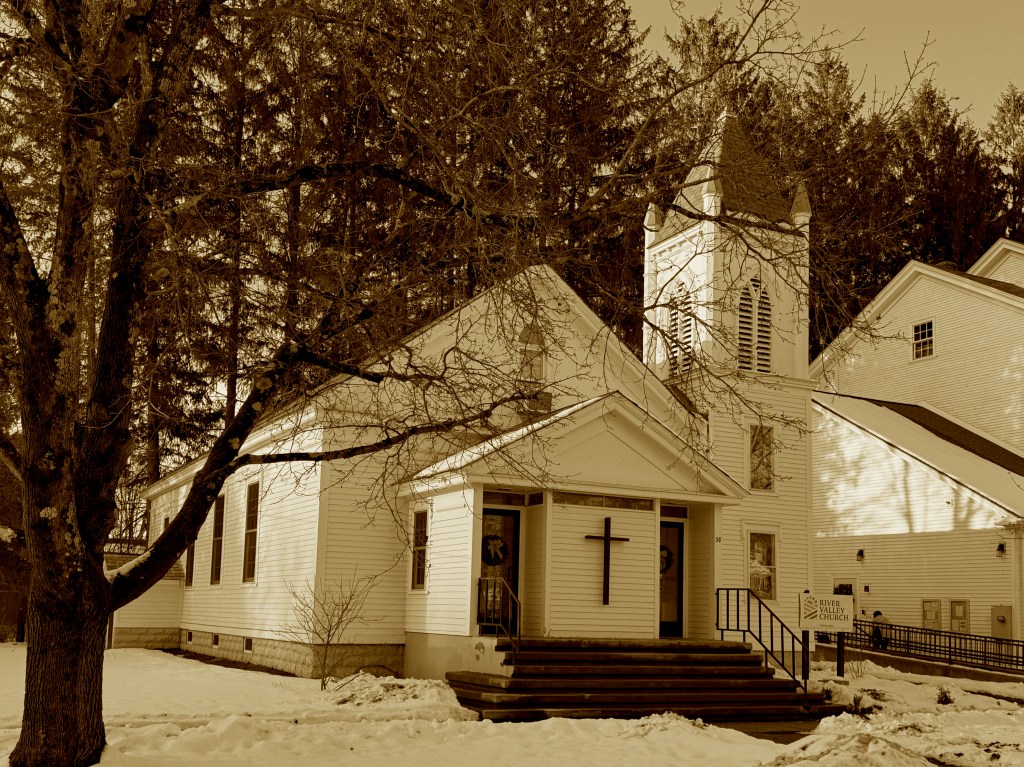
Built in 1845, this building has served multiple congregations, including Methodist, Episcopalian, Catholic and Evangelical communities, reflecting the evolving religious life of Walpole. Its simple, mid-nineteenth-century design exemplifies New England village church architecture while accommodating functional needs over time. After St. Joseph’s Catholic Church relocated in 2011, the building was revitalized as River Valley Church in 2024, continuing its long tradition as a place of worship. The structure preserves its historic character while supporting the spiritual and social life of the modern village.
In 1844 this lot was sold off from the meeting house lot, which in turn in 1848 was sold to a group representing the Methodist Church. The building dates from 1845. In 1868, James L. Mitchell purchased it for the Episcopalian Church, which then sold it to the Catholic Church five or six years later. These changes in ownership and denominations reflect the changing demographics and religious life in Walpole.
After St. Joseph’s Catholic Church relocated to North Walpole (joining the congregation of St. Peter’s Catholic Church) in 2011, the building found new life as River Valley Church, an Evangelical congregation that began services there in 2024, continuing its long-standing role as a place of worship and community gathering. The structure retains its historic character, reflecting mid-nineteenth-century church architecture with a simple, functional design typical of New England village houses of worship, while also adapting to the needs of its modern congregation.
River Valley Church continues to serve as a spiritual and community center, illustrating the evolving religious landscape of Walpole while preserving an important historic structure on Elm Street.
44 Elm Street

44 Elm Street is a representative village house, illustrating the solid, restrained dwellings that formed the everyday fabric of Walpole in the years following the Revolution. Standing on land once owned by Samuel and Phebe Bellows Grant, it reflects the gradual subdivision of large house lots around Washington Square and the close relationship between prominent families and village growth.
The land on which this house stands was originally part of the Grants’ extensive holdings associated with the Bellows–Grant House at 42 Main Street. In 1806 they sold this portion of their property (eight rods south on the west side of what was then Washington Square), beginning a long sequence of transactions that helped transform large house lots into the dense, walkable village center we recognize today.
By 1810 the property was occupied by Oren Hall, who lived here while operating a shop just to the south. This detail highlights an essential feature of early Walpole: it was a working village, not rigidly divided into residential and commercial zones. Houses, shops, and small enterprises stood side by side, especially around Washington Square, allowing daily life to unfold within a compact area.
Over the next several decades, the house passed through the hands of clothiers, merchants, clergy, and families whose names recur throughout Walpole’s records: Chandler, Adams, Gage, Bellows, Sherman and Johonnot. The succession of owners illustrates continuity rather than change. The house was repeatedly adapted, maintained, and inhabited, rather than replaced. Its significance lies not in prominence or display, but in how it helps explain the lived-in, layered character of Walpole village itself.
Look at the buildings across the Common on Washington Street
9 Washington Street
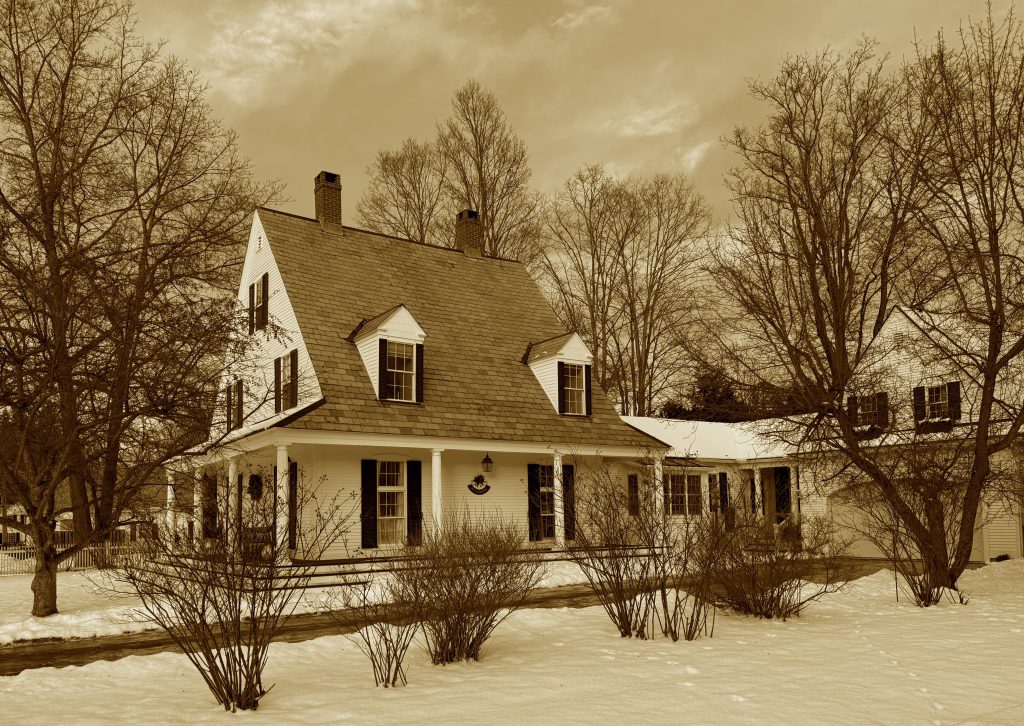
Built in 1839, this house is a well-preserved example of Walpole’s late Federal–early Greek Revival architecture, with its steep front-facing gable, symmetrical façade, and classical porch reflecting the town’s taste for dignified restraint. Likely built for John Williams of Cambridgeport, it later became home to three women of the Williams family, highlighting a lesser-noticed but important pattern of women-centered households in nineteenth-century village life. Over time, the house passed through a series of regional owners, yet it has remained remarkably true to its original 1840s character.
Its steep, front-facing gable gives the building its distinctive triangular profile, a form that became popular in the 1830s as Greek Revival ideas were adapted to traditional New England houses. The white clapboard exterior, dark shutters, and overall restraint reflect Walpole’s long-standing preference for dignified simplicity rather than display.
The façade is carefully balanced, with symmetrically placed windows and a broad, full-width porch supported by slender classical columns. That porch introduces a clear Greek Revival note, while twin interior chimneys rising behind the ridge recall the house’s original heating and room arrangement. Set back on its lawn and framed by mature trees, the house retains the character of a prosperous nineteenth-century village residence.
The house’s ownership history is equally revealing. It was likely built for John Williams of Cambridgeport, Massachusetts, who purchased the land in 1839 and appears to have invested in a substantial, up-to-date home in Walpole. By the mid-nineteenth century, however, the house was occupied by three women: Eliza and Sophia Williams and Margaret Harrington. The fact that the house was occupied by three single women was not uncommon, but is often overlooked in village histories. Eliza later left the property to Margaret, who married Dr. George A. Blake in 1856.
Over time, the property passed through a succession of mostly absentee or non-local owners, including residents of Maine, New York and Rhode Island, reflecting Walpole’s gradual transition from a self-contained village to a town connected to wider regional networks. Despite these changes in ownership, the house has retained its essential 1840s character.
15 Washington Street — First Congregational Church
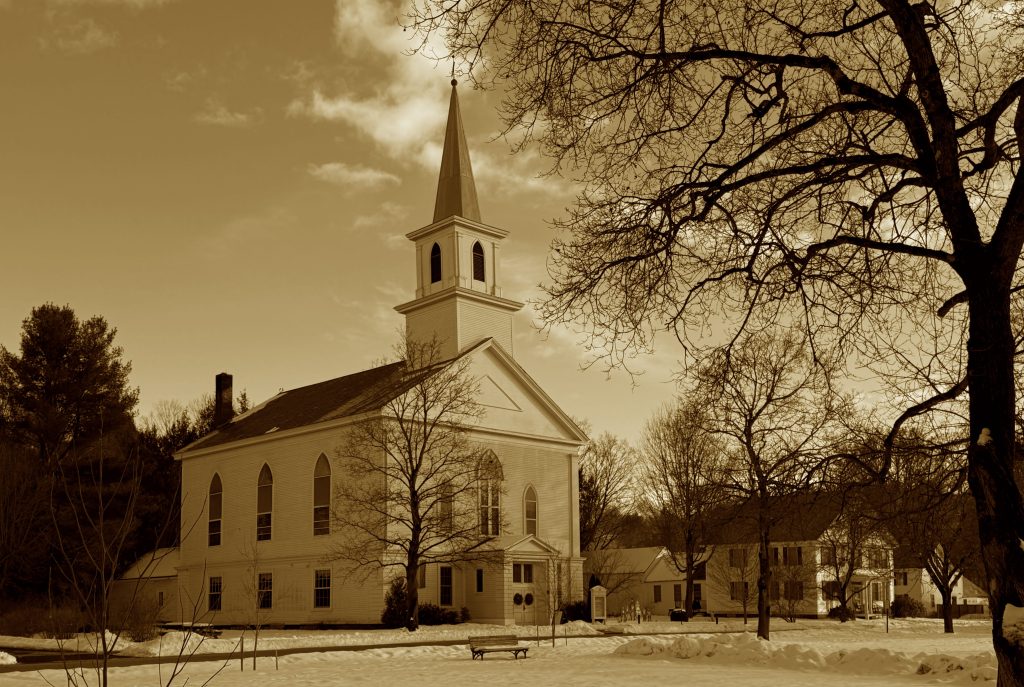
Established in 1832 by members who left the Unitarian “hill” society, the First Congregational Church was built on the Village Common as a new center for worship. In 1873, the building was raised 10 feet to add a vestry and kitchen beneath the sanctuary, enhancing its role in social and community life. The church remains an active congregation and a prominent architectural landmark, anchoring the eastern edge of the Common and reflecting nearly two centuries of religious and civic history in Walpole.
The First Congregational Church at 15 Washington Street was established when a group of Congregationalists withdrew from the “hill” society and formed their own congregation in late 1832. Over the following year and a half, the members built the church on the Town Common, establishing a new center for worship and community life.
In 1873, the building underwent a significant modification: it was raised 10 feet, and a vestry and kitchen were added beneath the sanctuary, expanding its functionality for social and community gatherings. This combination of architectural adaptation and continued use illustrates how the church has served not only as a place of worship but also as a hub for civic and social life in Walpole.
The First Congregational Church remains an active congregation and a prominent architectural and social landmark, anchoring the eastern edge of the Common and reflecting nearly two centuries of religious and community history in the village.
19 Washington Street — Congregational Church Parsonage
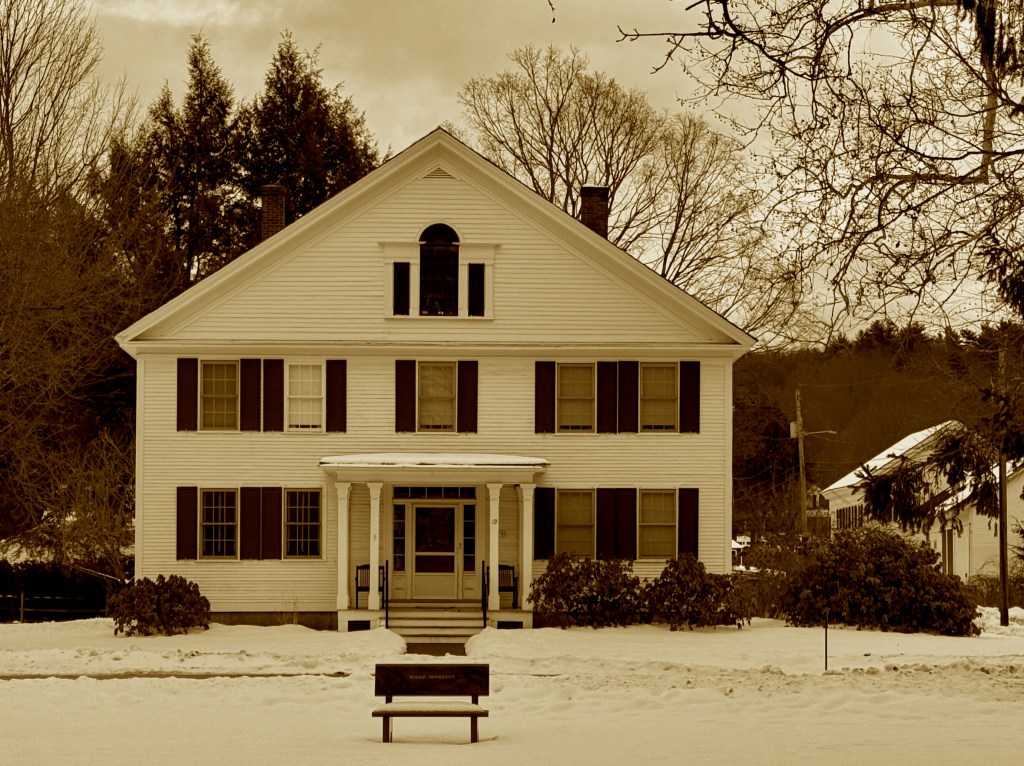
The Congregational Church parsonage is a prominent late-eighteenth-century village house, likely built in the 1790s by cabinet-maker Nicanor Townsley, and later refined with Greek Revival details. Its symmetrical façade, arched attic window, and classical porch reflect Walpole’s early prosperity and taste. Long associated with the Dana, Bellows, and Grant families, the house was a center of domestic and intellectual life before being given to the Congregational Church in 1883, securing its enduring role in the religious and architectural history of Walpole.
This house, now used as the Congregational Church parsonage, is a distinguished example of late Federal–early Greek Revival architecture, likely built in the 1790s. It is a large, symmetrical, two-and-a-half-story, wood-frame dwelling with a side-gabled roof, twin brick chimneys, and white clapboard siding—features typical of substantial New England village houses of the period.
One of its most notable architectural features is the arched attic window centered in the gable, a refined detail derived from Palladian design. The centered entrance, now sheltered by a Greek Revival porch with square columns, reflects later nineteenth-century improvements while maintaining the building’s formal balance. The evenly spaced multi-pane windows and dark shutters reinforce its orderly, classical character.
The house was likely built by Nicanor Townsley (1755-1830), a local cabinet-maker who acquired the property before 1795. Its careful proportions and fine details suggest the hand of a skilled craftsman. By the early nineteenth-century, it passed through several owners, including members of the Dana family.
In 1827 the property came to Submit Dana (1764-1836), the widow of Samuel B. Dana (d. 1825). Her daughter, Sarah Sumner Dana (1792-1867), lived here with her husband, Thomas Bellows II (1779-1825), and later raised her daughter, Sarah Isabella Bellows (1820-1866) in the house.
Sarah Isabella Bellows married George W. Grant (1812-1881), who came to Walpole in the 1840s after business reverses in Boston. Grant enlarged and improved the house and became known locally for his wit, humor, and literary talent. Evenings here were remembered as lively and stimulating, marked by conversation and playful verse.
After the deaths of members of the Grant family, the house declined until 1883, when it was given to the Congregational Church for use as a parsonage. Since then, it has remained a prominent and dignified presence in the village, reflecting both Walpole’s architectural traditions and its religious heritage.
Continue South on Elm Street
50 Elm Street — Former Mrs. Wright’s Boardinghouse / Elmwood Inn / Old Colony Inn

Built around 1811 by fur trader David Stone, this house blends Federal and Georgian architectural elements, including a fanlight, Palladian window, and two-story pilasters. In the mid-nineteenth century, it became a cultural hub, hosting performances by the Walpole Amateur Dramatic Company, including a notable 1855 production featuring Louisa May Alcott. Operating as the Elmwood Inn and later, the Old Colony Inn, it hosted James Michener while he researched his novel “Hawaii,” drawing inspiration from Walpole for his fiction. Now a private residence, the house preserves its architectural charm and its rich connections to Walpole’s artistic and literary heritage.
50 Elm Street was built circa 1811 by David Stone (1776-1839), a fur trader who had made his fortune in the early American fur business. The house showcases a blend of Federal and later Georgian architectural elements, including a fanlight over the front door, a Palladian window above, and two-story pilasters flanking the façade. Around 1868, a second-story porch was added, reflecting evolving tastes and use of the building.
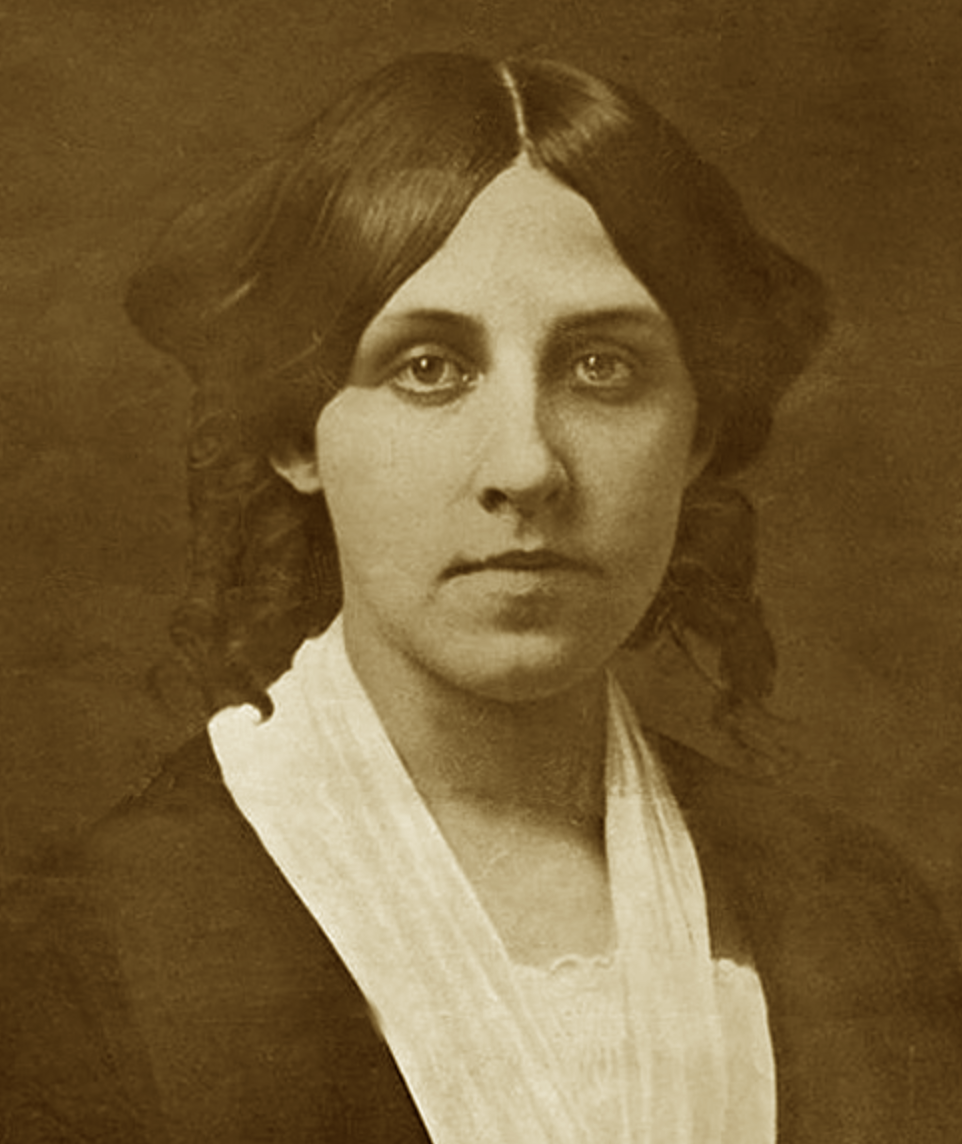
The house is historically significant for its role as a cultural venue in mid-nineteenth-century Walpole. It was the site of performances by the Walpole Amateur Dramatic Company, which held productions in the attic. On 11 September 1855, both Louisa May Alcott and her sister Annie performed in The Jacobite and The Two Bonneycastles, entertaining 100 to 200 attendees. A review of this performance was later published in the Boston Gazette. At the time, the house was owned by Dr. Jesseniah Kittredge, who maintained the property from 1830 to 1868.
After Kittredge sold the property, it became Mrs. Wright’s Boarding House, which evolved into the Elmwood Inn. In 1930, Donald McNaughton of Lowell, Massachusetts purchased the inn and renamed it The Old Colony Inn.
During the 1950s, while researching and writing his novel Hawaii (1959), James A. Michener resided here, using Walpole as the model for the hometown of one of the novel’s central families. In a 1969 letter to Walpole librarian Anita Aldrich, Michener described Walpole as “one of the most beautiful villages in the United States” and remembered that it was the view of the First Congregational Church parsonage across the Common from his window that inspired the residence of Michener’s Bromley clan.

The house is now a private residence, but it remains a notable site linking Walpole to Alcott family history, nineteenth-century village theater, and American literary culture, while also reflecting the architectural evolution of a prominent village inn over nearly two centuries.
Cross the Town Common (East) to the corner of Washington Street and Middle Street; Head East on Middle Street
As you cross the Common, you may notice the black granite bench centered on the porch of the Congregational Church parsonage. It is dedicated to Ronald Edward Frankiewicz (1946–2017), who was born in nearby Bellows Falls, Vermont, and spent his entire life in Cheshire County, residing in Walpole, Keene and neighboring Hillsdale, New Hampshire. In 2021, his widow, Marcia Frankiewicz, petitioned the village to place a memorial bench on the Common in his honor (at her expense). The Select Board chose this location, linking a personal remembrance to the shared landscape of the Common.
12 Middle Street

Built around 1793 by tanner David Stevens and moved to its current site circa 1839, this house features a Georgian-inspired façade with quoined corners, pilasters, and a central-hall plan. A later Colonial Revival porch blends historical styles, reflecting evolving architectural tastes. Beyond its design, the house played a significant social role in the mid-nineteenth century, sheltering runaway slaves as part of the local abolitionist network. It stands as a testament to both Walpole’s architectural heritage and the moral courage of its residents.
Built about 1793 for David Stevens, a Walpole tanner, this house originally stood on Main Street, on the site now occupied by 27 Main Street. Stevens acquired the lot in 1792 from Gen. Benjamin Bellows, and it is likely that he erected a dwelling soon afterward. Within a few years Stevens left Walpole, beginning a long chain of ownership that reflects the commercial life of the village in the early republic.
By the early nineteenth century, the property passed through the hands of traders and merchants, including David Stone, Levi Pierce of Boston, and Joseph Bellows Jr. In 1812 it was purchased by William Cochran, whose family owned the house until 1839. That year, following Cochran’s death, the house was moved back from Main Street to its present site on Middle Street, an action that reshaped both the building and its setting. Philip Peck, who acquired the property soon afterward, is credited with relocating the structure and constructing the present house on the lot.
Architecturally, the house presents a refined Georgian-inspired façade, closely related to the nearby William Buffum House at 25 Main Street. Shared features include corner quoining, molded window caps, pilasters framing the entrance, a five-bay elevation with a central-hall plan, and a five-light transom over the front door. The building retains its original hipped roof, while a later Colonial Revival porch spans the façade, illustrating how nineteenth- and early twentieth-century owners adapted earlier forms to changing tastes.
Beyond architecture, 12 Middle Street is remembered for its association with Capt. John Cole (1806–1875), a retired sea captain who lived here in the mid-1840s and early 1850s. Born in nearby Westmoreland, Cole operated the general store Cole & Wyman on Main Street. According to Frank T. Cole’s The Early Genealogies of the Cole Families in America (1887), Cole was deeply engaged in Walpole’s civic and reform life. A committed member of the “Free Soil”* movement, he attended the 1848 convention that nominated Martin Van Buren (1782-1862) (former president of the U.S., serving 1837-1841) as the party’s presidential candidate and was an outspoken advocate for human rights.
Most notably, Cole belonged to a local network that assisted runaway slaves traveling north to Canada, and tradition holds that this house served as a place of refuge along that route. He was also active in temperance work and local benevolent societies. One often-repeated story recalls that Cole and his wife survived a shipwreck, each believing the other lost, only to be reunited later on a street in New York City.
Today, 12 Middle Street stands as a reminder of Walpole’s layered past—its early village development, its architectural continuity, and the moral courage of residents who connected this small New Hampshire town to the broader currents of nineteenth-century reform.
*The Free Soilers (1848–1854) were members of the Free Soil Party, a national political movement opposing the expansion of slavery into western U.S. territories under the slogan “Free Soil, Free Speech, Free Labor, and Free Men.” The movement eventually merged with the Republican Party.
Continue East on Middle Street to Main Street; turn Right (South)
25 Main Street — William Buffum House

Built around 1785 with a Georgian core, the William Buffum House was extensively remodeled in the 1830s into a striking Greek Revival residence by merchant William Buffum. Its most prominent features include a two-story Doric portico, a pedimented façade with a Palladian window, and Greek Revival door and window detailing, while much of the original Georgian structure remains visible on the north side. The house exemplifies Walpole’s architectural evolution, blending post-colonial craftsmanship with nineteenth-century aspirations, and remains a cornerstone of the village’s historic Main Street.
The William Buffum House, located at 25 Main Street, stands as one of Walpole’s finest and most instructive examples of architectural evolution: a building that blends a late-eighteenth-century Georgian core with a striking mid-nineteenth-century Greek Revival transformation. Originally built circa 1785 by Ebenezer Crehore (1764-1819) of Milton, Massachusetts, the house brought to Walpole the hallmarks of late-Georgian design.
About 1797 the house passed to David Carlisle, Jr. (1740-1797) who died in December of that year. Carlisle was a Revolutionary War veteran and publisher of the local newspaper The Farmer’s Weekly Museum.
During the 1830s, under the ownership of merchant William Buffum (1793-1841), the house underwent extensive remodeling to reflect the new Greek Revival taste then sweeping the nation. The most visually arresting alteration is the full two-story Doric portico on the Main Street façade, complete with well-spaced Doric columns, a full entablature with triglyphs, and a flush-board pediment. In the pediment’s center sits a prominent Palladian window, a feature seen elsewhere in town on houses attributed to master builder Aaron P. Howland.
Under the renovation, the house also gained Greek-Revival–style touches such as the front doorway with sidelights and a transom divided with leaded muntins, first-story windows that are six-over-six with cornices, and larger, double-hung twelve-over-twelve windows on the upper floors.
Yet despite these dramatic changes, much of the original Georgian structure endures. This is especially evident on the north side of the house facing Middle Street, which still displays the original five-bay layout, central-hall plan, traditional Georgian door and window framing, and corner quoins at the west end.
Inside, the floorplan reflects both eras: the front door now opens into a central hallway (reconfigured to align with the new Main Street entrance), but original features remain, including folding shutters (inside the windows) and in some cases the earlier wood framing. The attic’s old timbers are oak, in contrast to the later chestnut used for the Greek Revival-era additions, a subtle but telling fingerprint of the building’s layered history. A recent owner substantially changed the interior, starting a new chapter in the building’s history.
Thus the William Buffum House does more than decorate Main Street: it tells a story. Its Georgian core reflects the craftsmanship and sensibilities of New England’s early post-colonial period. Its Greek Revival transformation speaks to the aspirations of a rising merchant class keen to signal status and modernity, and its continued survival, with details from both eras intact, makes it a living chronicle of Walpole’s architectural and social evolution. For these reasons, the William Buffum House remains a cornerstone of the village’s historic landscape.
Look South up the hill to Wentworth Road
The road you climb to the south of the village is named for Governor Benning Wentworth (1696–1770), who served as colonial governor of New Hampshire from 1741 until 1766.
Wentworth played a key role in granting many of the early town charters that shaped the settlement of New Hampshire’s Connecticut River Valley. One of these grants (in 1752) went to Col. Benjamin Bellows; Bellows and his associates laid out what became the town of Walpole, New Hampshire — then called “Bellowstown.”
Because of that history, Wentworth’s name and the road bearing it connect us directly to the colonial origins of the town — a reminder of its roots in eighteenth‑century land grants, surveying, and settlement patterns that shaped the region long before modern Walpole developed.
31 Wentworth Road — Knapp House
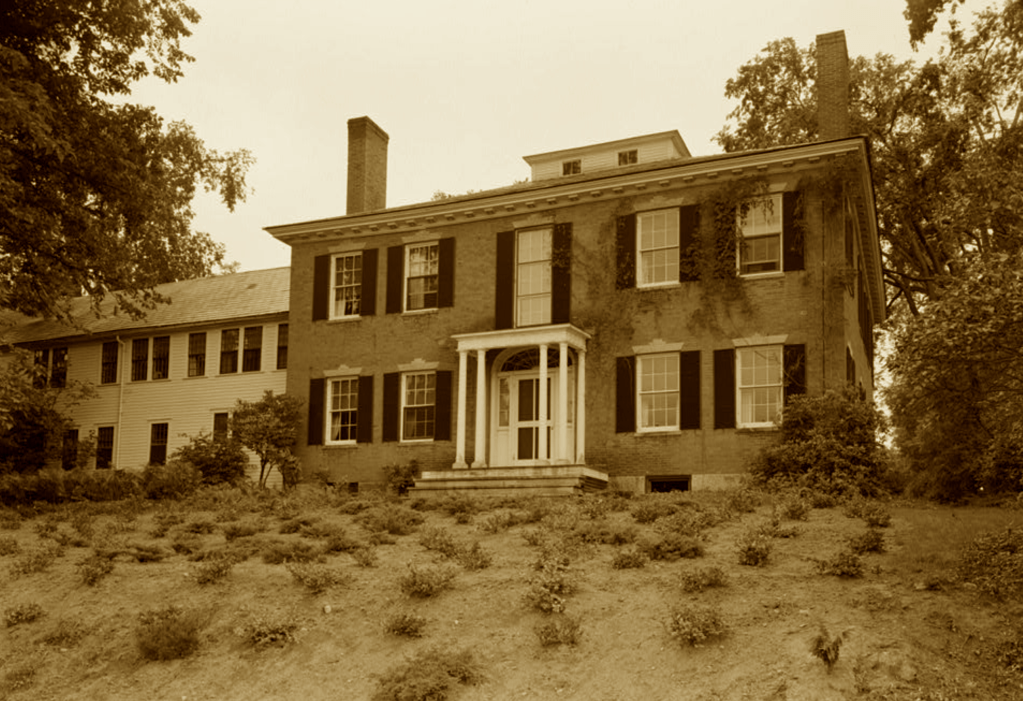
Built around 1812 by Josiah Bellows II and later owned by the Knapp family for over a century, this brick residence is one of Walpole’s finest examples of Federal (Adam‑style) architecture. Its refined proportions, elliptical portico, delicate columns, and four end chimneys reflect early nineteenth-century innovations in style and domestic planning. The interior preserves remarkable features, including original hand-painted French scenic wallpaper by Joseph Dufour. The house’s long Knapp family tenure, preserved grounds, and lilac hedge—linked in local lore to Louisa May Alcott’s “Under the Lilacs”—connect architecture, landscape, and village cultural memory, making it a defining landmark on the approach from Main Street.
As you leave Walpole’s village center and begin the climb up Wentworth Road from Main Street, near its junction with Prospect Hill Road and Old Keene Road, the first property on the left, partially hidden by trees even in winter is the Knapp House. Built in 1812, this striking brick residence marks both a physical and symbolic shift away from the public-facing confidence of the Greek Revival village and toward the more private, refined domestic ideals of the early American republic.
Constructed during a period of early nineteenth-century prosperity, the Knapp House reflects cosmopolitan taste and architectural sophistication rarely seen in rural New England at the time. Its refined proportions, restrained ornamentation, and careful relationship to its landscape express an inward-looking elegance that contrasted with earlier colonial building traditions.
The house was built by Josiah Bellows II (1789–1842), a member of one of Walpole’s prominent families. An inscription carved into the sill of a first-floor window on the north side—BUILT MDCCCXII—confirms its construction date. In 1820, Bellows mortgaged the property to a cousin, and in 1824 sold it to his brother-in-law, Jacob Knapp (1773–1868). The Knapp family retained ownership for more than a century, until 1927.
The Knapp House is among Walpole’s finest examples of Federal/Adam-style design and is particularly notable for its brick construction, an uncommon and costly choice in a region where timber framing remained the norm. Brick signaled durability, fire resistance, and social ambition. The house features gracefully curved elliptical steps leading to a modest portico supported by paired slender columns. The entrance is capped not by a typical semicircular fanlight, but by an elliptical transom, a subtle but telling Federal refinement. Inside, the plan reflects evolving ideas about comfort and efficiency: four chimneys placed at the ends of the building replaced the earlier central chimney mass, allowing for improved circulation, light and ventilation.
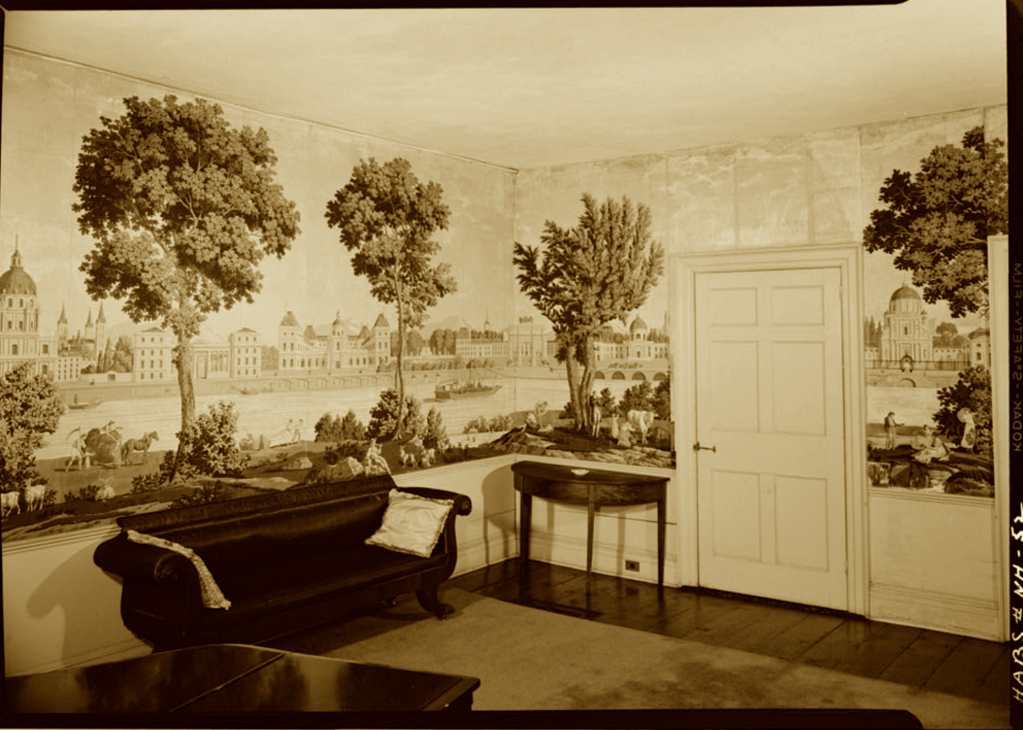
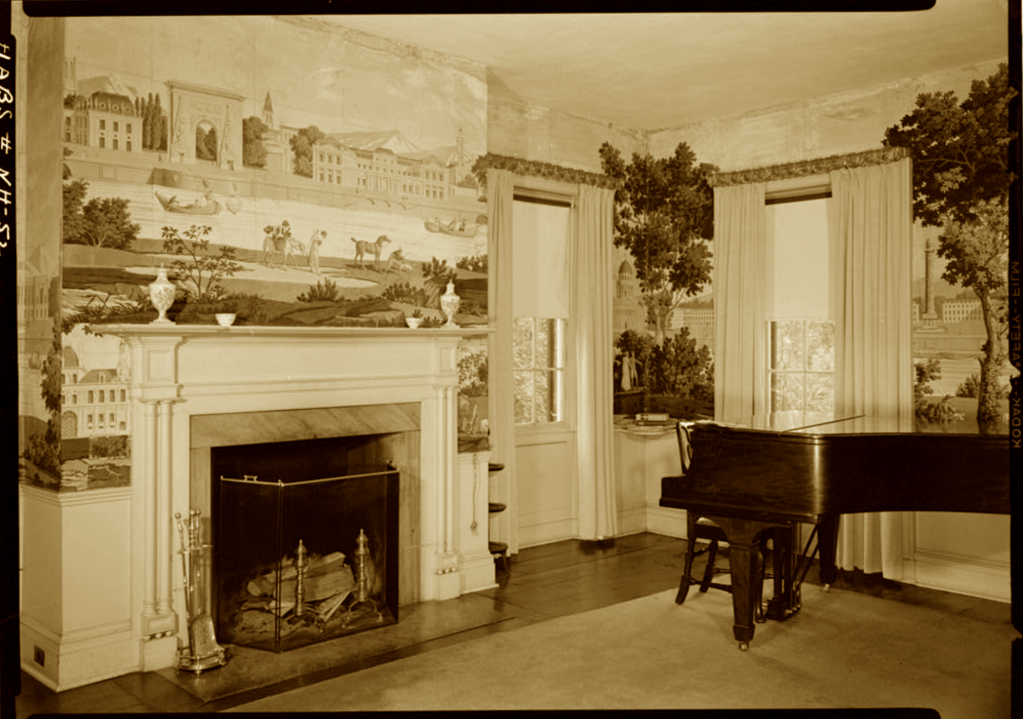
One of the house’s surviving decorative features is its hand-painted French scenic wallpaper, Les Monuments de Paris, produced in 1814 by Joseph Dufour et Cie of Mâcon, France. Dufour wallpapers are particularly prized, because the original wood blocks used in their production have been lost.
Still preserved in one of the parlors, the panoramic panels depict celebrated Parisian landmarks and convey an unmistakable aspiration toward European culture—an unexpected statement of taste in early nineteenth-century rural New Hampshire.
The property is also closely associated with Frederick Newman Knapp (1821–1889), a descendant of the family and one of the nationally significant figures connected to Walpole. Knapp was a prominent Unitarian minister, a committed abolitionist, and a humanitarian organizer of remarkable scope.
He was actively involved with the Boston Vigilance Committee, which aided freedom seekers escaping slavery via the Underground Railroad.

During the Civil War, Knapp served with the United States Sanitary Commission, where his administrative skill and tireless energy helped coordinate relief for Union soldiers on an immense scale. Contemporary accounts credited him with overseeing aid that reached tens of thousands of troops, and his work earned him honorary membership in the Grand Army of the Republic. A tree planted on the grounds in 1855 by Frederick Newman Knapp remains today as a living reminder of the family’s long stewardship and the site’s continuity across generations.
Local tradition also ties the Knapp House to Walpole’s abundant lilacs. According to longstanding lore, the lilac hedge along this stretch of Wentworth Road inspired similar plantings throughout the village and may have influenced Louisa May Alcott’s 1878 children’s novel Under the Lilacs. While no definitive documentary evidence confirms a direct connection, the association has become part of Walpole’s shared cultural memory.
The Knapp House embodies several key themes in Walpole’s history. It represents the architectural transition from colonial and Georgian forms to the refined Federal style of the early republic. Its materials and detailing reflect the aspirations of a prosperous rural elite engaged with broader cultural currents. The Knapp family’s century-long ownership, and the survival of original interiors, landscape features and associated stories link the early nineteenth century to the present, making the Knapp House a vital thread in Walpole’s architectural, social, and moral history.
Cross Main Street at Union Street and walk East on Union Street
14 Union Street — Walpole Unitarian Church & Hastings House

The Walpole Unitarian Church, completed in 1843, became a separate center of worship after the town assumed control of the old meetinghouse. A clock from the Walpole Academy was added to its tower in 1844, marking the building as a local landmark. After the roof collapsed under heavy snow in 1920, the church was rebuilt and rededicated in 1922, continuing its long-standing role in village religious and civic life.
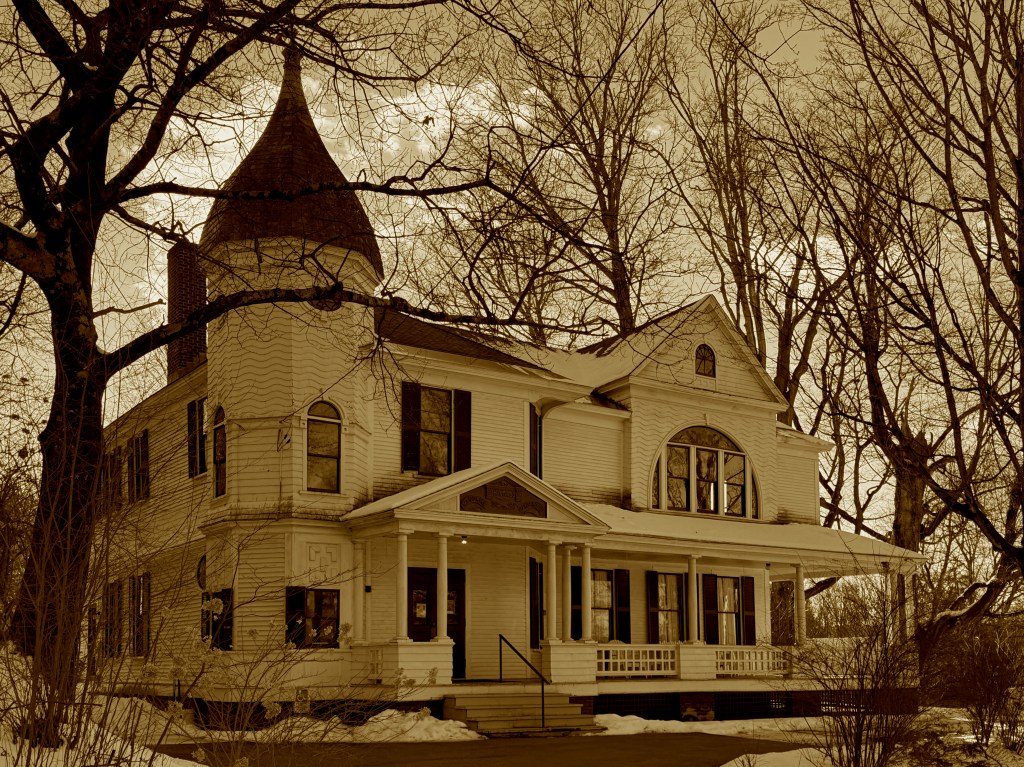
Adjacent Hastings House, built in 1896 as the church’s parish house by Thomas Nelson Hastings in memory of his wife, Amy Bridge Hastings, reflects restrained late-Victorian design and has historically hosted Sunday School, social clubs and community groups. Hastings House remains active as a gathering place for classes, meetings, and celebrations, sustaining its role as a center for education, fellowship and civic engagement.
The Walpole Unitarian Church at 14 Union Street was established when the town’s Congregational Society opted to organize a separate Unitarian congregation on Main Street, following the town’s assumption of control over the old meetinghouse on the Common. The society acquired a parcel of land bordered by Main, Union, and School Streets and began construction of a new church.
The building was completed in January 1843, and in 1844 a clock from the Walpole Academy building was installed in its tower, providing both a functional timepiece and a visual landmark for the community. The church served the town for nearly 80 years until the winter of 1920, when heavy snow caused the roof to collapse. Only the front wall and the organ gallery remained intact.
The congregation rebuilt, and the new church was dedicated in September 1922, preserving the location and continuing its role as a center of worship and civic life. The Walpole Unitarian Church remains an active congregation, linking modern Walpole to its nineteenth‑century religious and social history.
Hastings House
Hastings House was built in 1896 as the parish house of the Walpole Unitarian Church. It was designed and given by Thomas Nelson Hastings (1858–1907) in memory of his wife, Amy Bridge Hastings (1862–1895), daughter of Hudson E. Bridge. His gift reflected both personal devotion and a desire to support the life of the congregation.
Constructed by Hira Ransom Beckwith, a builder from Claremont, New Hampshire, the building was dedicated on January 20, 1896. Architecturally, it reflects the restrained late-Victorian style of the period, with its shingled upper gables, simple bracketed eaves, and a broad, welcoming porch facing the street. The interior includes a large assembly room and smaller meeting spaces designed to accommodate the social and educational life of the church.
Through the late nineteenth and early twentieth centuries, the Hastings Memorial Parish House was in near-constant use. Among the groups that met here were:
- The Sunday School
- The Unitarian Ladies Society and Sewing Group (formerly the Walpole Female Benevolent Society)
- The Footlighters Club, a drama group formed in 1898
- The T.O.U.X. Club (“Ten of Us Ten”), founded by ten young women for social and charitable work
- The Young People’s Religious Union
- The Layman’s League (the Men’s Club)
By 1962, most of these organizations had faded from use, leaving only the Sunday School and the Walpole Branch Alliance active in the building. Yet Hastings House continues to be a living part of the community. It is available for rental for weddings, funerals, parties, and other gatherings and hosts a variety of ongoing activities, including yoga and Tai Chi classes (such as Bliss Yoga, Kripalu Gentle Yoga, and Long River Tai Chi), as well as book clubs and a weekly meditation group that meets in the space. Groups and individuals of all ages use the parish house as a place to connect, learn and celebrate.
16 Union Street — Unitarian Church Parsonage
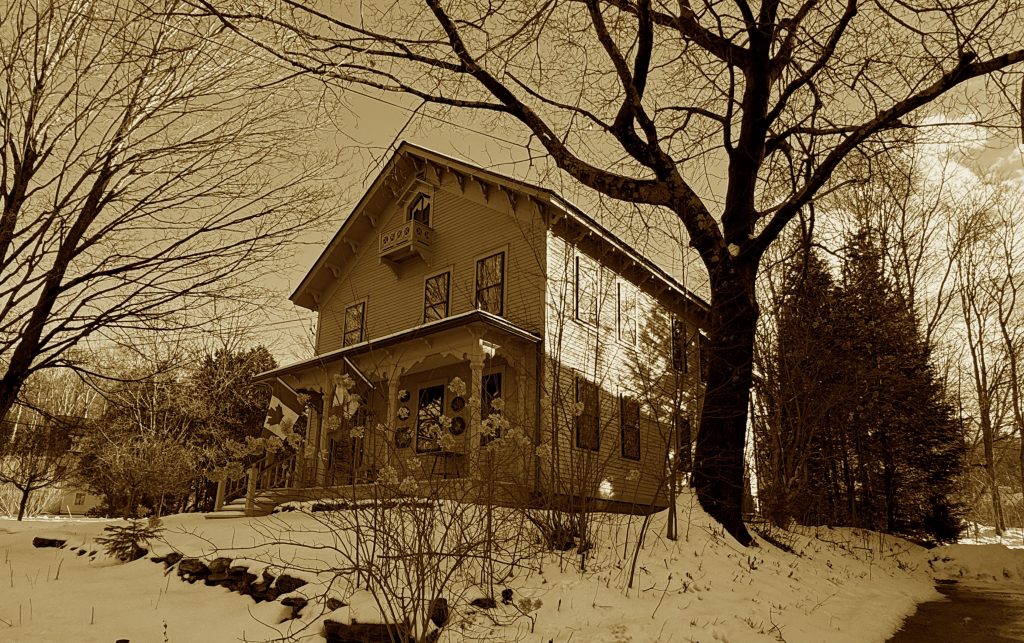
Completed in 1850 through the efforts of the Unitarian Ladies Society, this house provided a permanent home for the church’s ministers, who had previously boarded elsewhere in the village. Its design blends Greek Revival and Italianate elements, including a Juliet balcony in the front pediment, and the interior features a curved staircase, double parlors, and coffered ceilings. The building served as the church’s parsonage for over 160 years and is now a private residence, preserving both its architectural charm and its connection to Walpole’s religious history.
Set slightly back from the street beneath mature trees, the parsonage presents a dignified yet domestic presence, its tall, rectangular form and broad front porch signaling both respectability and welcome.
The exterior reflects a thoughtful blend of Greek Revival and Italianate influences, a combination well suited to a mid-nineteenth-century minister’s house. The building’s overall symmetry, wide clapboards, and strong cornice line recall the Greek Revival, while Italianate details soften the form: deeply overhanging eaves with decorative brackets and a small Juliet balcony tucked into the front pediment, an unusual and elegant feature that adds vertical emphasis and visual interest. The full-width porch, supported by slender posts and trimmed with delicate detailing, wraps the house in shade and reinforces its role as a place of hospitality within the village.
In 1848, the ladies of the Unitarian Ladies Society and Sewing Group of the Walpole Unitarian Church set out to provide a permanent home for their ministers, who until then had boarded in private homes or rented rooms around the village. Finding suitable housing had become increasingly difficult, so the women undertook the project themselves. A verse written at the time praised their efforts; the source is unknown, but it is quoted in Martha M. Frizzell’s A History of Walpole, New Hampshire:
“Have stitched on the clapboards and quilted the roof,
And run every crack with a seam water-proof.
And who would have thought, that a house, barn and shed,
Could be all put together with needle and thread.”
With their work, and with contributions from the congregation, the parsonage was completed in the autumn of 1850. The minister moved in just before Christmas and held a housewarming on Christmas Eve.
The interior retains a sweeping curved staircase, double parlor, a formal dining room, and coffered ceilings. The building served as the church’s parsonage for more than 160 years, until it was sold by the congregation in 2011. It is clearly recognizable as a house built to express care, stability, and community purpose.
13 Union Street — David Buffum House

Built in 1835 for merchant and civic leader David Buffum, this two-story Greek Revival house was designed to be one of the finest in Walpole. The home features high ceilings, broad floorboards, six fireplaces, folding interior shutters, a sweeping front stairway, and frosted and etched sidelights at the entrance, with later additions including marble fireplaces. Buffum, active in town affairs as a bank president, legislator, and library founder, spared no expense in its construction, reflecting both his wealth and status. Restored in the late 1960s and early 1970s, the house remains a prime example of Greek Revival elegance and a testament to the social and civic prominence of its original owner.
Built in 1835 for David Buffum (1803–1889), this balloon-framed Greek Revival house remained in the Buffum family until 1928. Buffum, born in Westmoreland, New Hampshire to Joseph and Mary Buffum, moved to Walpole at age seventeen to clerk in his brother William’s store. He married Mary Hubbard in 1829 and became a prominent local merchant and civic leader. Over his career, Buffum was a member of the Walpole Rifle Company, president of the Savings Bank of Walpole, the town’s first librarian (1853–1859, with the books kept in his store), a charter member of the Walpole Carpet Company, and a state legislator in 1849–1850. Notably, he received a premium for his cattle at the first fair of the newly organized New Hampshire Agricultural Society in 1850.
The house was constructed to be one of the finest in Walpole. An abstract of the building contract (dated 5 March 1835, on file at the Walpole Historical Society) follows:
Memorandum of an agreement made the fifth day of March AD 1835, between George Kilburn of Walpole … and David Buffum of said Walpole
The said Kilburn agrees to build for said Buffum a two story house, low part to the same, wood house & barn agreeably to plans … to be erected on said Buffum’s House lot in Walpole Village. The said Kilburn is to dig and stone a cellar under the whole of the two story part of the house, the walls to be of good stone well laid and pointed … & the cellar to be suitably lighted … To have a piassa [piazza] of one story … with fluted columns … The two west fireplaces of the lower story to be freestone. The outside of the house to be finished with a good rich straight moulding cornice around the two story part & the piassa. The two west fireplaces of the lower story to be freestone. The outside of the house to be finished with a good rich straight moulding cornice around the two story part & the piassa. The windows in the two story part to be of Keene glass 11 by 15 inches & those in the two front parlors to be hung with weights. The parlor windows to be finished with shutters & those rooms to have sliding doors … To be a Venitian window in the west pediment … The style of the finish of the house to be as good as Mr. Ephraim Holland’s.
The outside of the house & low part to be well painted white with three coats. The barn and woodhouse with two coats of yellow. The front part of the inside of the two story part … to be well painted white, & the rest of the inside … with yellow & slate colour.
The whole to be finished by the first day of December next.
And the said Buffum agrees, when the above is completed, to convey to said Kilburn … that part of his house lot which is bounded as follows, to wit, Beginning at the north west corner thereof, thence on the main street to the north garden fence, thence easterly in a line with said fence about fifteen rods to the west side of the most easterly apple tree, thence parallel with the first mentioned line to the academy land thence on said Academy land to the place of beginning, with buildings thereon, and all the privilege of water which he now holds and also pay said Kilburn the sum of four hundred dollars…
David Buffum, George Kilburn
Buffum spared no expense, aiming to make the home equal to any in the village.
Architectural features include broad floorboards, ten-foot ceilings, six fireplaces, interior folding and paneled Indian shutters, a broad front stairway, and frosted and etched sidelights at the entrance. Marble fireplaces were added later. Despite periods of neglect and fire damage, particularly to the summer kitchen and woodshed, the house was extensively restored from 1967–1974 by prior owners.
The David Buffum House exemplifies Greek Revival elegance adapted for a prosperous merchant family and reflects the prominence of its owner in Walpole’s civic, commercial and cultural life.
Return to Main St; turn Right (North)
28 Main Street — Dr. Abel Parker Richardson House

Built in 1889 for Dr. Abel Parker Richardson, this striking Queen Anne–style house replaced the earlier 1766 General Benjamin Bellows house that had stood on this site for more than a century. Its corner tower, varied shingles, decorative gables, and sweeping wraparound porch reflect the late-Victorian taste for picturesque design.
Built in 1889 for Dr. Abel Parker Richardson (1834–1900), this house is one of Walpole’s finest expressions of late-Victorian Queen Anne architecture. The asymmetrical massing, prominent corner tower with conical roof, varied shingle textures, decorative gable ornament, and expansive wraparound porch with turned posts and balustrades are all characteristic of the style. The design emphasizes verticality and picturesque effect, while the porch unifies the façade and reflects the era’s emphasis on domestic leisure and display along Main Street.
The house stands on a historically important site long associated with the Bellows family. An earlier dwelling built by General Benjamin Bellows circa 1766 (Col. Bellows’ eldest son) occupied this lot for more than a century before passing through several owners, including Thomas Bellows, Edward Crosby, and Henry P. Foster. In 1886, the property was purchased by Dr. Abel Parker Richardson, a prominent Walpole physician. In 1888, Richardson demolished the eighteenth-century house and erected the present residence, completed in 1889.
Before entering medicine, Richardson served as principal of the Walpole High School in 1857. He received his medical degree from Dartmouth Medical College in 1864, pursued postgraduate study at Harvard, and practiced medicine in Walpole for nearly thirty years. In addition to his medical work, he served as town clerk for over three decades and was active in regional medical boards and professional societies, making him one of Walpole’s most prominent civic figures of the late nineteenth century.
32 Main Street — Walpole Academy

Built in 1831 by master builder Aaron P. Howland, the Walpole Academy is a distinguished example of Greek Revival architecture, with a classical temple-front portico, Doric columns, and pedimented gable. Originally a private academy founded in 1825, the building became Walpole’s public high school in 1853 and educated generations until 1950. Today it houses the Walpole Historical Society. Its well-preserved design reflects the style’s association with learning, civic virtue and national identity, making it a landmark of both architecture and education in the village.
Standing prominently on a hill at the heart of the village, the Walpole Academy is the most complete expression of Greek Revival ideals in Walpole. Built in 1831 by master builder Aaron P. Howland, its temple-form design reflects the early nineteenth-century belief that education was a civic duty and that classical architecture could embody integrity, democratic purpose and national identity. As both school and landmark, the Academy stands at the intersection of architecture, learning and public life that defines Walpole’s historic character.
The academy’s design is rooted in the classical ideal. Its façade is organized as a three-bay Greek prostyle temple, with a stately portico projecting from the gable end. The full-height columns support a broad entablature and a pedimented gable, presenting a formal temple front that would not have been out of place in the architectural pattern books of the 1820s and 1830s. Beneath the portico, the façade is covered in flushboards, a technique builders used to imitate the smooth stone of ancient Greek buildings. The entablature itself is especially striking; Howland spaced the triglyphs in the Doric frieze six columns apart, an unusual and sophisticated detail that reveals his familiarity with classical precedents and his careful attention to proportion. For a small New Hampshire town, the refinement of this classical vocabulary underscores how seriously communities like Walpole embraced architecture as a civic language.
Walpole Academy’s physical form tells only part of its story. The institution began in 1825, when the first academy opened “for the reception of scholars” at a time when New England towns increasingly turned to private academies to supplement public schooling. When the organization received its charter in 1831, Howland’s new building gave it an architectural presence equal to its ambitions. In 1853, the academy shifted from private enterprise to public necessity, becoming Walpole’s high school. For nearly a century it served in that role, shaping the education of generations of residents until 1950, when it began a new life as the home of the Walpole Historical Society. In each of these roles, the building remained dedicated to shared knowledge and public purpose, even as the community’s needs evolved.
Although deeply woven into Walpole’s own history, the building’s importance extends beyond the local community. Across New England, many early academy buildings have disappeared or have been altered beyond recognition. Walpole’s remains intact, retaining the graceful temple front and finely proportioned detailing that made the Greek Revival style synonymous with American civic architecture in the decades before the Civil War. It stands as a rare and eloquent example of the academy movement that played such a central role in early American secondary education.
The Walpole Academy endures as both an architectural landmark and a symbol of the town’s long commitment to learning. Its preservation and listing on the National Register of Historic Places ensure that this dignified Greek Revival structure, once a beacon of classical ideals in a rural village, continues to anchor the cultural and educational story of Walpole, linking the town’s early civic ideals with its modern commitment to memory and preservation.
Turn Around — Three Greek Revival Landmarks
At the corner of Main and Middle Streets, three Greek Revival landmarks—Walpole Academy (1831), the William Buffum House (1785/1840), and the Philip Peck House (1840) offer a striking glimpse of the village’s nineteenth-century architectural character. Walpole Academy, with its front-facing gable, Doric portico, and classical pediment, served as the town’s high school until 1950 and now houses the Walpole Historical Society. The William Buffum House blends a Georgian core with Greek Revival updates, including a two-story Doric portico and a Palladian attic window, and was once home to publisher David Carlisle Jr. The Philip Peck House completes the trio with its balanced proportions and refined ornamentation. Together, these buildings, some built or remodeled by master builder Aaron P. Howland, showcase Walpole’s civic pride and embrace of Greek Revival style.
At the intersection of Main and Middle Streets, take a moment to appreciate three of Walpole’s finest Greek Revival buildings, all visible from this vantage point: the Walpole Academy (1831), the William Buffum House (1785/1840), and the Philip Peck House (1840). At least two of these structures were either built or remodeled by master builder Aaron P. Howland, whose craftsmanship helped define the architectural character of the village.
The Walpole Academy, the centerpiece of the three, exemplifies the Greek Revival style. Its front-facing gable roof, flush-board triangular pediment, and fully articulated Doric entablature with a decorated frieze and cornice create a striking classical composition. The front portico, supported by four well-proportioned fluted columns, announces its civic and educational importance. The Academy served as Walpole’s high school until 1950 and today houses the Walpole Historical Society and Museum, preserving both local history and architecture.
The William Buffum House, believed to have been remodeled by Aaron P. Howland for the Buffum family during the 1830s, blends the earlier Georgian core with Greek Revival updates, including a two-story Doric portico and characteristic Palladian window in the attic. Notably, the house was also home to David Carlisle Jr., publisher of The Farmer’s Weekly Museum, whose printing press was supplied by the famed Boston printer Isaiah Thomas, connecting the building to Walpole’s early cultural and journalistic history.
Finally, the Philip Peck House (1840) completes the trio of Greek Revival gems. Like the other two, it features hallmark elements of the style: classical proportions, refined ornamentation, and attention to symmetry, creating a cohesive visual statement along this section of Main Street.
These three buildings illustrate Walpole’s embrace of Greek Revival architecture in both public and private structures, showcasing the skill of Aaron P. Howland and the town’s civic pride during the first half of the nineteenth-century. They form the architectural centerpiece of the village, visible in one glance from this intersection, and remain enduring symbols of Walpole’s historic character.
27 Main Street — Philip Peck House
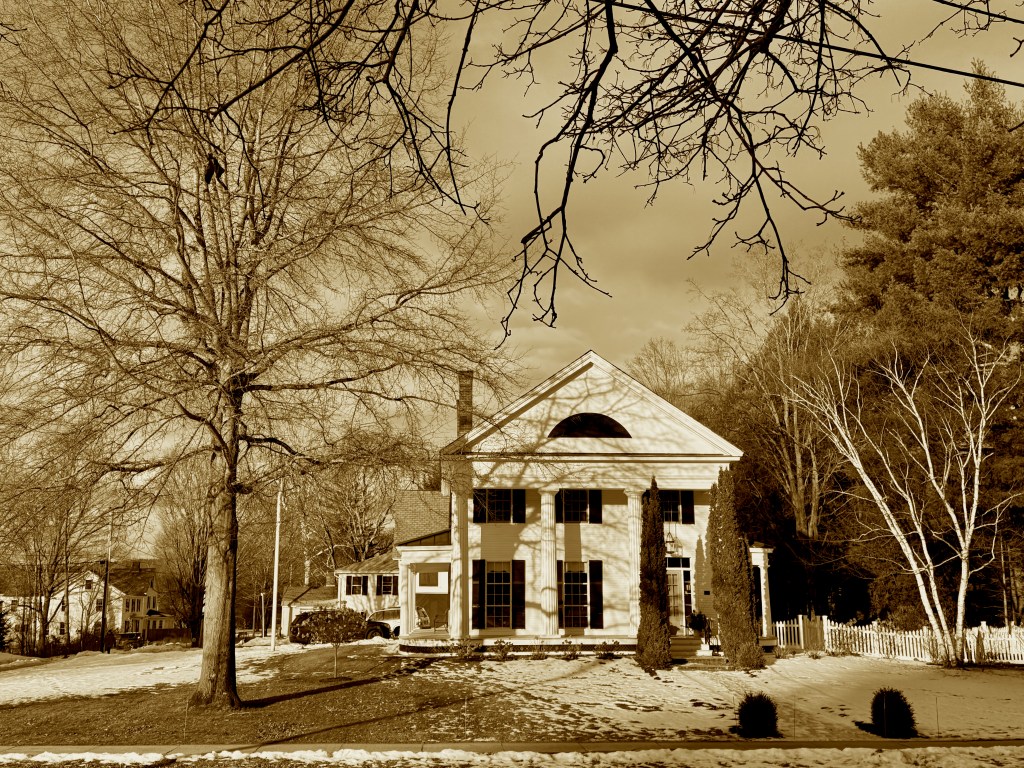
The Philip Peck House, also known as the Margaret Porter House or the Peck-Porter House, was built around 1840 by Philip Peck, a prominent local merchant, for his bride Martha Eleanor Bellows of one of Walpole’s leading families. A fine example of Greek Revival architecture, the house features a striking pedimented portico with four two-story Doric columns and rare double side porches. A rear wing and attached barn reflect the integration of domestic and agricultural functions typical of the period. Over the years, the house passed through several notable families, including the Porters, from whom it takes its current name. It stands as a landmark of mid-nineteenth-century design and social prominence, listed on the National Register of Historic Places.
The Philip Peck House, also known as the Margaret Porter House or the Peck-Porter House, was built circa 1840 by Philip Peck (1812–1875), who had moved to Walpole from Massachusetts in 1830. Peck worked initially as a clerk in Colonel David Buffum’s dry goods store and later became a partner in the firms Bellows & Peck and Peck & Co., embedding him in the commercial life of the village.
Peck married Martha Eleanor Bellows (1811–1898), a member of one of Walpole’s most prominent families and the great-granddaughter of Col. Benjamin Bellows, the founder of the town. On 4 January 1839, Peck moved the circa 1793 Georgian house to the rear of the lot (now 12 Middle Street) and began construction of a new Greek Revival-style residence facing Main Street.
The house was completed in 1840 for Peck’s bride, symbolizing both personal prosperity and social prominence. In 1846, the property was sold to Henry Foster, and after several subsequent owners, it was acquired in 1875 by Dr. Winslow Porter (1823-1891), whose family resided there for many years. From Dr. Porter, ownership passed to Carrie Augusta Perry Porter (1863-1944), the wife of Warren Winslow Porter (1860-1939), and then to Margaret Perry Porter (1901-1955) whose name has come to be associated with the house.

The house is a superb example of Greek Revival architecture, noted especially for its double side porches, a rare feature in New Hampshire. Its defining element is the pedimented, prostyle portico supported by four two-story fluted Doric columns, flanked by single-story, columned side porches that enhance its classical symmetry and grandeur. Behind the main block, a 1½-story wing links the residence to an attached barn, reflecting a practical integration of domestic and agricultural spaces.
The Philip Peck House stands as a landmark of mid-nineteenth-century taste and refinement, combining architectural elegance with connections to some of Walpole’s most influential families. Its commanding presence on Main Street makes it a centerpiece of the village’s Greek Revival architectural landscape. The property is listed in the National Register of Historic Places.
35 Main Street – Amasa Allen House
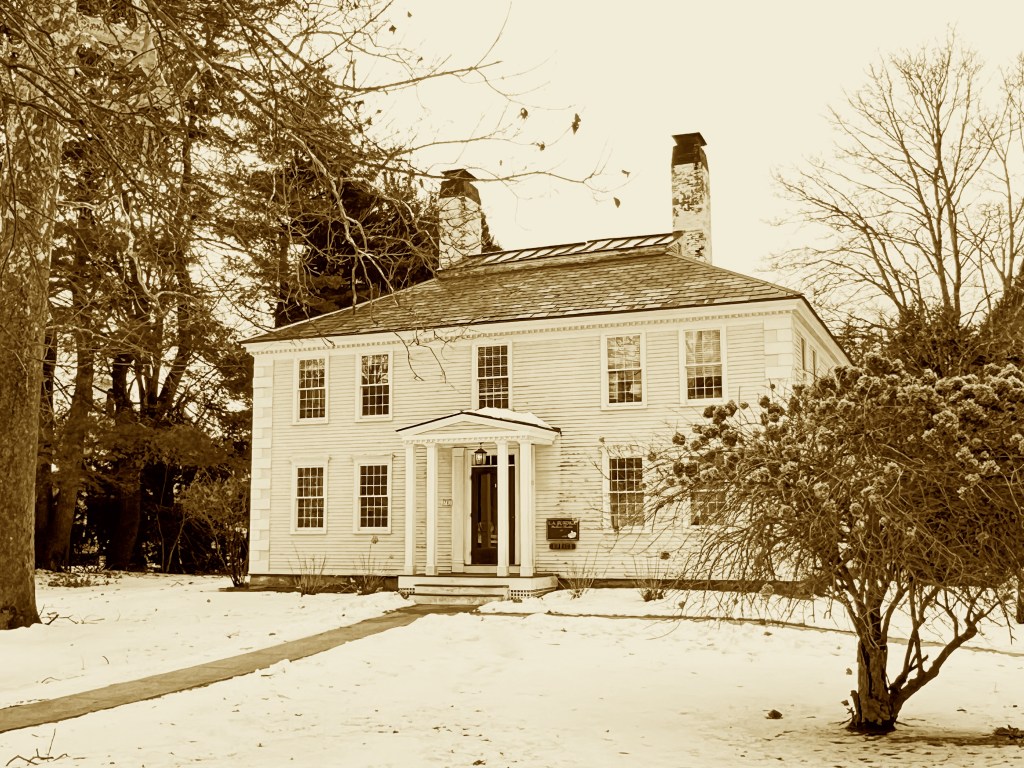
The Amasa Allen House (also known as the Tatem–Peck House), built in 1792 by General Amasa Allen, is one of Walpole’s finest examples of late-Georgian architecture, featuring a low hip roof, corner quoining, a symmetrical five-bay façade, and a central-hall plan with multiple fireplaces. Allen, a prominent local figure, lived here until 1821, and the house later passed to notable families including Dr. William Tatem and the Pecks. Today it houses the headquarters of L.A. Burdick Chocolates, maintaining its prominent role in the village while preserving its historic character. The house exemplifies both the architectural traditions and civic prominence of Walpole’s influential residents.
Standing prominently on Main Street, the Amasa Allen House (also known as the Tatem-Peck House) is one of Walpole’s finest surviving examples of late-Georgian domestic architecture. Although built in 1792 (quite late in the Georgian period), its features reflect stylistic traditions more characteristic of pre-Revolutionary New England. In rural towns like Walpole, such conservative architectural preferences often persisted well after they had faded in urban centers.
The house exhibits several hallmark Georgian characteristics:
- A low hip roof, creating a balanced, cubic form.
- Corner quoining, a feature typically found on more formal urban houses.
- A symmetrical five-bay façade centered on a refined entrance surround.
- A traditional two-story central-hall interior plan, designed around two massive central chimneys.
- Four fireplaces on each floor, illustrating both prosperity and the heating needs of an eighteenth-century northern home.
- Notable interior sliding window shutters, a high-quality detail that was uncommon in Walpole at the time.
The house was built by General Amasa Allen (1751-1821), a soldier of the Revolution who came to Walpole from Pomfret, Connecticut. By the time he erected the home in 1792, Allen had become a prominent figure in the community. His standing is reflected in the fact that, when pews were sold to finance the construction of the new meetinghouse on Prospect Hill, only Col. Benjamin Bellows purchased more pews than Allen—a clear indicator of both wealth and status.
Allen lived in this house until his death in 1821, and during that time he participated actively in the civic life of the town, including local militia affairs, land transactions, and early town governance.
In 1947 the house was purchased by Dr. William H. Tatem (1912-2001), one of Walpole’s respected physicians. His ownership gave rise to the alternative name “Tatem House.” Later, the Peck family, another well-established local family, occupied the residence, leading to the blended name “Tatem-Peck House” sometimes used today.
These successive owners illustrate the home’s continuity as a residence for influential townspeople whose professional and civic contributions shaped Walpole during the nineteenth- and twentieth-centuries.
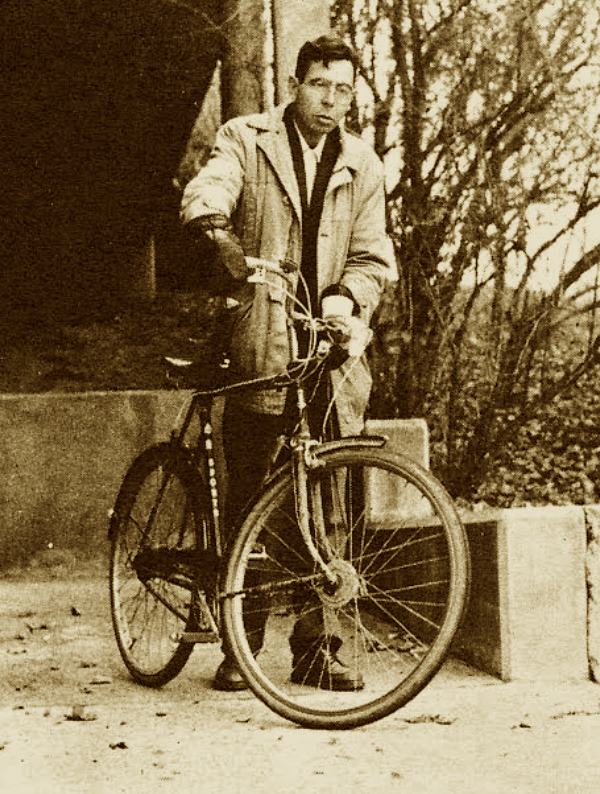
The Amasa Allen House has a highly visible role in town life as the headquarters of L.A. Burdick Chocolates, the internationally known artisan chocolatier founded by Larry and Paula Burdick. The company’s presence, along with the nearby Burdick’s Café and the Walpole Grocery, has had a significant impact on Walpole’s contemporary cultural and economic identity. Its careful stewardship of the historic house has also ensured that this landmark remains one of the best-preserved Georgian structures in the village.
40 Main Street — Charles Hooper House

Built around 1863, the Charles Hooper House is a distinguished Italianate residence in Walpole, noted for its bracketed eaves, tall arched windows, and a cupola that echoes the building’s elegant arch motifs. Hooper, a successful ship owner, used the home to showcase his prosperity, engaging in a rivalry with neighboring shirt manufacturer Silas Bates. In 1926, Dr. Bayard Mousley converted the carriage house into Walpole’s first hospital, giving the property lasting significance in the town’s social as well as architectural history. The house exemplifies mid-nineteenth-century style while reflecting the economic and civic vitality of the period.
Built around 1863, the Charles Hooper House is one of Walpole’s finest examples of the Italianate style—fashionable in mid-nineteenth-century New England for its evocation of Italian villas and its emphasis on decorative detail. The house displays hallmark features of the style: bracketed eaves, tall narrow windows, and especially the elegant repetition of an arched motif. The arch that frames the entrance porch echoes in the window caps and rises again in the cupola, unifying the building’s design and giving the house its distinctive vertical emphasis.
The original owner, Charles Hooper (1809-1866), was a successful ship owner whose presence in inland Walpole reflects the town’s far-reaching commercial ties during this period. Hooper was known locally for his friendly rivalry with Silas Bates, the prosperous shirt manufacturer whose residence stood up the road at 52 Old North Main Street. When Hooper built a cupola on his house, Mr. Bates in turn added an even larger one to his house. Their side-by-side displays of prosperity symbolized Walpole’s mid-nineteenth-century economic vitality, when mercantile fortunes and small-scale industry helped shape the village.
In 1926, the property took on an entirely new community role when it was purchased by Dr. Bayard Mousley (1879-1935), who converted the carriage house into Walpole’s first and only hospital. For many residents, this small facility offered the first local access to modern medical care, making the Hooper House not only architecturally significant but also an important site in the town’s social history.
42 Main Street — Bellows–Grant House
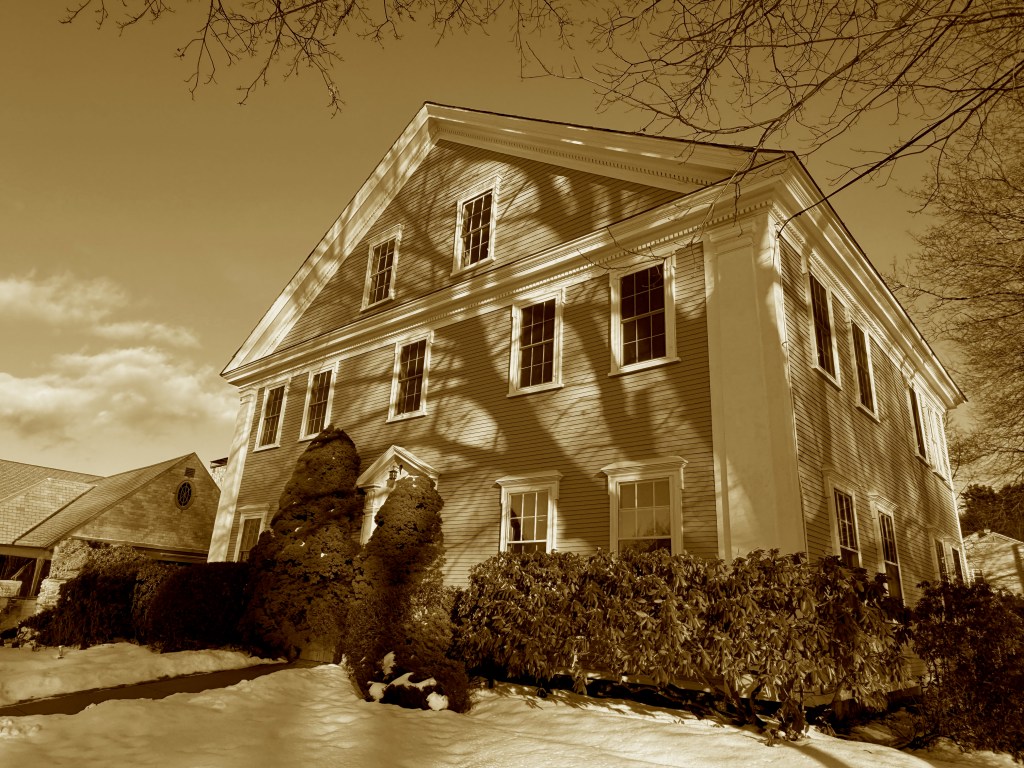
Built around 1791 by General Benjamin Bellows as a wedding gift for his daughter Phebe, the Bellows–Grant House is a substantial late-Georgian residence with transitional Federal details, including corner pilasters, a dentilled cornice, and a symmetrical seven-fireplace façade. Its size and refined craftsmanship reflected the status of the Bellows family and the aspirations of the newly married couple. Later owners, including Benjamin Willis Jr. and the Jennison family, added Greek revival updates and maintained the property for over a century. The house illustrates both Walpole’s architectural evolution and the prominence of the families who shaped the village’s early civic and social life.
Built around 1791 by General Benjamin Bellows (1740-1802) (eldest son of Col. Benjamin Bellows), the Bellows–Grant House is one of the village’s most substantial late-Georgian residences. Bellows constructed the house as a wedding gift for his daughter Phebe Bellows (1770–1847) upon her marriage to Samuel Grant (1765–1845), a saddler in Walpole who inherited substantial land holdings on the death of General Bellows, who began farming on a massive scale and became interested in raising sheep (at one time possessing a flock of one thousand). He was prominent in town affairs, and was one of the founders of the Walpole Academy in 1831. Their home reflected both the status of the Bellows family and the aspirations of the young couple, becoming one of the architectural anchors of early Main Street.
The house is a grand transitional Georgian/Federal structure, retaining conservative Georgian massing while incorporating details that anticipate the more delicate Federal style. Notable exterior features include full corner pilasters that formalize the façade, a dentilled cornice and frieze, emphasizing the roofline, molded window surrounds and window caps, characteristic of refined late-eighteenth-century craftsmanship, a symmetrically composed façade with a central entry, and seven fireplaces, a mark of both wealth and domestic comfort in the period.
In 1846, the property was purchased by Benjamin Willis Jr., (1791–1870) a Boston-based businessman whose acquisition reflects the increasing reach of Walpole’s village as an attractive location for urban professionals and investors. Willis updated the house with Greek revival details, reflecting the mid-nineteenth-century taste for cleaner lines and more monumental ornamentation. In 1859, John Jennison (1807-1880) acquired the house. Members of the Jennison family occupied 42 Main Street for more than a century, making it one of the long-standing family residences in the village.
The Bellows–Grant House stands as an important document of Walpole’s architectural evolution, from its Georgian roots through its nineteenth-century classic revival updates. It stands as a reminder of the prominent families who shaped the early civic and commercial life of the town.
47 Main Street — Commercial Block
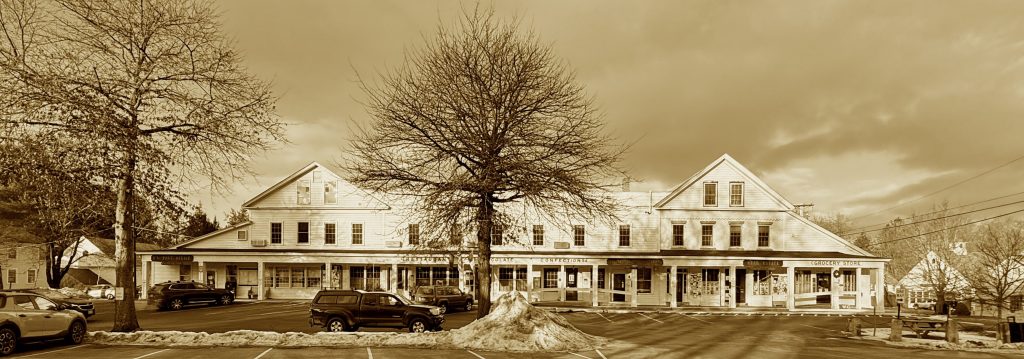
47 Main Street has been Walpole’s commercial heart since at least 1807, hosting shops operated by prominent local families such as the Buffums, Pecks, Bellows and Allens. The original “brick block” burned in 1849, making way for the current commercial row, long known as Davis’ Block, which continued to house general stores, law offices, and specialty shops. 47 Main Street remains a vibrant center of village life, including the post office, local markets, cafés, and small businesses, maintaining a two-century tradition of commerce and community gathering.
This block has served as the commercial heart of Walpole since at least 1807, when early merchants began building substantial stores along this prime stretch of Main Street. A succession of prominent businessmen, including Col. David Buffum, Philip Peck, Josiah Bellows III and Amasa Allen, operated shops here, linking the site directly to many of the village’s most notable homes and families. These enterprises formed the economic backbone of early Walpole, supplying dry goods, groceries, and general merchandise to the growing community.
A vivid account of the block comes from Thomas Bellows Peck, writing in 1895 about his boyhood memories from fifty years earlier. His description captures both the scale of the early commercial buildings and life before the arrival of the railroad:
“I can barely remember the ‘brick block’ so called which stood on the site of what is now known as ‘Davis’ Block.’ It was a long building three stories in height and at the time it was burned in 1849 was used for three stores. Judge Vose’s law office was in the second story over the south store. I distinctly remember the night when it was burned, but can recall little about the building except seeing heavy teams just arrived from Boston with loads of merchandise standing in front of it waiting to unload. This was before the completion of the Cheshire railroad, when all goods were brought from the city on wagons drawn by four or more horses. I recall, too, that the room over the middle store was at one time occupied for a brief period by a traveling artist who took daguerreotypes, then a comparatively new invention. He must have been one of the first who came to town. He took excellent pictures which have remained clear and distinct to the present time.”
The destruction of the “brick block” in 1849 paved the way for the construction of the present commercial row—known for much of the nineteenth and early twentieth-century as Davis’ Block. The storefronts continued to house general stores, law offices, specialty shops, and small trades, mirroring the economic life of a rural New England village adapting to industrial-era transportation and commerce.
47 Main Street remains the vibrant center of village life. The block includes:
- The United States Post Office, a community anchor
- The Restaurant at Burdick’s, a regionally known destination that draws visitors to Walpole
- The Walpole Chocolate Shop & Café, the local retail outlet for L.A, Burdick handmade chocolates
- Galloway Real Estate, a brokerage serving the community since 1961
- The Walpole Grocery, a beloved market
Additional small businesses occupy the upper floors and continue the block’s two-century tradition of local enterprise.
Together, these establishments demonstrate the continuity of Main Street as both an economic hub and a gathering place, linking contemporary village life with its early nineteenth-century commercial origins.
48 Main Street — Bridge Memorial Library

The Bridge Memorial Library, built of native stone in 1891, was a gift to Walpole from Hudson E. Bridge in memory of his father. Designed in the Richardsonian Romanesque style, the building features heavy masonry, broad rooflines, deep-set windows, and a welcoming central entrance, reflecting the late-nineteenth-century ideal of a dignified public institution. Inside, the library offers open reading rooms, built-in shelving, and meeting spaces, emphasizing accessibility and community use. The library remains a lasting symbol of the Bridge family’s connection to Walpole and a cornerstone of the town’s cultural and civic life.
The Bridge Memorial Library is one of Walpole’s most distinguished civic landmarks, built of native stone and standing prominently on Main Street. The library was given to the town in 1891 by Hudson E. Bridge (1858–1934) in memory of his father — the same Hudson E. Bridge who made possible St. John’s Episcopal Church.
Hudson E. Bridge was a member of a prominent St. Louis industrial family whose success came from large-scale ironworks and hardware manufacturing. His father, Hudson Ernestus Dorr Bridge (1810–1875), helped establish the influential Bridge & Beach Manufacturing Company, at one time one of the largest stove and ironworks firms in the United States. Although business operations were centered in Missouri, the Bridge family maintained longstanding ties to New England, and several family members spent summers or extended periods in Walpole. The younger Hudson Bridge developed a particular affection for the town, becoming one of several affluent seasonal residents who contributed generously to its cultural and civic life.
His gift of the Bridge Memorial Library was both a tribute to his father and an investment in Walpole’s future. The building’s architecture reflects the late-nineteenth-century ideal of a durable, dignified public institution. Constructed of native fieldstone, carefully shaped and tightly laid, the library has a rugged, enduring presence. This use of local stone not only showcased regional materials but symbolized the permanence the donor intended.
The building exhibits characteristics associated with the Richardsonian Romanesque style, popular for libraries and town buildings of the era, including its broad rooflines, heavy masonry walls, and subtly emphasized entrance. Windows set within deep stone surrounds admit abundant natural light while preserving the visual solidity of the walls. The entrance, originally marked by substantial wooden doors, provides a welcoming yet substantial focal point on the façade.
Inside, the library features an open reading room, built-in shelving, and a fireplace that brings warmth and domestic comfort to the public space. While the interior has evolved over the years, the building’s plan emphasizes accessibility and community use, with a central computer room, meeting space and the library stacks.
The Bridge Memorial Library remains a testament to the Bridge family’s lasting connection to Walpole and to the town’s commitment to learning, architecture and civic identity. Its stone walls and thoughtful design continue to anchor the cultural life of the community.
52 Main Street — Walpole Artisans Cooperative & In the Company of Flowers

Easy to overlook, this is one of Walpole’s oldest business buildings, in use since the 1790s. For more than two centuries it’s been a place to shop, chat, get shaved, or pick up everyday necessities. Today, that tradition lives on with local art at the Walpole Artisans Cooperative and flowers at In the Company of Flowers.
At first glance, this modest clapboard building on Main Street may not demand your attention, but it has hosted more than two centuries of Walpole’s working life. Along with the former print shop just to the north across High Street, it is among the oldest surviving business buildings in town, a distinction earned not through grandeur but through constant use.
The story begins in the 1790s, when Amasa Allen assembled this lot in pieces, establishing a store here by at least 1792. Almost immediately, the site became part of Walpole’s early commercial strip. By 1794, John Carlisle (1768-1833) was making boots and shoes nearby, and in 1822 the property passed to William Mitchell (1788-1881), a saddler whose shop and barber’s chair would become a local legend.
Mitchell’s barbershop is remembered thanks to Judge Josiah Grahme Bellows (1841-1906), who recounted a hair-raising episode involving Major J. Britton (1817-1896), a later storekeeper here (as recounted in Martha M. Frizzell’s History of Walpole, New Hampshire). Half-shaved and realizing Mitchell was alarmingly drunk, Britton attempted to flee, only to be “held by the nose” and forced to sit until the shave was complete. The same Major Britton later achieved unintended fame as a jury foreman who announced in open court, “We think Judge Vose was about right,” before being sent back to convert that opinion into an actual written verdict.
Through the 19th century, the building remained a hub of everyday enterprise:
- Boot and shoemakers (again, in 1873),
- A furniture store (opened by Charles A. Howard in 1874),
- A barber shop (Henry E. Hewey, 1887),
- And later, markets, including the long-running partnership of B. Frank Webster and Matthew Gorham, followed by Slade’s Market in the early 1900s.
In the mid-20th century, Alexander MacDonald (1909-1984) enlarged the store (1953), adapting it for modern commerce. Earlier still, Harvey Ball (1818-1902) operated a jewelry and clock business here, repairing old timepieces before going on to greater success as a photographer.
Today, the building continues its long tradition of local craft and trade. It is home to Walpole Artisans Cooperative, celebrating handmade work by regional artists, and a florist called In the Company of Flowers. After more than 230 years, this unassuming structure remains what it has always been: a place where Walpole works, shops and carries on.
Take a detour – turn Right (East) on High Street
15 High Street — Alcott Apartments

The Alcott Apartments on High Street, originally a mid‑nineteenth-century duplex, served as the Walpole home of Louisa May Alcott and her family from 1855 through 1857. Relocated from beside the Bellows–Grant House, the residence provided stability after the family’s earlier hardships and offered Louisa space for creative growth while caring for her ailing sister, Elizabeth. The family’s time in the house reflects the influence of Amos Bronson Alcott’s Transcendentalist ideals, shaping Louisa’s thinking on education, abolition and women’s rights. The building stands as a testament to Louisa Alcotts’ formative years in Walpole and her enduring literary and cultural legacy.
This unassuming building on High Street holds one of Walpole’s most celebrated literary connections. Although its exact construction date is unknown, the house became a two-family dwelling in the mid-nineteenth-century, and from 1855 to 1857 the left side served as the residence of Louisa May Alcott and her family. This period formed an important chapter in the Alcotts’ lives.
Originally, the house stood beside the Bellows-Grant House at 42 Main Street. When Benjamin Willis purchased the Main Street property in 1846, he also acquired the lot to its north. Willis had the existing house moved from that location up to High Street and converted it into a duplex. It was in this newly relocated and adapted dwelling that the Alcotts found a stable home during their Walpole years.
The Alcotts’ arrival in Walpole came at a moment when the family was recovering from the difficulties that often followed Bronson Alcott’s idealistic ventures. A central figure in the Transcendentalist movement and a close associate of Ralph Waldo Emerson (1803-1882) Henry David Thoreau (1817-1862), and Sarah Margaret Fuller (1810-1850), Amos Bronson Alcott (1799-1888) was known for his progressive, and sometimes polarizing, educational and social philosophies. His utopian experiment at Fruitlands (his agrarian commune in Harvard, Massachusetts) had collapsed just a decade earlier, and the family continued to feel the economic aftershocks of his lofty but impractical ideals. Walpole offered a place where the family could enjoy some measure of stability and where Bronson could reconnect with sympathetic relatives who appreciated his intellectual pursuits, even if they did not always share his reformist zeal.
The Alcott connection to Walpole arose through family ties. Benjamin Willis had married Elizabeth Sewall May (1798-1822), sister of Abby May Alcott (1800-1877), Louisa’s mother. Willis’ son, Hamilton Willis (1818-1878), and Hamilton’s wife, Louisa May Windship Willis (1819-1862), were Louisa May Alcott’s cousins. It was Hamilton and Louisa May Windship Willis who invited their cousin Louisa to come to Walpole in June 1855. Louisa’s sister Anna worked for Benjamin Willis as a governess in 1846 while they were living at Hillside in Concord, Massachusetts, and later in Walpole.
Louisa arrived first, settling into the left side of the duplex. The rest of the Alcott family joined her in July 1855. Though Walpole provided a more orderly life than the family had often known, their time here was marked by both creative growth and emotional strain. During these years, Louisa’s beloved younger sister, Elizabeth Sewall Alcott—“Beth” in Little Women—suffered lingering complications from scarlet fever, an illness she had contracted several years earlier while helping a destitute immigrant family. Elizabeth’s fragile health shadowed the family’s stay in Walpole, underscoring the precariousness of their circumstances and deepening Louisa’s sense of responsibility.
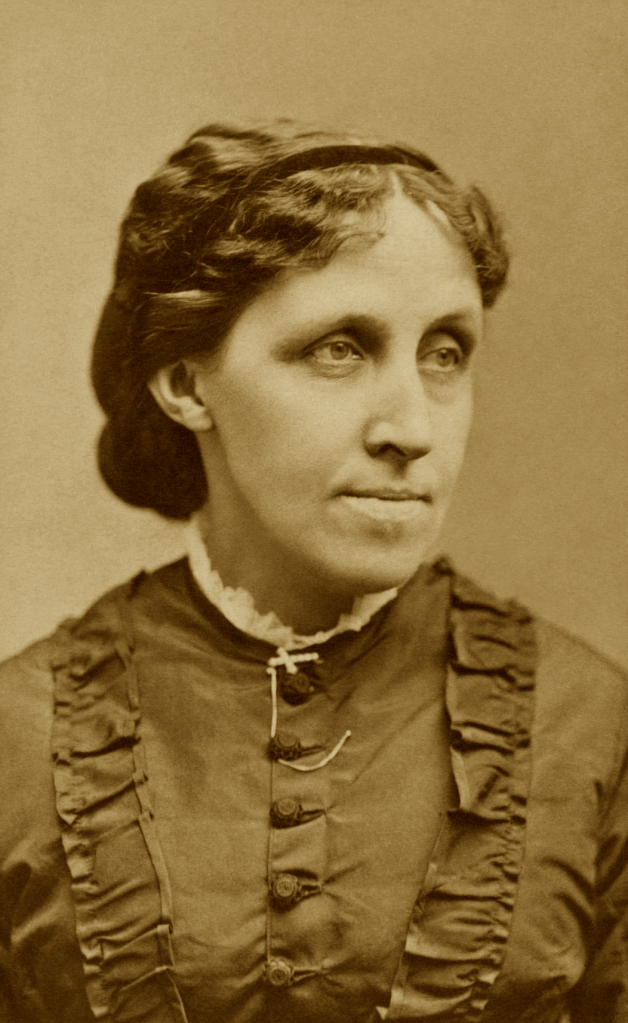
The environment in Walpole offered Louisa space to write, read and reflect. The intellectual atmosphere shaped by her father’s Transcendentalist convictions (belief in individual conscience, self-reliance, educational reform, and the moral imperative to challenge injustice) continued to influence her thinking during these years. Bronson’s commitment to abolition, educational equality and women’s moral and intellectual capabilities left a lasting imprint on Louisa, informing her own progressive views on feminism and the abolition of slavery. Her later works, most notably Little Women, would carry these values forward in ways that were both subtle and revolutionary for their time.
Though less often highlighted in biographies, the years Louisa May Alcott spent in Walpole were formative in her development as both a writer and an adult navigating the demands of supporting her family, caring for an ailing sister, and finding her own voice.
Today the building is known as the Alcott Apartments. Its connection to one of America’s most beloved authors and to a family central to American literary and reform movements remains a key piece of Walpole’s cultural and literary heritage.
Return to Main Street; turn Right (North)
54 Main Street — Former Isaiah Thomas Print Shop

54 Main Street, now a law office, was the print shop of Isaiah Thomas in the 1790s, where he published books, pamphlets and newspapers, including “The Farmer’s Weekly Museum.” Under the editorship of Joseph Dennie, the paper gained national recognition, turning Walpole briefly into notable literary hub in early America. Though the publication eventually ceased, the building’s history reflects the village’s early role in American letters. It stands as a reminder of Walpole’s cultural and literary significance during the Federal period.
This modest building at 54 Main Street belies the extraordinary literary and publishing history that unfolded within its walls. In the 1790s, it housed the Walpole print shop of Isaiah Thomas (1749–1831), one of the most influential printers, publishers, and patriots of the early United States. Thomas, already renowned for founding the Massachusetts Spy and for his role in spreading revolutionary ideas, expanded his operations into Walpole, where he printed books, pamphlets, and newspapers for a rapidly growing readership in northern New England.
Among the most notable works produced here was The Farmer’s Weekly Museum, a newspaper that would briefly transform Walpole into a major cultural and literary hub, demonstrating that intellectual ambition and cultivated taste were not confined to large cities, but could flourish wherever readers were willing to engage seriously with ideas.
In 1795, the gifted young writer Joseph Dennie (1768–1812), then just twenty-seven, arrived in Walpole. A Boston-born Harvard graduate, Dennie had trained for the law but soon rejected it in favor of literature, believing that careful reading, elegant expression and moral reflection were essential to both personal refinement and the health of the republic.
He became editor of The Farmer’s Weekly Museum during its third year of publication.

Dennie’s graceful, incisive prose, especially in his celebrated essay series The Lay Preacher, quickly captured national attention. He argued that learning, pursued with taste and judgment, was both a pleasure and a civic good.
Under his direction, the Museum became one of the most admired newspapers in the country, attracting contributions from many of the leading literary figures of the early Federal period. Circulation increased dramatically, as noted by Andrew P. Peabody writing in The American Antiquarian Society (October 1889), stretching “from Maine to Georgia, and as far west as Ohio.” For a brief but remarkable moment, Walpole enjoyed a reputation as a sophisticated literary outpost, associated nationwide with thoughtful essays, cultivated wit and the conviction that carefully argued and elegantly expressed ideas mattered.
Despite its acclaim, the paper eventually failed financially, and Dennie moved on to Philadelphia, where he founded The Port Folio, one of America’s first successful literary monthlies. There he cemented his legacy as a central figure in early American letters and as a champion of learning pursued for both delight and public good.
Though the building now serves as a law office and rental apartments, it remains one of Walpole’s most significant historical sites. Within these walls, Isaiah Thomas’ presses helped circulate news and ideas throughout the region, and Joseph Dennie’s editorial vision briefly elevated Walpole to national literary prominence. The building stands as a reminder that even the humblest structures can shelter moments when intellectual passion, disciplined curiosity and the love of learning leave a lasting mark.
Continue North on Old North Main Street
11 Old North Main Street —“The Historic House”
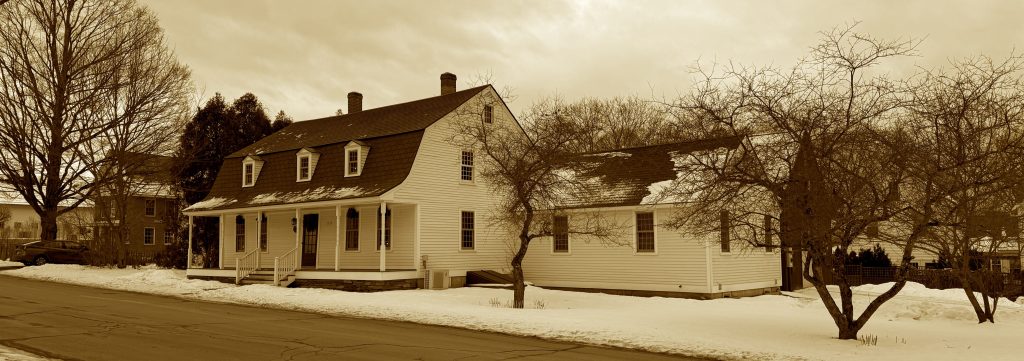
11 Old North Main Street, known as the “Historic House,” is Walpole’s oldest surviving dwelling, built around 1761 by Asa Baldwin. It features a distinctive pulvinated overhang and a saltbox form, reflecting mid-eighteenth-century New England craftsmanship with rare stylistic touches. A notable early resident was stagecoach operator Otis Bardwell, and the house briefly served as the parsonage for Rev. Jonathan Leavitt, linking it to both local commerce and early religious life. Saved from demolition in 1930 by concerned townspeople, it became the first home of the Walpole Historical Society. Now a private residence, the house stands as a tangible record of the village’s architectural, social and cultural history.
The oldest surviving dwelling in the village of Walpole, the so-called “Historic House” was built around 1761 by Asa Baldwin and remains one of the most remarkably intact examples of mid-eighteenth-century domestic architecture in the region. Over its long life it has sheltered a succession of owners, including Otis Bardwell, who lived here for roughly twenty-five years during the height of his success as a stagecoach operator. Bardwell prospered in that line of work, running coaches that connected Walpole with surrounding towns, and his years in this modest but sturdy house marked the period before he eventually purchased the Aaron Howland House. His association links the building to an important era in the town’s early transportation and commercial history.
The house’s survival was nearly cut short in 1930, when an oil company sought to purchase the property, demolish the building and replace it with a filling station. Alarmed at the prospect of losing Walpole’s earliest dwelling, a group of concerned residents quickly organized, secured a loan, and bought the property themselves. Their successful effort not only preserved the structure but also provided a home for the newly established Walpole Historical Society, which used the house as its headquarters and museum until 1948.
The house is characteristic of its mid-eighteenth-century origins, with a saltbox form, a gambrel roofline, and the simplicity and sturdy craftsmanship typical of early New England homes. Yet one feature distinguishes it from its regional peers: the unusual pulvinated (convex) overhang that curves across the front façade. This gently bulging projection is far more commonly found in the Hudson River Valley and in parts of southern New England than in New Hampshire, suggesting that the builder may have been influenced by traditions from outside the Connecticut River Valley, or that the overhang was added slightly later as stylistic tastes evolved. Whatever its source, the overhang gives the house a distinctive presence rare in northern New England architecture.
The house also bears witness to a more complicated aspect of Walpole’s early past. Shortly after its construction it became the parsonage of Rev. Jonathan Leavitt (1731–1802), the town’s first minister. His tenure ended abruptly in 1764 after an incident that remains one of the more troubling episodes in local history. Leavitt was “detected in leading home a runaway slave of his, a woman, by a rope round her neck and attached to the pommel of his saddle.” On hearing of the outrage, Col. Bellows declared “That such cruelty should not be tolerated” and “that he settled parson Leavitt and he would unsettle him.” The event is a stark reminder that slavery was practiced in New England, including here in Walpole. This moment, preserved in local history, adds a sobering human dimension to a house often admired for its age and architectural charm.
The Historic House stands not only as Walpole’s earliest surviving structure but also as a layered record of the town’s experience: its early settlement, its religious beginnings, its participation in regional trade and travel, and its evolving commitment to preservation and historical truth. Its well-crafted eighteenth-century frame speaks to the skill of the town’s first builders, while the stories of the people who lived here invite a fuller understanding of Walpole’s complex and often challenging past.
Seen together, these intertwined histories make the Historic House a rare and valuable touchstone, offering visitors a deeper sense of the people, ideals, struggles and aspirations that shaped the village from its earliest days.
Cross Colonial Drive; continue North on Old North Main Street
26 Old North Main Street

Built circa 1811 by tanner Daniel W. Bisco, this house is a notable example of rural Federal-period architecture, distinguished by its large ell connecting the main house to the barn. The home features a symmetrical façade, finely proportioned windows, and understated ornament typical of the Federal style. Tradition holds it was the first house in Walpole with an indoor bathroom, reflecting the progressive tastes of its early owners. In 1905, a front portico and two-story bay were added, blending Colonial Revival and late-Victorian elements with the original design. The house illustrates Walpole’s evolving architectural tastes and long-standing tradition of careful adaptation over two centuries.
Built circa 1811 by tanner Daniel W. Bisco (1766-1828), this house is an excellent example of rural Federal-period design is distinguished by the large extended ell that connects the main block to the barn. This configuration is seen in many early New England farmsteads, but executed here with unusual scale and refinement. The main house retains hallmark Federal features, including its symmetrical façade, understated ornament, and delicately proportioned windows.
Tradition holds that this was the first house in Walpole to include an indoor bathroom, a notable innovation for a small New Hampshire village in the early nineteenth-century. This detail points to the prosperity and progressive interests of its early owners, who embraced modern conveniences well ahead of many contemporaries.
In 1905, the house underwent a significant update with the addition of the front portico and the projecting two-story bay, both of which introduced late Victorian and Colonial Revival elements while preserving the original Federal core. The result is a distinctive blending of architectural eras, characteristic of Walpole’s long history of tasteful renovation rather than wholesale replacement.
Though not associated with a single nationally known figure, the house stands as a testament to the town’s evolving architectural tastes and the comfort, status, and permanence sought by generations of Walpole families who lived in and adapted it over more than two centuries.
34 Old North Main Street — Silas Bates House
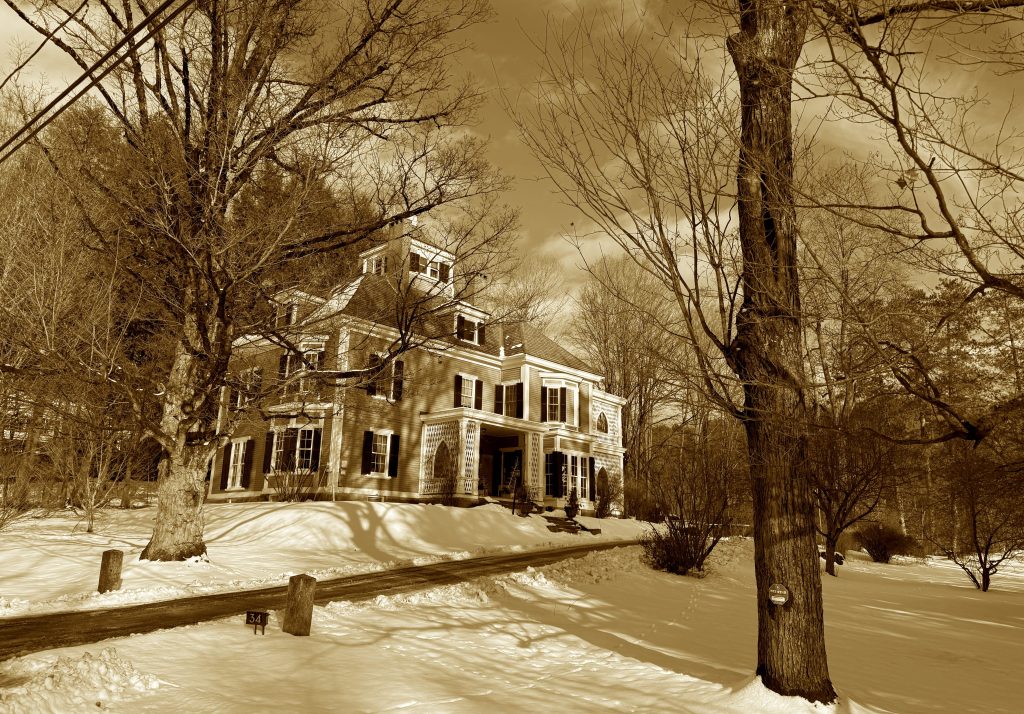
Built circa 1867 for shirt manufacturer Silas Bates, this house is a striking example of high Victorian architecture in Walpole. The house features Moorish arches, Gothic windows, projecting bays, and a richly detailed façade that reflects both wealth and eclectic Victorian tastes. A dramatic belvedere, accessed via a spiral staircase, offers commanding views of the village and surrounding hills. Bates’ home embodies the era’s industrial prosperity and love of architectural experimentation. It remains one of Old North Main Street’s most visually distinctive and historically significant residences.
Built around 1867 for Silas Bates (1814-1885), one of Walpole’s nineteenth-century industrialists, this house is among the village’s more exuberant examples of high Victorian architecture. Bates, a prosperous shirt manufacturer whose firm, Bates & Aldrich, once operated in Walpole, was known for his friendly rivalry with fellow entrepreneur Charles Hooper, whose Italianate house stands nearby at 40 Main Street. Bates’ home reflects not only his wealth but also his taste for architectural drama and fashionable eclecticism.
The house is richly ornamented, combining a range of Victorian motifs in a single, cohesive composition. Distinctive Moorish arches and latticework soften and enliven its porches, while double Gothic windows, dormers, and projecting bays contribute to a picturesque, highly articulated façade. These stylistic flourishes showcase the Victorian era’s delight in varied forms, contrasting textures and romantic silhouettes.
Crowning the structure is a belvedere, accessible by a spiral staircase rising through the third and fourth floors. From the top, one could view the village, farms, and hills beyond, a feature that underscored the owner’s status and the era’s fascination with commanding views.
The house stands as a testament to Walpole’s mid-nineteenth-century period of industrial energy and architectural experimentation. As one of the village’s most visually distinctive dwellings, it contributes significantly to the architectural richness of Old North Main Street.
42 Old North Main Street — Josiah Bellows III House

Built around 1814 for Josiah Bellows III, this house is an elegant Georgian/Federal residence that remained in the Bellows family for over a century. The house features a hipped roof, central hall plan, and a Greek Revival portico, with later Italianate and Colonial Revival updates reflecting evolving tastes. Bellows, a civic leader and War of 1812 captain, made the home a center of family and local prominence. The property exemplifies refined early nineteenth-century architecture while illustrating the Bellows family’s long-standing influence in Walpole.
Built around 1814, this distinguished Georgian/Federal residence was constructed for Josiah Bellows III (1788–1842), son of Josiah Bellows II (1767-1846) and Rebekah Sparhawk (1768-1792), and a prominent figure in early nineteenth-century Walpole.
Known locally as “Handsome Si,” Bellows was widely regarded as popular, energetic and influential in town affairs. During the War of 1812, he led a company of Walpole men in the defense of Portsmouth, enhancing his local reputation for leadership and civic commitment.
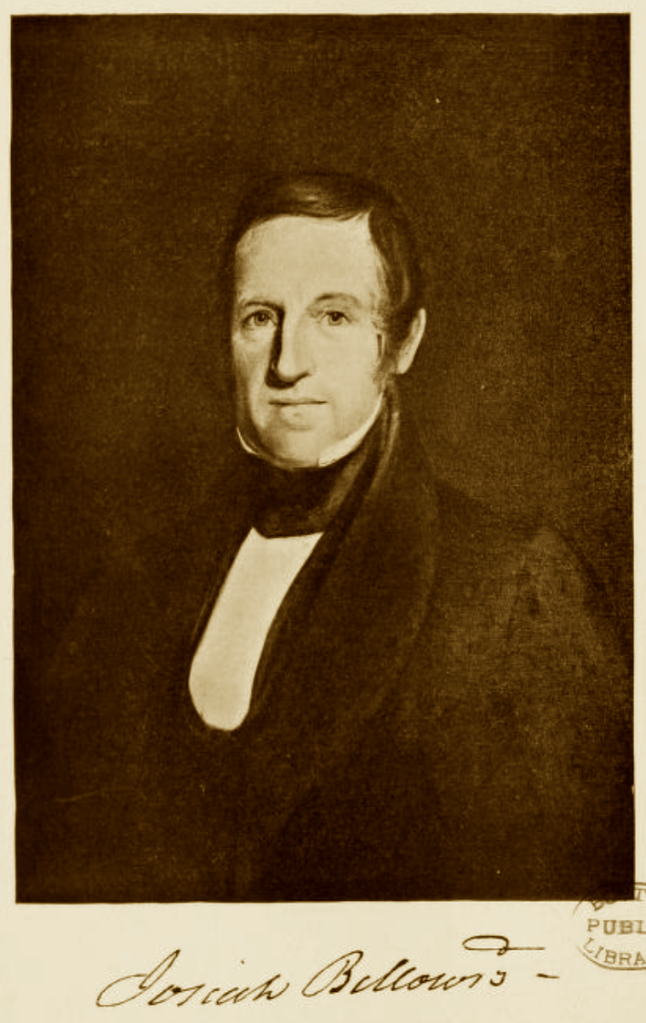
In 1813, Bellows married Stella Czarina Bradley (1796-1833), daughter of U.S. Senator Stephen Rowe Bradley. Her death in 1833, followed soon by the loss of their four children, marked a tragic period in his life. Bellows remarried in 1840 to Mary Ann Hosmer, widow of Dr. Alfred Hosmer, a Walpole native. Their son, Josiah Grace Bellows, was born on July 24, 1841—just months before Bellows himself died on January 13, 1842. The house remained in the Bellows family for more than a century, passing out of their ownership in 1944.
Architecturally, the home is a fine example of the Georgian/Federal style, featuring a hipped roof and central hall plan. The front entrance was later enhanced with a Greek Revival portico, complete with paired columns and sidelights, giving the façade a more monumental presence. On the south elevation, symmetry is carefully maintained, while an added porch supported by Italianate posts reflects mid-nineteenth-century stylistic updates. Both north and south chimneys are aligned along the central axis, reinforcing the house’s formal balance.
A single-bay addition displays Colonial Revival tracery, part of a later wave of architectural embellishment. On the north side, a two-story wing extending eastward may originally have served as carriage bays, suggesting the functional evolution of the property over time.
42 Old North Main Street stands as one of Walpole’s handsomest early nineteenth-century residences—an elegant blend of Federal refinement and later stylistic layers, deeply connected to one of the town’s foundational families.
56 Old North Main Street — Bates Cottage
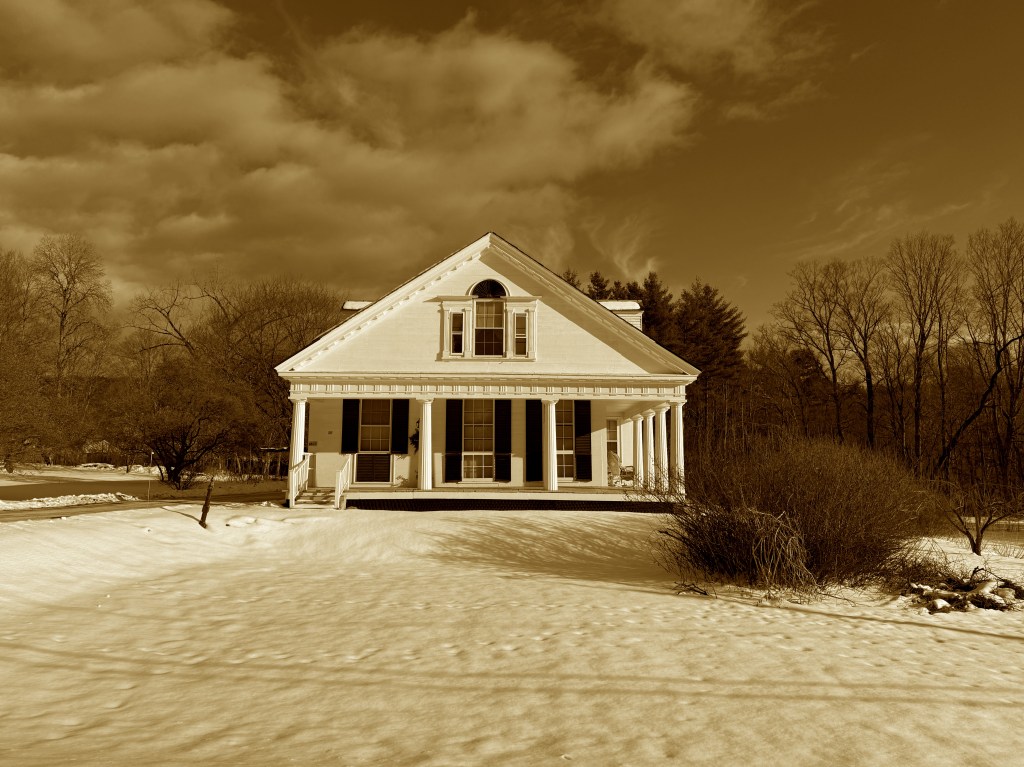
56 Old North Main Street, known as the Bates Cottage, was built in 1832 for widowed Louisa Bellows Hayward and later became associated with Mary Georgiana Bates, a founding director of the Walpole Historical Society. The modest house reflects the domestic scale and restrained elegance typical of Aaron P. Howland’s early nineteenth-century work. Its long connections to the Bellows and Bates families tie it to Walpole’s civic and social history. The cottage remains a visible reminder of the town’s architectural traditions and the personal stories that shaped the village.
Set along Old North Main Street, the house long known as the Bates Cottage carries with it a meaningful strand of Walpole’s nineteenth-century story. According to The Bellows Genealogy, the cottage was built in 1832 for Mrs. Louisa Bellows Hayward (1792-1868), the widow of John White Hayward (1786-1832). Louisa was the daughter of Josiah Bellows and Rebecca Sparhawk, and a granddaughter of Col. Benjamin Bellows. For more on Josiah Bellows, see the description of the next site on this tour.
Recently widowed, Louisa returned to her hometown and constructed a modest dwelling near her father’s residence on a portion of the family farm. Here she lived with her children for several years before eventually moving to the farm of her son Waldo Flint Hayward (1831-1897) on Prospect Hill in Walpole. The house remained small in scale and domestic in character, but its long association with the Bellows and Hayward families, both central to Walpole’s early civic life, gives it a place in the town’s broader narrative.
Its better-known name, however, comes from a later chapter. The cottage became widely recognized as the “Bates Cottage” because it was rented for many years by Mary Georgiana Bates (1861–1936), a devoted Walpole resident whose civic contributions helped shape the town’s historical memory. Bates was a founding director of the Walpole Historical Society, and her long tenancy here cemented the house’s identity in the minds of local residents. Under her occupancy, the cottage became a familiar and well-loved part of the Old North Main Street streetscape.
The cottage exhibits massing and detailing that strongly suggest the hand of Aaron P. Howland, the master builder responsible for some of Walpole’s most significant early nineteenth-century structures, including the Walpole Academy. While simpler than his major civic works, the Bates Cottage shows the same sensitivity to proportion and restrained ornamentation that characterize Howland’s domestic buildings. This association enriches the house’s importance, placing it within the continuum of Howland’s work and highlighting the influence he had on the town’s architectural character during the 1830s.
The Bates Cottage stands as a modest but telling piece of Walpole’s history: a home built for a young widow seeking stability, later associated with one of the town’s foremost champions of local heritage, and likely shaped by the craftsmanship of Walpole’s preeminent builder. Its presence on Old North Main Street evokes both the personal stories and the architectural traditions that together form the fabric of the village.
67 Old North Main Street — Josiah Bellows House
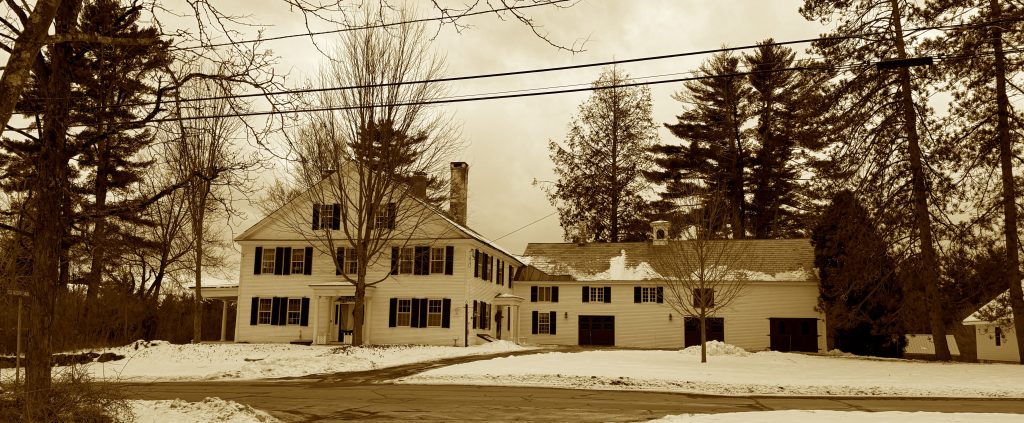
67 Old North Main Street, the Josiah Bellows House, occupies the site of Walpole’s first meetinghouse, begun in 1761 but never completed. Around 1788, Josiah Bellows built the present house, which was later expanded for his large family. The interior features sophisticated decorative elements, including Zuber panoramic wallpaper, highlighting the refinement of its occupants. A nineteenth-century ell added functional space for household and farm needs. The property reflects both Walpole’s early civic history and the enduring legacy of the Bellows family.
The property at 67 Old North Main Street holds deep roots in Walpole’s early civic history. The first town meetinghouse was begun here in 1761, though it was not occupied until 1764 and was never fully completed. For the next two decades, townspeople repeatedly debated finishing the structure, but it was ultimately abandoned and allowed to deteriorate.
The land was later acquired by Josiah Bellows (1767-1846), “Uncle Si,” youngest son of Col. Benjamin Bellows, the town’s principal early patron. Around 1788, Josiah built the present house, expanding it over time to accommodate his growing family. He first married Rebecca Sparhawk (1768-1892); after her death, in 1793 he married her sister Mary Sparhawk (1773-1869). Together, the two sisters bore eleven children, and in a memorable family event, three of those children were married on the same day.
The interior retains notable early decorative features, including original stenciling in the front hall and a parlor adorned with a rare panoramic wallpaper made by Manufacture Papiers Peints Zuber et Cie of Rixheim, France, called Eldorado, created in 1848. This imported French scenic paper (hand-printed from carved woodblocks) was a luxury item in its day, and its imaginative landscape of lush foliage, distant mountains, and romantic ruins adds a layer of artistic distinction to the house. Surviving original Zuber panoramas are uncommon, though the original wood blocks survive and Zuber’s nineteenth-century panoramic wallpapers are still produced at great expense. Its presence here reflects both the refinement and the aspirations of the home’s mid-nineteenth-century occupants.
A substantial ell, added later in the nineteenth-century, provided space for carriage storage, housekeeper’s quarters, and a summer kitchen, reflecting both the scale of the household and the functional needs of a prosperous family homestead.
Josiah Bellows’ life ended abruptly in an accident. While driving a wagon on the Keene road a short distance south of the village, he met an oncoming stagecoach and turning too sharply, fell from his wagon and sustained a fatal head injury. He died two days later.
The house stands as a layered testament to Walpole’s early municipal history, the Bellows family legacy, and more than two centuries of architectural evolution.
Turn around and walk South to Rogers Street; turn Right (West) on Rogers Street to Main Street
78 Main Street — Walpole Foundation Pocket Park
Here you will find a small town-owned park maintained by The Walpole Foundation. Built on the site of a former derelict house, it features seating, plantings, and a stream-side gazebo, offering a private, restful spot in the village. The park supports community gatherings and reflects the Foundation’s mission to preserve and enhance Walpole’s historic center.
The charming green space at 78 Main Street is a pocket park owned by the town of Walpole and maintained by The Walpole Foundation. The park provides an attractive pause in the streetscape along the village’s principal thoroughfare. A derelict house was demolished to create this professionally designed public open space offering seating, plantings, and a welcoming stream-side gazebo for residents and visitors alike. As with many Foundation-owned properties, its purpose is to preserve the character of the village center while enhancing community life.
Cross Main St to the Sidewalk, turn Left (East) and walk one block to Fountain Square
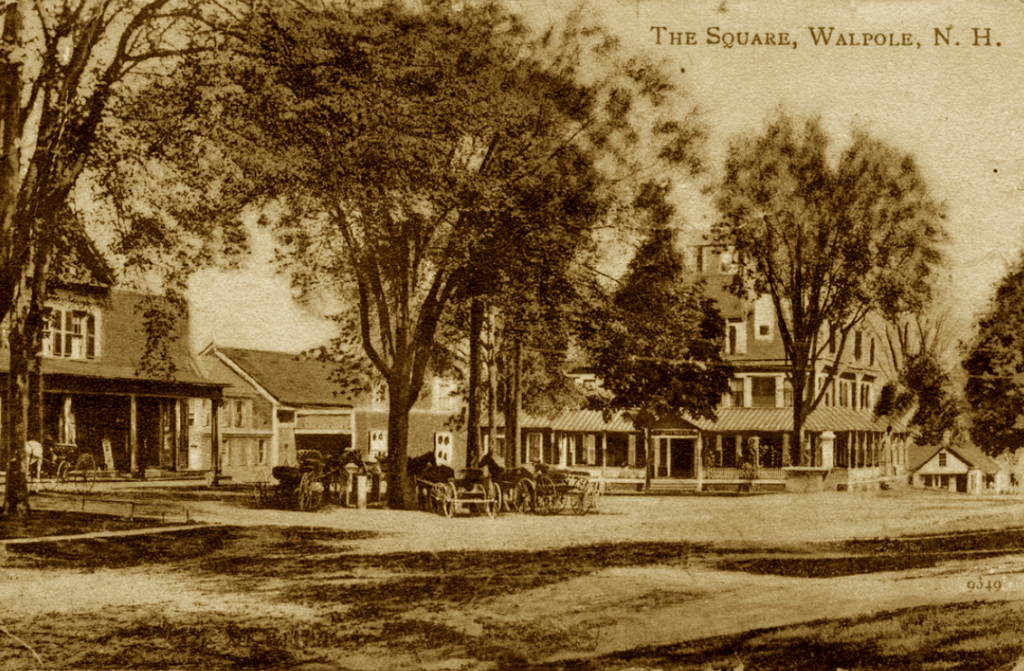
Main Street, once part of the Third New Hampshire Turnpike, forms the backbone of Walpole’s village life. For more than two centuries, it carried travelers, freight, and ideas, shaping the placement of homes, inns, shops and civic institutions. Walking it today, one can see how the road’s alignment and the village’s architecture together reflect continuity, community, and the rhythms of life that have long defined Walpole.
The stretch of Main Street that angles northwest from Fountain Square once went by a different name: Turnpike Road. So did the stretch of Main Street running south from the square before climbing what is now Prospect Street, though it is not clear when the name was changed. When the road was first laid out in 1799 as part of the Third New Hampshire Turnpike, it was a bold promise of connection in a region where overland travel had long been difficult. Over time, as the toll company dissolved and the town took over maintenance (by 1819 it was a free road), the old turnpike gradually settled into village life under a new name. Yet the term “Turnpike Road” lingered well into the early twentieth-century; a 1915 Sanborn Fire Insurance map still labels it as such, a reminder of its origins.
From its earliest days, the turnpike was the spine of Walpole. In the late eighteenth-century, New Hampshire, like much of New England, looked to turnpikes as a way to knit distant communities together. The road that ran through Walpole became part of a vital north–south corridor along the Connecticut River Valley. It carried stagecoaches, mail, and freight; it funneled travelers toward river crossings at Westminster and Bellows Falls, and linked small farms to wider markets. For Walpole, the turnpike was more than a road. It was the artery that gave the village life.
Life in Walpole soon oriented itself around this steady stream of movement. House lots appeared along the roadside, followed by the town’s earliest inns, taverns, and shops—places where travelers paused and neighbors gathered. As the years passed, the road drew to it the institutions that would define the community. Westminster Street, leading directly to the river crossing into Vermont, grew in tandem, and its importance helps explain why Walpole’s Town Hall and Common came to be there rather than on Main Street, contrary to the usual New England pattern. The meeting of Main and Westminster Streets formed the natural heart of the village, where paths, commerce, and civic institutions converged, and where Fountain Square would eventually crystallize the connection between architecture, public life and community identity.
Even after the toll era faded and the name “Main Street” took hold, the character of the road changed very little. It remained the village’s principal corridor, lined with markets, general stores, and professional offices. Residents gathered here at churches, on the Common, or simply in front of shop windows, and nearly all civic life radiated from this central crossroads. The roads that once carried stagecoaches now carry automobiles and the rhythms of the town.
Elsewhere in New England, many original turnpikes were transformed into highways, often eroding the character of the towns they passed through. Walpole was an exception. When Route 12 was built in the 1920s, residents ensured the highway bypassed the central business district, preserving the historic scale, character and civic rhythms of Main Street. Preservation was a long-term goal, for an article in the Keene Evening Sentinel of 27 November 1957 (“Area Construction Projects Near Completion”) noted that “Long-range plans call for a by-pass route west of Walpole village …”. Today, Main Street remains the village’s backbone: home to landmark businesses, the focus of community life, and a steward of a historic character that has endured generations of change. Walking it now, one can still sense a continuity of movement: the same alignment of road, village, and landscape experienced by travelers more than two centuries ago.
Conclusion of the Walking Tour: Fountain Square
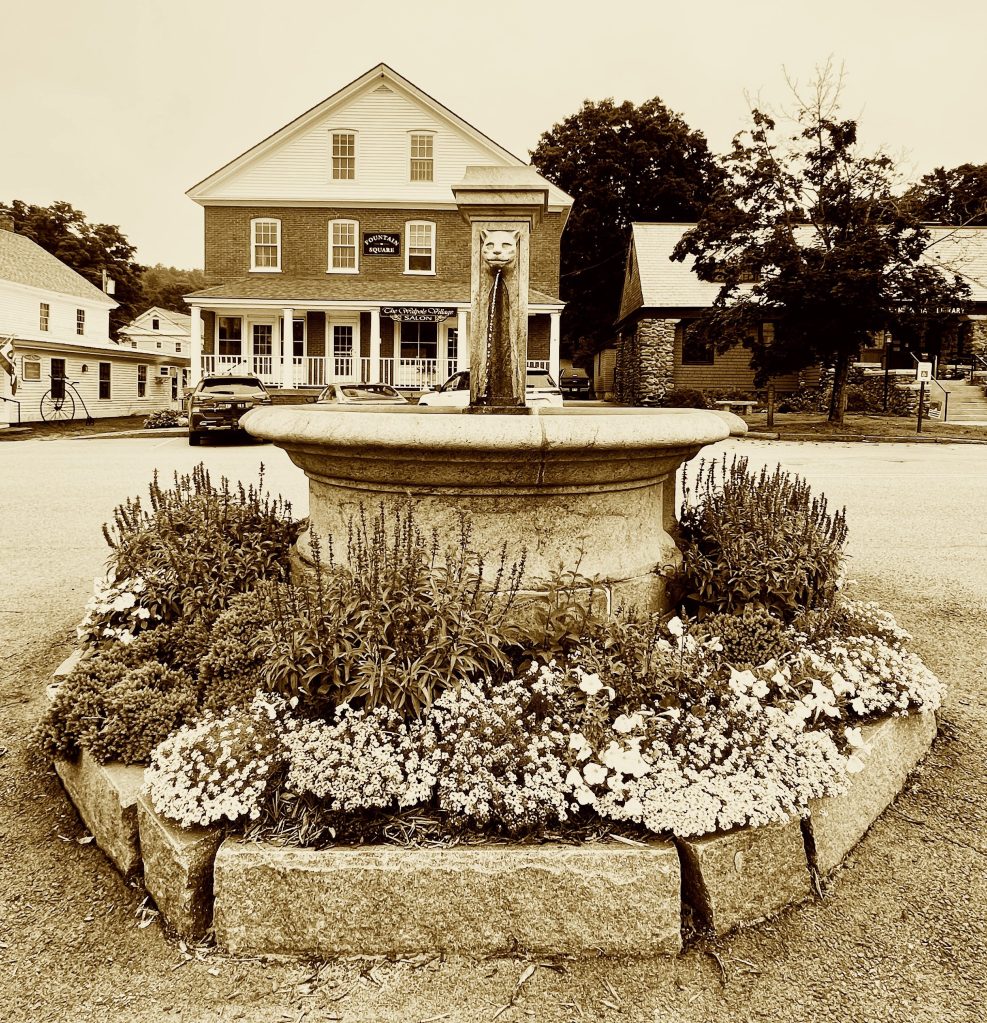
Fountain Square brings the walking tour to its conclusion, where Walpole’s Greek Revival buildings and the Delano & Aldrich fountain converge to tell the village’s story. The classical architecture embodies early nineteenth-century civic ideals—democracy, moral purpose and cultural aspiration—while the fountain, inscribed with lines from Ralph Waldo Emerson’s poem “Monadnoc,” evokes the Transcendentalist reverence for nature, self-reliance and moral insight. Together, these elements highlight the influences that shaped this community: public virtue expressed through architecture, and introspection inspired by the natural world, particularly the legendary catamount and Mount Monadnock. The site exemplifies Walpole’s layered history, where reason and reflection, civic pride and personal contemplation coexist. Standing here, visitors are invited to appreciate both the village’s built heritage and its philosophical inheritance: “Take the bounty of thy birth—Taste the lordship of the earth.”
As we return to the center of the village, Walpole’s architectural story gathers its final threads here in Fountain Square, where the built environment expresses not only the classical ideals of the early nineteenth-century but also the reflective spirit that later took hold in New England. You have seen how the Greek Revival buildings lining Main Street and surrounding the Town Common embodied the aspirations of a young republic: its belief in democracy, integrity, civic purpose and cultural independence. Their bold pediments and careful proportions still assert those values today.
By the late nineteenth century, however, the region’s cultural imagination had been reshaped by the influence of Transcendentalism, a movement rooted in New England and led by thinkers such as Amos Bronson Alcott, Ralph Waldo Emerson, Henry David Thoreau and Sarah Margaret Fuller.
Drawing on European Romanticism and the liberal religious currents of Unitarianism, the Transcendentalists argued that genuine understanding arises not from institutions or inherited authority, but from the individual’s direct, intuitive encounter with the world.
They championed self-reliance, moral sincerity, and trust in one’s inner compass over social convention or material ambition. Many also linked personal awakening to public responsibility, advocating passionately for the abolition of slavery, women’s rights, and educational reform. In many ways, the Transcendentalists were ahead of their time—their concerns remain compelling today.
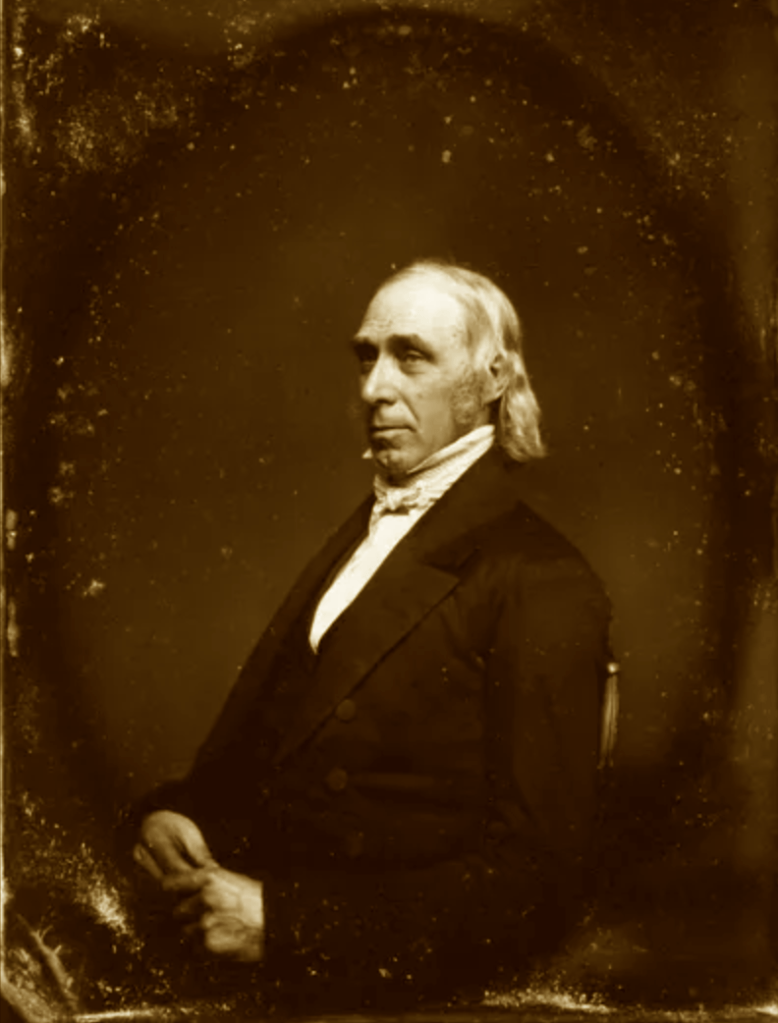

This philosophical shift brought with it a renewed reverence for the natural world—not as scenery alone, but as a source of instruction, and no natural landmark loomed larger in the New England imagination than nearby Mount Monadnock, some thirty miles southeast of Walpole.
The mountain’s name comes from the Abenaki language, commonly translated as “the mountain that stands alone.” The Abenaki people are an Indigenous nation whose ancestral homelands encompassed much of present-day northern New England, southern Quebec, and the Canadian Maritimes. Long before European settlement, Monadnock was a significant presence in their cultural and geographic landscape, its solitary form marking the land both physically and spiritually.
Rising abruptly above the surrounding countryside, Monadnock became one of the most-climbed mountains in the world. For nineteenth-century writers and thinkers, its stark profile and exposed summit offered more than inspiration: they demanded attentiveness, humility, and endurance.

The arduous, weathered, unsheltered climb itself became a form of moral encounter. In this way, Monadnock served not merely as a symbol, but as a teacher.
Emerson climbed Monadnock several times, describing it as “an aerial isle”—a place set apart, where the distractions of society fell away and deeper realities might be apprehended. In his poem Monadnoc, Emerson portrays the mountain as a stabilizing presence for the region, a moral axis as much as a geographic one:
To far eyes, an aerial isle
Unploughed, which finer spirits pile,
Which morn and crimson evening paint
For bard, for lover and for saint;
An eyemark and the country’s core,
Inspirer, prophet evermore;
Pillar which God aloft had set
So that men might it not forget
Thoreau visited Monadnock four times between 1844 and 1860, finding in its “sublime grey mass” a rebuke to intellectual posturing and human restlessness. In the opening of his poem Mountains, written in the early 1840s (but published posthumously in 1895), he praises the mountain not for its beauty alone, but for its steadfastness and its refusal to yield to fashion, theory, or haste:
With frontier strength ye stand your guard,
With grand content ye circle round,
Tumultuous silence for all sound,
Ye distant nursery of rills,
Monadnock and the Peterborough Hills;—
Firm argument that never stirs,
Outcircling the philosophers,—
Like some vast fleet,
Sailing through rain and sleet,
Through winter’s cold and summer’s heat;
Still holding on upon your high emprise,
Until ye find a shore amid the skies;
Not skulking close to land,
With cargo contraband,
For they who sent a venture out by ye
Have set the Sun to see
Their honesty.
For both Emerson and Thoreau, Monadnock embodied a disciplined freedom: independence without isolation, solitude without withdrawal. It affirmed a central Transcendentalist belief that nature, encountered directly and attentively, could steady the mind, clarify moral judgment, and restore a sense of proportion between the individual and the larger world.
For many New Englanders, Monadnock came to embody qualities they admired in themselves and aspired to cultivate: independence, steadfastness, humility before nature and clarity of thought. The mountain stood not only as a physical landmark, but as a moral guidepost, affirming the Transcendentalist belief that nature itself is a temple, offering insight, grounding and renewal.
By the late nineteenth century, Transcendentalism as an organized movement had passed, but its influence endured, absorbed into New England’s cultural memory and expressed through poetry, commemoration (public remembrance as a celebration of the individual) and civic design (organic forms harmonizing with the landscape). That inheritance finds tangible form here in Fountain Square.
The site once featured a bandstand, removed in 1889, before Charles Prentice Howland (1870–1932), a son of Henry Elias Howland (1835-1913) and Sarah Louise Miller (1838-1884), and a grandson of Aaron P. Howland and Huldah Burke Howland, presented a gift to the village in 1905: a public fountain “for horses and human beings.”
Designed by the American Beaux-Arts firm Delano & Aldrich of New York City and carved from Branford Red Granite quarried at Stony Creek, Connecticut, the fountain brought both beauty and utility to the crossroads of Main and Westminster Streets.
Over time, the fountain fell into disrepair. By the 1940s its mechanism had failed, and by the 1960s it brimmed with summer flowers instead of flowing water. Yet Walpole’s sense of stewardship endured. In 1983 the community established a “Restore the Fountain Fund,” and the restored fountain was proudly rededicated following the Old Home Days Parade in 1984.
The fountain features a pillar crowned with the carved head of a catamount, from which a single spout fills the basin below. The choice of a catamount is itself richly symbolic. Once native to New Hampshire and throughout New England, the catamount (also known as the eastern cougar or mountain lion) was long associated with strength, vigilance, independence and a keen attunement to its surroundings.
By the early twentieth century, when the fountain was conceived, the catamount had largely vanished from the region, surviving instead in memory, story and emblem. The last confirmed sighting was in Maine in 1938, but the US Fish and Wildlife Service did not declare the catamount extinct until 2018. The catamount’s presence here reflects more than nostalgia for a lost wilderness; it signals a desire to preserve, in symbolic form, the qualities that wilderness was believed to cultivate.
Like Mount Monadnock, the catamount was understood as solitary rather than social, self-possessed rather than domesticated. Both stood apart from human systems, governed by their own internal order. In this way, the carved head atop the fountain translates the moral lessons of the mountain into a civic setting. Positioned at the heart of the village, it reminds passersby that strength need not be aggressive, independence need not be isolating, and that attentiveness to the natural world remains a form of ethical discipline, even within an ordered town.
On the rear of the pillar, above the smaller basin intended “for human beings” is an inscription drawn from Emerson’s poem Monadnoc—a deliberate tribute to the mountain that so profoundly shaped New England’s literary and philosophical life. Emerson composed part of the poem during an 1845 ascent of Mount Monadnock. The lines chosen for the fountain read:
Take the bounty
of thy birth
Taste the lordship
of the earth
From “Monadnock”
Emerson
The inscription comes from Emerson’s 1876 revision of the poem, published posthumously in 1904. In the version first published in 1847, he had written “Accept the bounty,” later strengthening the phrase to the more active “Take the bounty,” a subtle shift that underscores the Transcendentalist conviction that moral and spiritual insight must be affirmatively claimed through direct experience. The stonecutter’s erroneous addition of the final “k” to “Monadnock” firmly anchors the words to the mountain itself.
Here, at the meeting point of Walpole’s early republican architecture and its later philosophical inheritance, the village’s character comes into focus. The Greek Revival buildings on Main Street and surrounding the Town Common speak of civic order, shared purpose and confidence in public life. The fountain, with its poetic inscription and watchful catamount, introduces a contemplative note that values reflection, attentiveness and the influence of the natural world.
Together they reveal a community informed by both reason and intuition, by public aspiration and interior life. Walpole’s enduring charm lies not only in the preservation of its historic buildings, but in the ideas those buildings continue to hold: democratic optimism on one hand, and the Transcendentalist insistence that truth is found through lived experience on the other.
As you conclude your tour, take a moment to reflect on what you’ve learned and experienced, and on the enduring character of Walpole revealed along the way. Fountain Square gathers the village’s story into a single space: architecture and landscape, memory and aspiration, human design and natural presence. In that balance, Walpole continues to affirm a belief shared by Emerson and his contemporaries—that a community flourishes when civic life remains open to reflection, and when the natural world is recognized not as backdrop, but as guide.
Take the bounty of thy birth — Taste the lordship of the earth

the State of New Hampshire Department of Parks & Recreation
Sources
George Aldrich, Walpole: As It Was, and As It Is, Claremont, NH: Claremont Manufacturing Co., 1880.
Ray Boas, As It Was … and Still Is … Walpole, New Hampshire, Walpole, NH: Self-published, 2014.
Frank T. Cole, The Early Genealogies of the Cole Families in America, Columbus: Hann & Adair, 1887.
Ralph Waldo Emerson, Poems, Boston: James Munroe & Co., 1847; Poems: Household Edition, Boston & New York: Houghton Mifflin and Company, 1904.
Martha McDonalds Frizzell, A History of Walpole, New Hampshire, Vol. I & II, Walpole: Walpole Historical Society, 1963.
Library of Congress, Historic American Buildings Survey, National Park Service, U.S. Department of the Interior, 1959 (Various records and photographs of buildings in Walpole, New Hampshire).
Thomas Bellows Peck, The Bellows Genealogy, or John Bellows, the Boy Emigrant of 1635 and His Descendants, Keene, NH: Sentinel Printing Company, 1898.
Bill Ranauro, Frontier Elegance; The Early Architecture of Walpole, New Hampshire, 1750-1850, Portsmouth, NH: Piscatagua Press, 2019.
Marjorie Whalen Smith, Historic Homes of Cheshire County, New Hampshire, Vol. I, II & III, Brattleboro, VT: Griswold Offset Printing, (I) 1968, (II) 1971, (III) 1979.
Austin Stevens, et al, ed., Walpole ’76, North Adams, MA: Excelsior Printing Company, 1976.
Henry David Thoreau, Poems of Nature, Boston, New York and London: Houghton, Mifflin & Co. & The Bodley Head, 1895.
Walpole Historical Society, Images of America: Walpole, Charleston SC: Arcadia Publishing, 2009.
Photographs are by the author unless otherwise noted. Postcard images are in the public domain.

 Aaron Howland House