The property at 67 Old North Main Street holds deep roots in Walpole’s early civic history. The first town meetinghouse was begun here in 1761, though it was not occupied until 1764 and was never fully completed. For the next two decades, townspeople repeatedly debated finishing the structure, but it was ultimately abandoned and allowed to deteriorate.
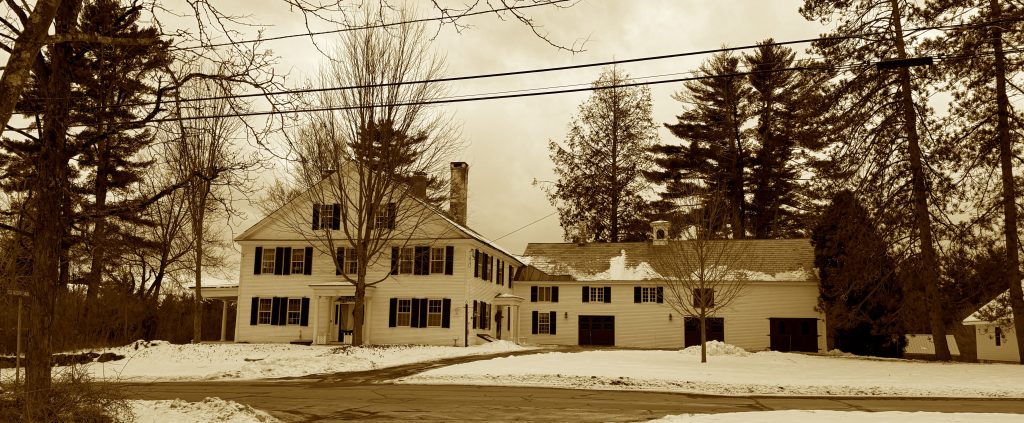
The land was later acquired by Josiah Bellows (1767-1846), “Uncle Si,” youngest son of Col. Benjamin Bellows, the town’s principal early patron. Around 1788, Josiah built the present house, expanding it over time to accommodate his growing family. He first married Rebecca Sparhawk (1768-1792); after her death, in 1793 he married her sister Mary Sparhawk (1773-1869). Together, the two sisters bore eleven children, and in a memorable family event, three of those children were married on the same day.
The interior retains notable early decorative features, including original stenciling in the front hall and a parlor adorned with a rare panoramic wallpaper made by Manufacture Papiers Peints Zuber et Cie of Rixheim, France, called Eldorado, created in 1848. This imported French scenic paper (hand-printed from carved woodblocks) was a luxury item in its day, and its imaginative landscape of lush foliage, distant mountains, and romantic ruins adds a layer of artistic distinction to the house. Surviving original Zuber panoramas are uncommon, though the original wood blocks survive and Zuber’s nineteenth-century panoramic wallpapers are still produced at great expense. Its presence here reflects both the refinement and the aspirations of the home’s mid-nineteenth-century occupants.
A substantial ell, added later in the nineteenth-century, provided space for carriage storage, housekeeper’s quarters, and a summer kitchen, reflecting both the scale of the household and the functional needs of a prosperous family homestead.
Josiah Bellows’ life ended abruptly in an accident. While driving a wagon on the Keene road a short distance south of the village, he met an oncoming stagecoach and turning too sharply, fell from his wagon and sustained a fatal head injury. He died two days later.
The house stands as a layered testament to Walpole’s early municipal history, the Bellows family legacy, and more than two centuries of architectural evolution.

