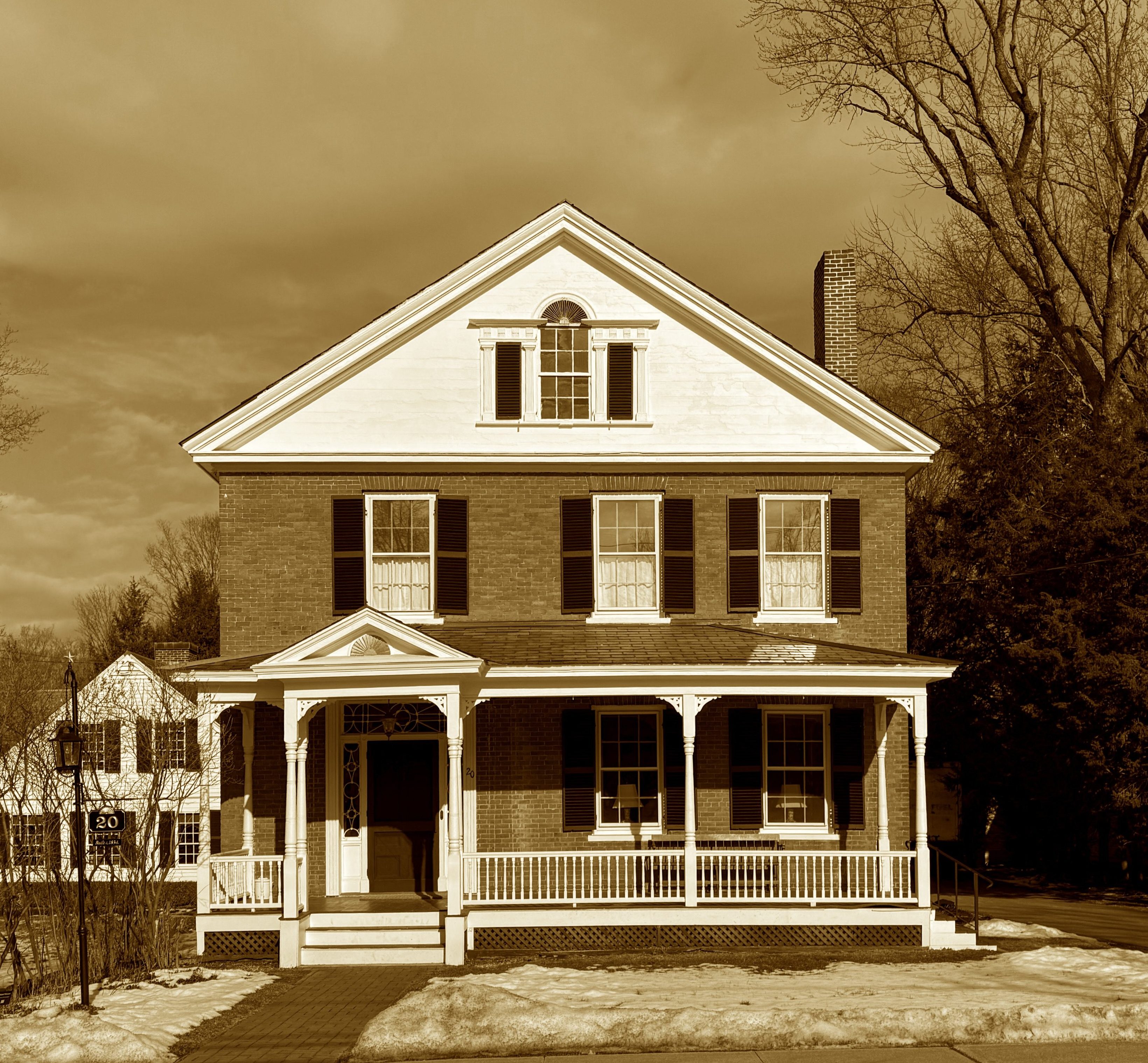

43 Westminster Street is on the National Register of Historic Places, and is a distinguished example of Federal-style architecture in Walpole. The house was built circa 1808 for Francis Gardner (1771-1835), a lawyer and state legislator, and later became the home of Stephen Rowe Bradley (1754–1830), a Vermont lawyer, judge and politician. Bradley was a United States senator from Vermont, serving 1791–1795 and 1801–1813.
Bradley played a key role in Vermont’s entry into the United States as the fourteenth state in 1791, representing the independent Vermont Republic in negotiations over its boundaries. He resided at this house from 1817 to 1830, during which time it served as both a family home and a center of legal and political activity.
The large 2½-story frame house features a hip roof, two interior brick chimneys, and a white clapboard exterior. Its well-proportioned Federal-style details reflect the architectural ideals of the early republic, emphasizing symmetry, restraint, and elegance. The house remained prominent in Walpole’s civic life through the nineteenth-century: in the late 1800s, it was owned by the New Hampshire Asylum for the Insane, before returning to private hands in 1913 when acquired by Henry K. Willard of the extended Bradley family.
The Stephen Rowe Bradley House remains a striking example of early nineteenth-century architecture and a tangible link to both Vermont and New Hampshire history, commemorating the life of a man central to the formation of the United States’ northeastern boundaries.

