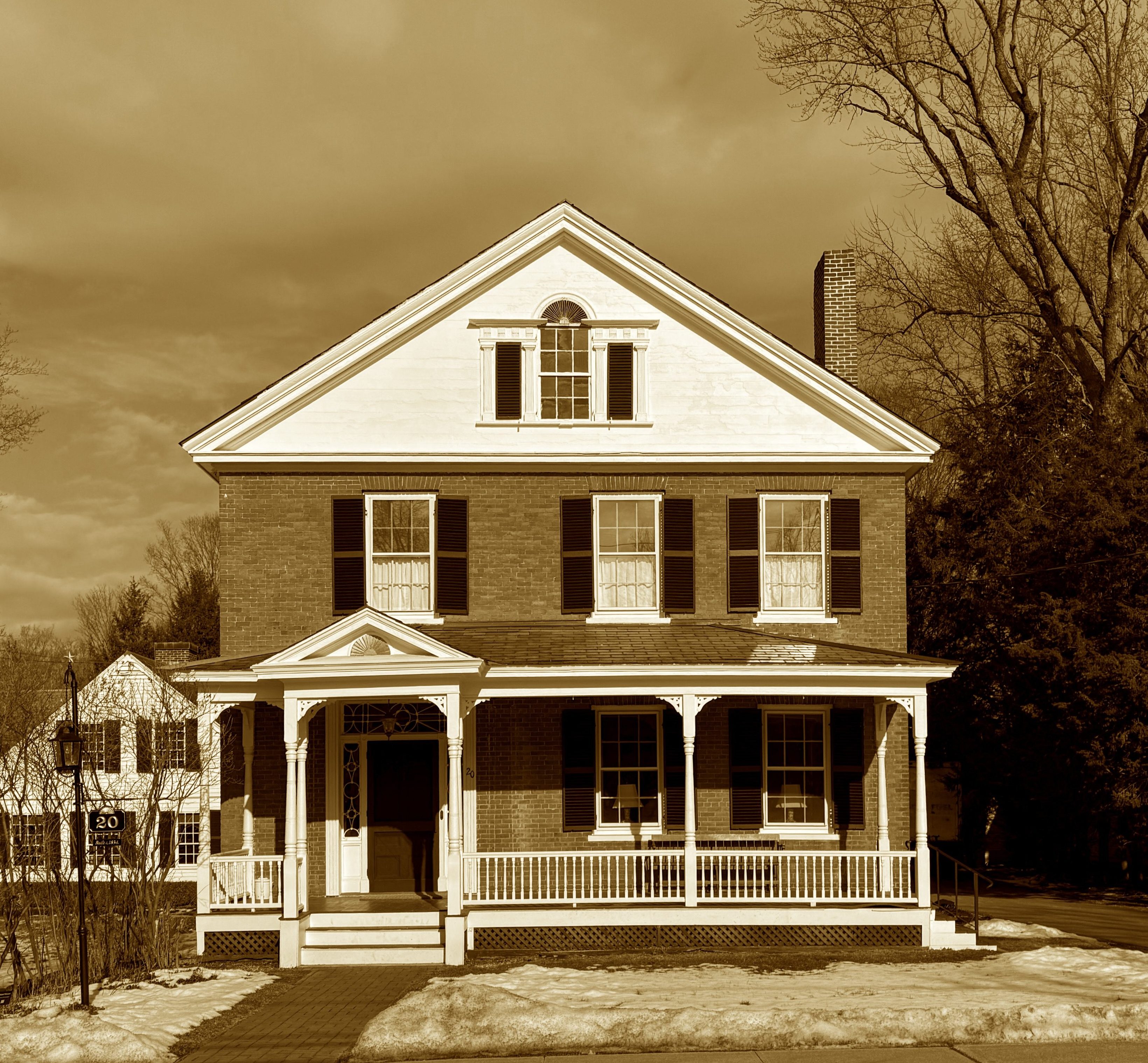
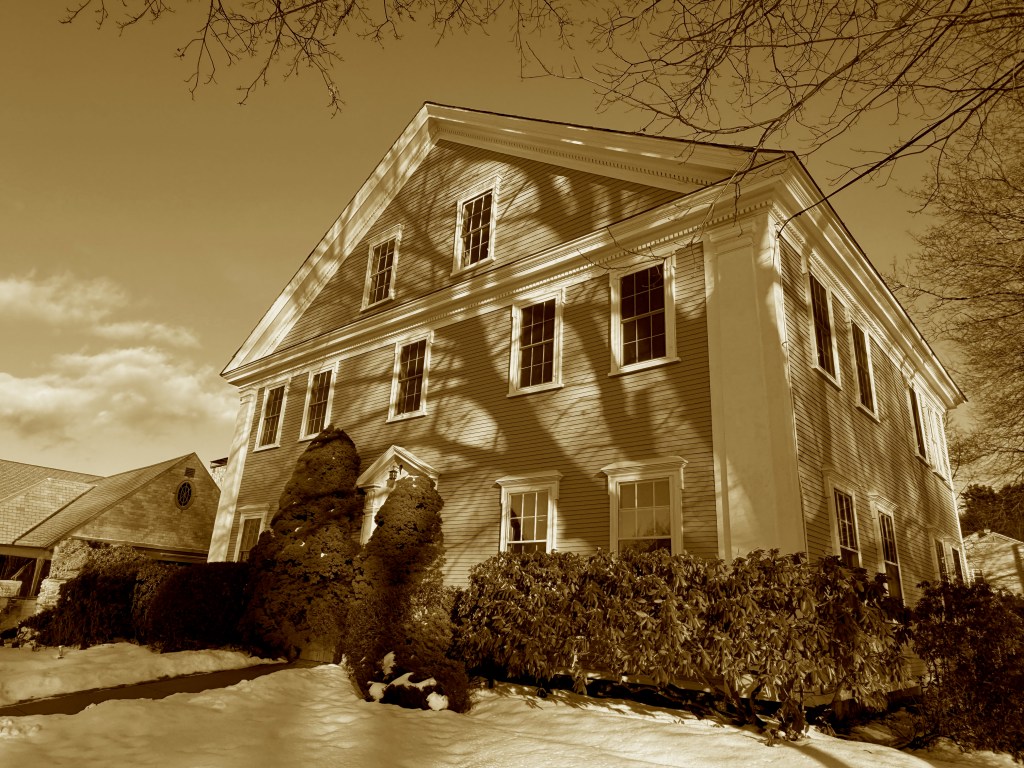
Built around 1791 by General Benjamin Bellows (1740-1802) (eldest son of Col. Benjamin Bellows), the Bellows–Grant House is one of the village’s most substantial late-Georgian residences. Bellows constructed the house as a wedding gift for his daughter Phebe Bellows (1770–1847) upon her marriage to Samuel Grant (1765–1845), a saddler in Walpole who inherited substantial land holdings on the death of General Bellows, who began farming on a massive scale and became interested in raising sheep (at one time possessing a flock of one thousand). He was prominent in town affairs, and was one of the founders of the Walpole Academy in 1831. Their home reflected both the status of the Bellows family and the aspirations of the young couple, becoming one of the architectural anchors of early Main Street.
The house is a grand transitional Georgian/Federal structure, retaining conservative Georgian massing while incorporating details that anticipate the more delicate Federal style. Notable exterior features include full corner pilasters that formalize the façade, a dentilled cornice and frieze, emphasizing the roofline, molded window surrounds and window caps, characteristic of refined late-eighteenth-century craftsmanship, a symmetrically composed façade with a central entry, and seven fireplaces, a mark of both wealth and domestic comfort in the period.
In 1846, the property was purchased by Benjamin Willis Jr., (1791–1870) a Boston-based businessman whose acquisition reflects the increasing reach of Walpole’s village as an attractive location for urban professionals and investors. Willis updated the house with Greek revival details, reflecting the mid-nineteenth-century taste for cleaner lines and more monumental ornamentation. In 1859, John Jennison (1807-1880) acquired the house. Members of the Jennison family occupied 42 Main Street for more than a century, making it one of the long-standing family residences in the village.
The Bellows–Grant House stands as an important document of Walpole’s architectural evolution, from its Georgian roots through its nineteenth-century classic revival updates. It stands as a reminder of the prominent families who shaped the early civic and commercial life of the town.

