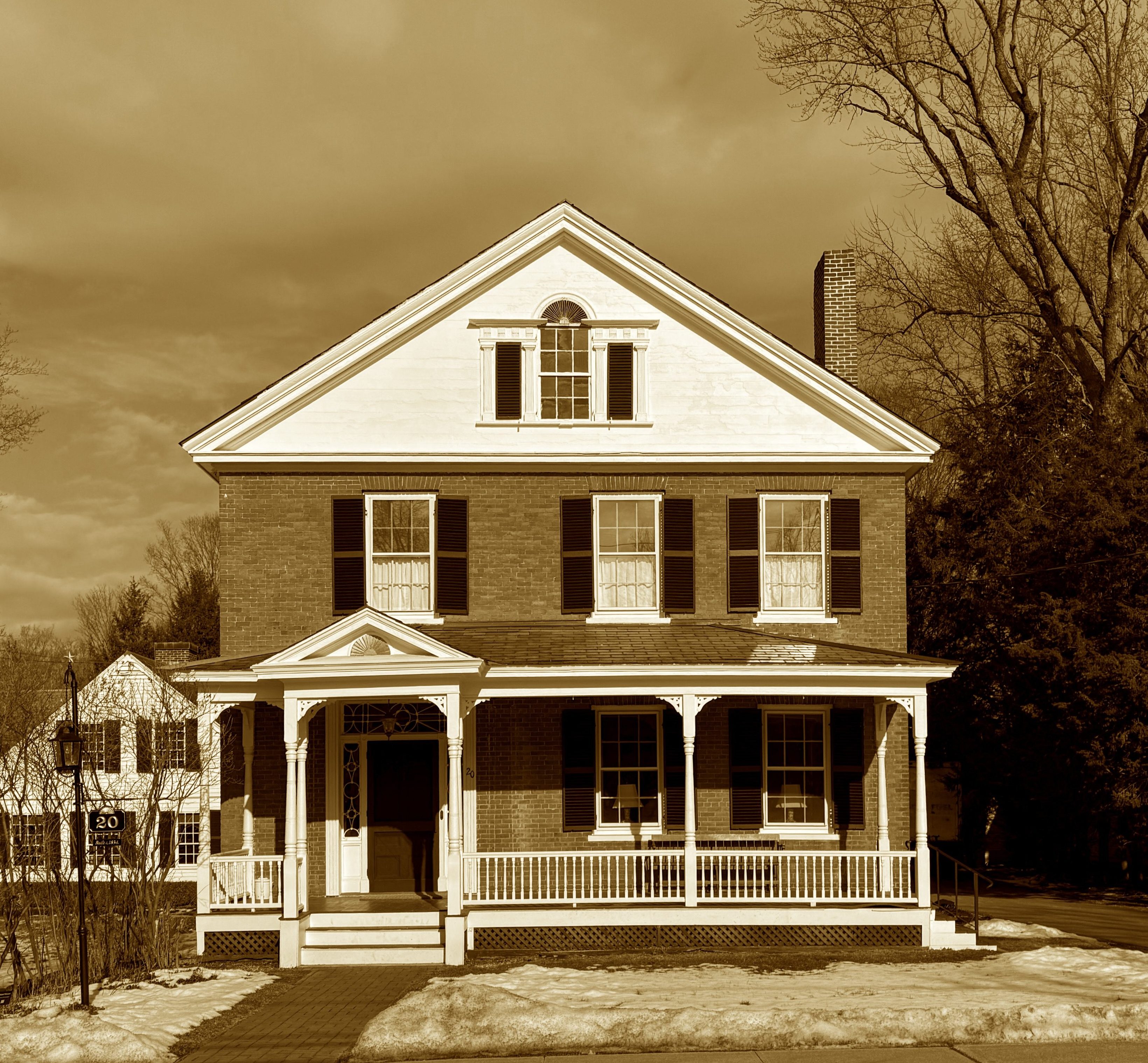

Built around 1833, this house stood on land owned at the time by John Bellows (1768–1840), who also owned the adjoining property at 48 Westminster Street (see that entry below for more on Bellows). While the architect or builder is not known, the house’s original form likely reflected the transitional Federal-to–Greek Revival idiom common in Walpole during the 1830s, characterized by straightforward massing and restrained detailing.
Bellows’ widow, Anna Hurd Langdon Bellows (1781–1860), sold the property in 1854, and in the decades that followed the house was significantly altered by later owners. The most dramatic change was the addition of a full third floor, which reshaped the original roofline and expanded the interior living space. Other updates over the nineteenth and early twentieth centuries further evolved the structure from a modest early residence into a more flexible, multi-use house.
In 1907, a subsequent owner, Mary Holland (1858–1937), established the property as The Holland House, a small lodging house that quickly became a favored stopping place for visitors arriving to open or preparing to close their summer homes in and around Walpole. Its position on Westminster Street, close to the village center yet slightly removed from Main Street, made it an inviting and convenient waypoint.
Following its period as a guest house, the building continued to adapt to changing needs and has since been converted into apartments. Even so, the house retains elements of its layered history: an 1830s core, substantial nineteenth- and twentieth-century alterations, and its brief but memorable early-twentieth-century life as one of Walpole’s modest seasonal lodgings.

