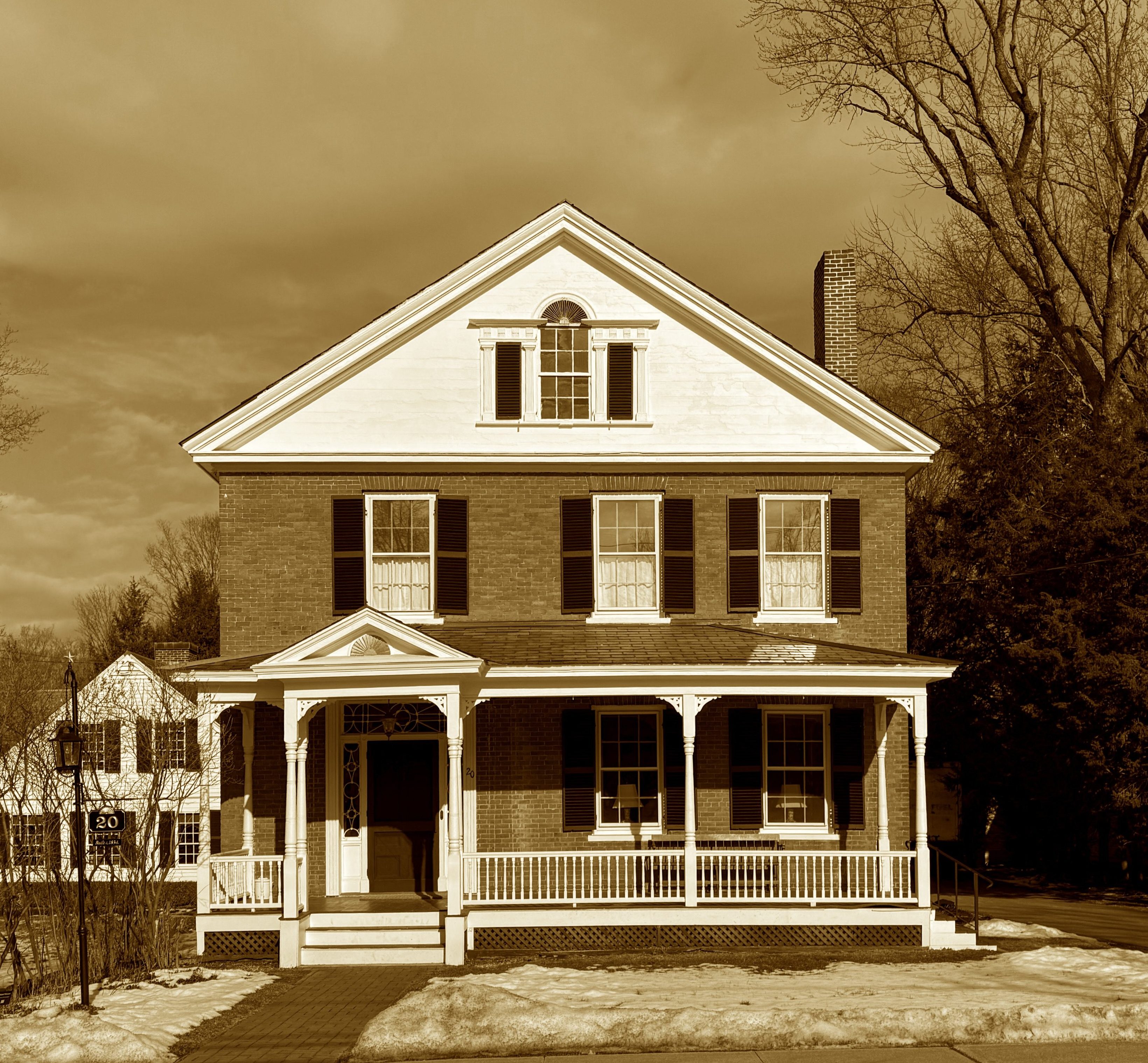
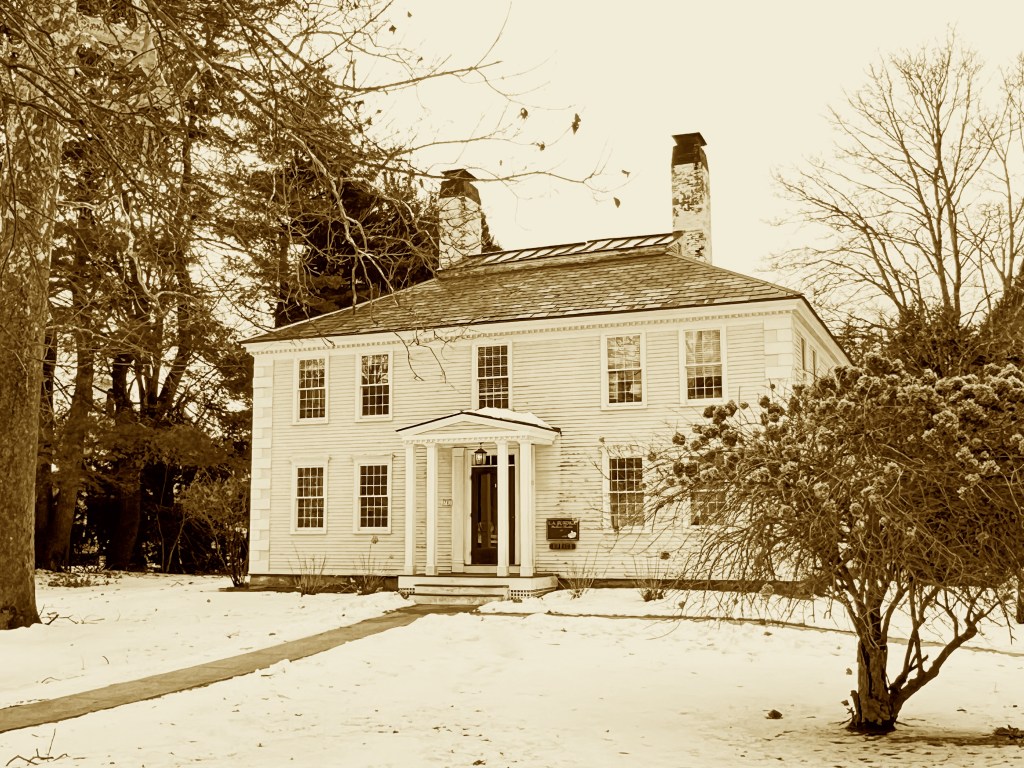
Standing prominently on Main Street, the Amasa Allen House (also known as the Tatem-Peck House) is one of Walpole’s finest surviving examples of late-Georgian domestic architecture. Although built in 1792 (quite late in the Georgian period), its features reflect stylistic traditions more characteristic of pre-Revolutionary New England. In rural towns like Walpole, such conservative architectural preferences often persisted well after they had faded in urban centers.
The house exhibits several hallmark Georgian characteristics:
- A low hip roof, creating a balanced, cubic form.
- Corner quoining, a feature typically found on more formal urban houses.
- A symmetrical five-bay façade centered on a refined entrance surround.
- A traditional two-story central-hall interior plan, designed around two massive central chimneys.
- Four fireplaces on each floor, illustrating both prosperity and the heating needs of an eighteenth-century northern home.
- Notable interior sliding window shutters, a high-quality detail that was uncommon in Walpole at the time.
The house was built by General Amasa Allen (1751-1821), a soldier of the Revolution who came to Walpole from Pomfret, Connecticut. By the time he erected the home in 1792, Allen had become a prominent figure in the community. His standing is reflected in the fact that, when pews were sold to finance the construction of the new meetinghouse on Prospect Hill, only Col. Benjamin Bellows purchased more pews than Allen—a clear indicator of both wealth and status.
Allen lived in this house until his death in 1821, and during that time he participated actively in the civic life of the town, including local militia affairs, land transactions, and early town governance.
In 1947 the house was purchased by Dr. William H. Tatem (1912-2001), one of Walpole’s respected physicians. His ownership gave rise to the alternative name “Tatem House.” Later, the Peck family, another well-established local family, occupied the residence, leading to the blended name “Tatem-Peck House” sometimes used today.
These successive owners illustrate the home’s continuity as a residence for influential townspeople whose professional and civic contributions shaped Walpole during the nineteenth- and twentieth-centuries.

The Amasa Allen House has a highly visible role in town life as the headquarters of L.A. Burdick Chocolates, the internationally known artisan chocolatier founded by Larry and Paula Burdick. The company’s presence, along with the nearby Burdick’s Café and the Walpole Grocery, has had a significant impact on Walpole’s contemporary cultural and economic identity. Its careful stewardship of the historic house has also ensured that this landmark remains one of the best-preserved Georgian structures in the village.

