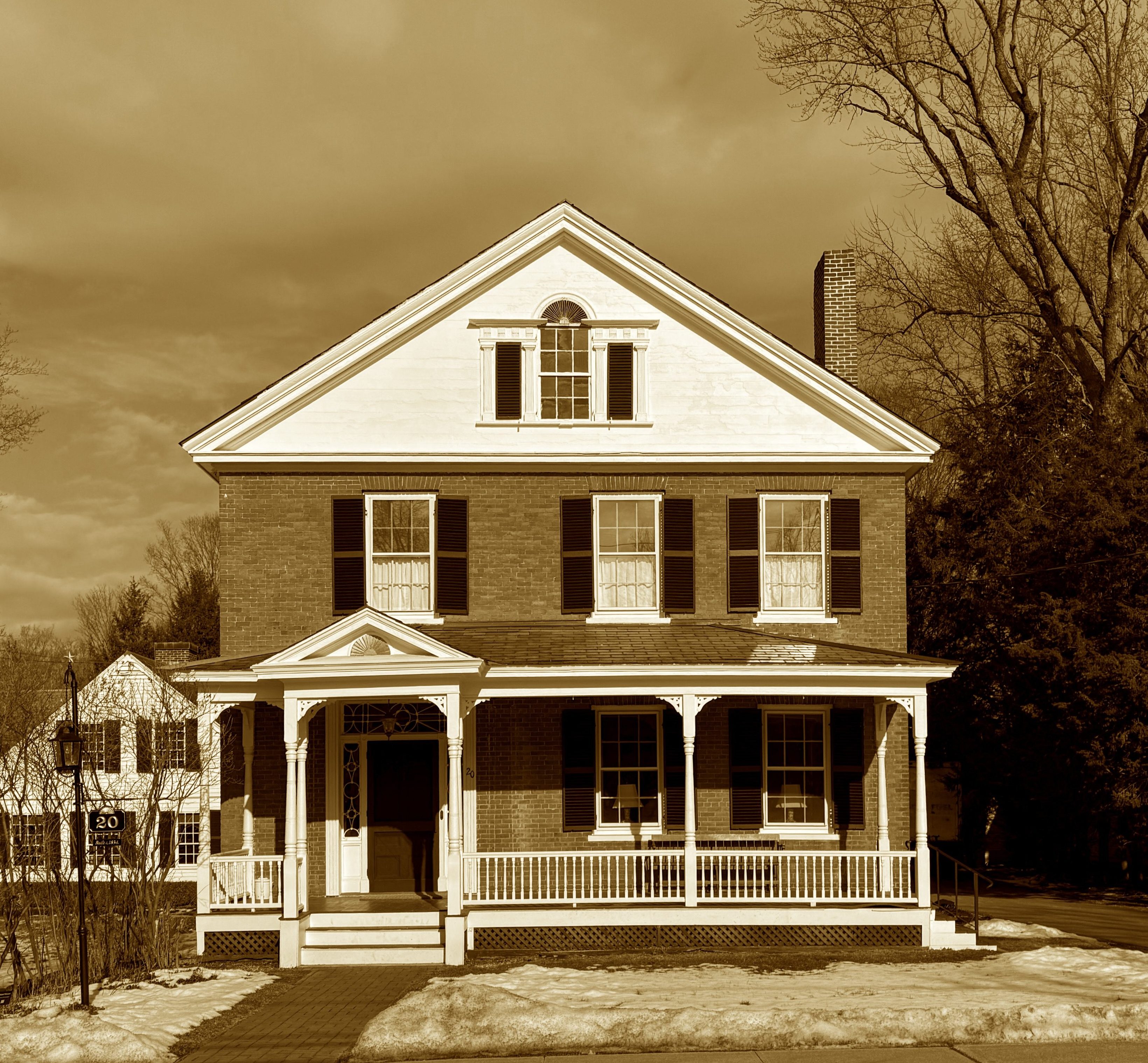
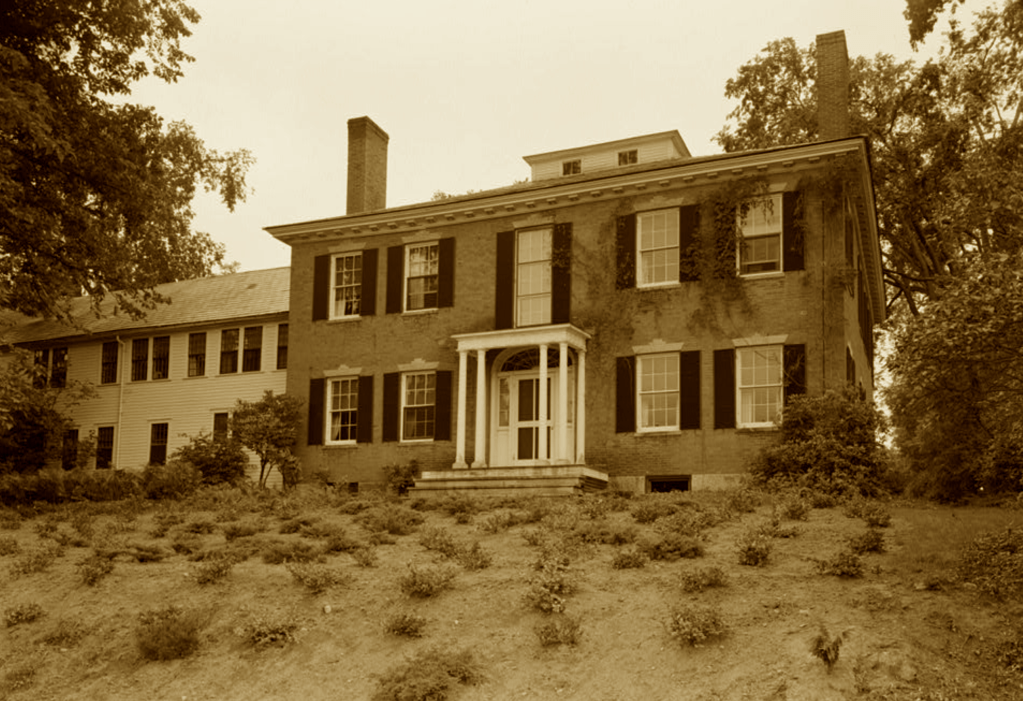
As you leave Walpole’s village center and begin the climb up Wentworth Road from Main Street, near its junction with Prospect Hill Road and Old Keene Road, the first property on the left, partially hidden by trees even in winter is the Knapp House. Built in 1812, this striking brick residence marks both a physical and symbolic shift away from the public-facing confidence of the Greek Revival village and toward the more private, refined domestic ideals of the early American republic.
Constructed during a period of early nineteenth-century prosperity, the Knapp House reflects cosmopolitan taste and architectural sophistication rarely seen in rural New England at the time. Its refined proportions, restrained ornamentation, and careful relationship to its landscape express an inward-looking elegance that contrasted with earlier colonial building traditions.
The house was built by Josiah Bellows III (1789–1842), a member of one of Walpole’s prominent families. An inscription carved into the sill of a first-floor window on the north side—BUILT MDCCCXII—confirms its construction date. In 1820, Bellows mortgaged the property to a cousin, and in 1824 sold it to his brother-in-law, Jacob Knapp (1773–1868). The Knapp family retained ownership for more than a century, until 1927.
The Knapp House is among Walpole’s finest examples of Federal/Adam-style design and is particularly notable for its brick construction, an uncommon and costly choice in a region where timber framing remained the norm. Brick signaled durability, fire resistance, and social ambition. The house features gracefully curved elliptical steps leading to a modest portico supported by paired slender columns. The entrance is capped not by a typical semicircular fanlight, but by an elliptical transom, a subtle but telling Federal refinement. Inside, the plan reflects evolving ideas about comfort and efficiency: four chimneys placed at the ends of the building replaced the earlier central chimney mass, allowing for improved circulation, light and ventilation.
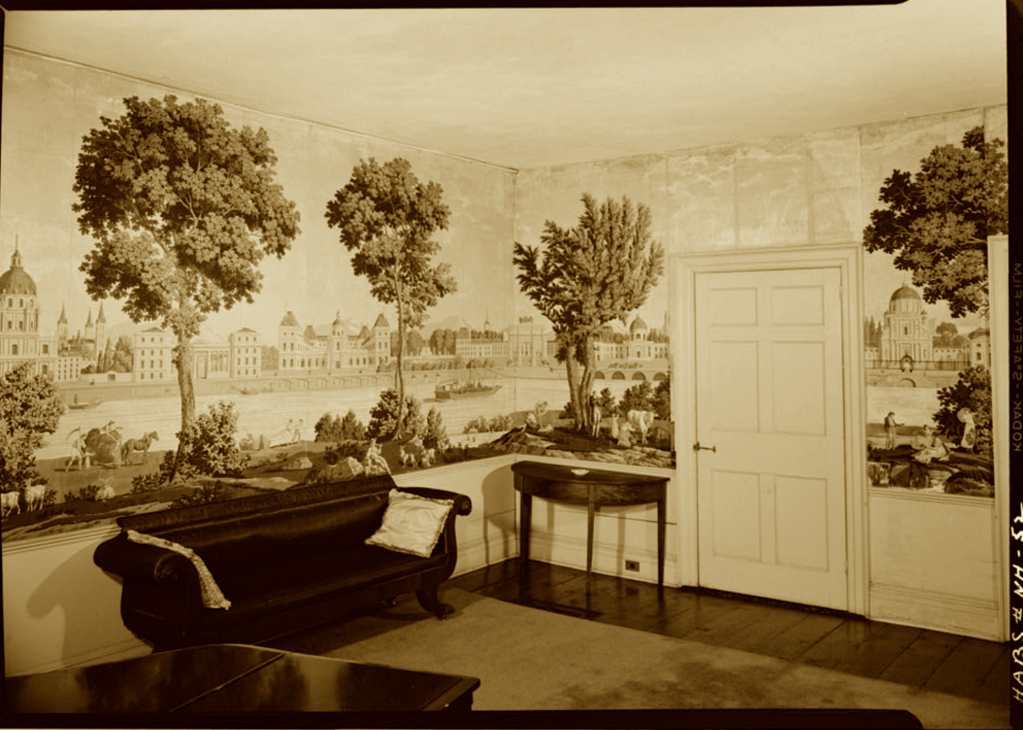
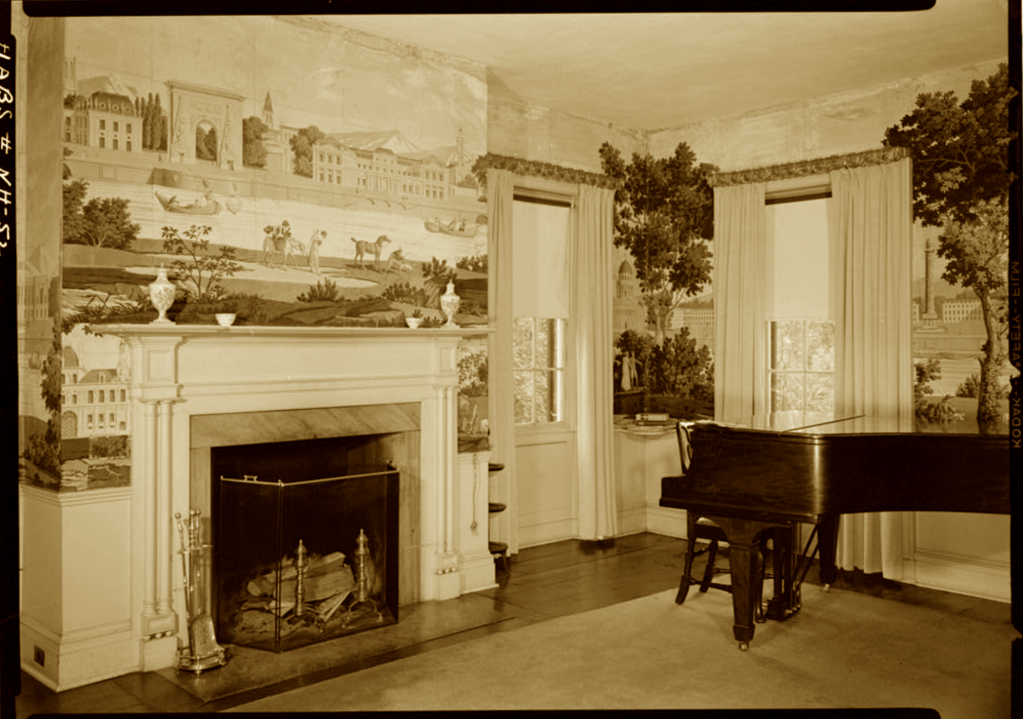
One of the house’s surviving decorative features is its hand-painted French scenic wallpaper, Les Monuments de Paris, produced in 1814 by Joseph Dufour et Cie of Mâcon, France. Dufour wallpapers are particularly prized, because the original wood blocks used in their production have been lost.
Still preserved in one of the parlors, the panoramic panels depict celebrated Parisian landmarks and convey an unmistakable aspiration toward European culture—an unexpected statement of taste in early nineteenth-century rural New Hampshire.
The property is also closely associated with Frederick Newman Knapp (1821–1889), a descendant of the family and one of the nationally significant figures connected to Walpole. Knapp was a prominent Unitarian minister, a committed abolitionist, and a humanitarian organizer of remarkable scope.
He was actively involved with the Boston Vigilance Committee, which aided freedom seekers escaping slavery via the Underground Railroad.

During the Civil War, Knapp served with the United States Sanitary Commission, where his administrative skill and tireless energy helped coordinate relief for Union soldiers on an immense scale. Contemporary accounts credited him with overseeing aid that reached tens of thousands of troops, and his work earned him honorary membership in the Grand Army of the Republic. A tree planted on the grounds in 1855 by Frederick Newman Knapp remains today as a living reminder of the family’s long stewardship and the site’s continuity across generations.
Local tradition also ties the Knapp House to Walpole’s abundant lilacs. According to longstanding lore, the lilac hedge along this stretch of Wentworth Road inspired similar plantings throughout the village and may have influenced Louisa May Alcott’s 1878 children’s novel Under the Lilacs. While no definitive documentary evidence confirms a direct connection, the association has become part of Walpole’s shared cultural memory.
The Knapp House embodies several key themes in Walpole’s history. It represents the architectural transition from colonial and Georgian forms to the refined Federal style of the early republic. Its materials and detailing reflect the aspirations of a prosperous rural elite engaged with broader cultural currents. The Knapp family’s century-long ownership, and the survival of original interiors, landscape features and associated stories link the early nineteenth century to the present, making the Knapp House a vital thread in Walpole’s architectural, social, and moral history.

