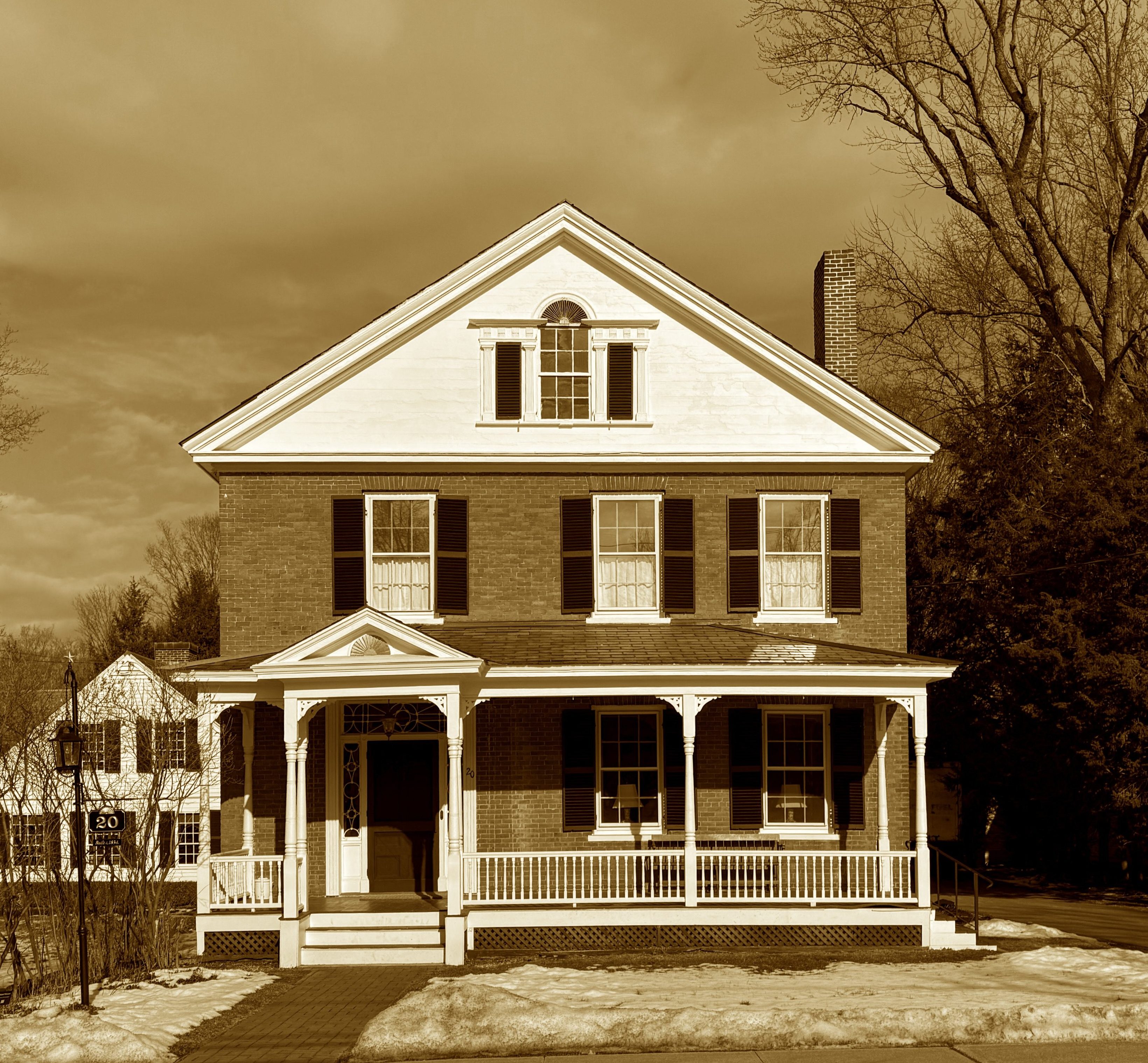

The William Buffum House, located at 25 Main Street, stands as one of Walpole’s finest and most instructive examples of architectural evolution: a building that blends a late-eighteenth-century Georgian core with a striking mid-nineteenth-century Greek Revival transformation. Originally built circa 1785 by Ebenezer Crehore (1764-1819) of Milton, Massachusetts, the house brought to Walpole the hallmarks of late-Georgian design.
About 1797 the house passed to David Carlisle, Jr. (1740-1797) who died in December of that year. Carlisle was a Revolutionary War veteran and publisher of the local newspaper The Farmer’s Weekly Museum.
During the 1830s, under the ownership of merchant William Buffum (1793-1841), the house underwent extensive remodeling to reflect the new Greek Revival taste then sweeping the nation. The most visually arresting alteration is the full two-story Doric portico on the Main Street façade, complete with well-spaced Doric columns, a full entablature with triglyphs, and a flush-board pediment. In the pediment’s center sits a prominent Palladian window, a feature seen elsewhere in town on houses attributed to master builder Aaron P. Howland.
Under the renovation, the house also gained Greek-Revival–style touches such as the front doorway with sidelights and a transom divided with leaded muntins, first-story windows that are six-over-six with cornices, and larger, double-hung twelve-over-twelve windows on the upper floors.
Yet despite these dramatic changes, much of the original Georgian structure endures. This is especially evident on the north side of the house facing Middle Street, which still displays the original five-bay layout, central-hall plan, traditional Georgian door and window framing, and corner quoins at the west end.
Inside, the floorplan reflects both eras: the front door now opens into a central hallway (reconfigured to align with the new Main Street entrance), but original features remain, including folding shutters (inside the windows) and in some cases the earlier wood framing. The attic’s old timbers are oak, in contrast to the later chestnut used for the Greek Revival-era additions, a subtle but telling fingerprint of the building’s layered history. The current owner substantially changed the interior and exterior, starting a new chapter in the building’s history.
Thus the William Buffum House does more than decorate Main Street: it tells a story. Its Georgian core reflects the craftsmanship and sensibilities of New England’s early post-colonial period. Its Greek Revival transformation speaks to the aspirations of a rising merchant class keen to signal status and modernity, and its continued survival, with details from both eras intact, makes it a living chronicle of Walpole’s architectural and social evolution. For these reasons, the William Buffum House remains a cornerstone of the village’s historic landscape.

