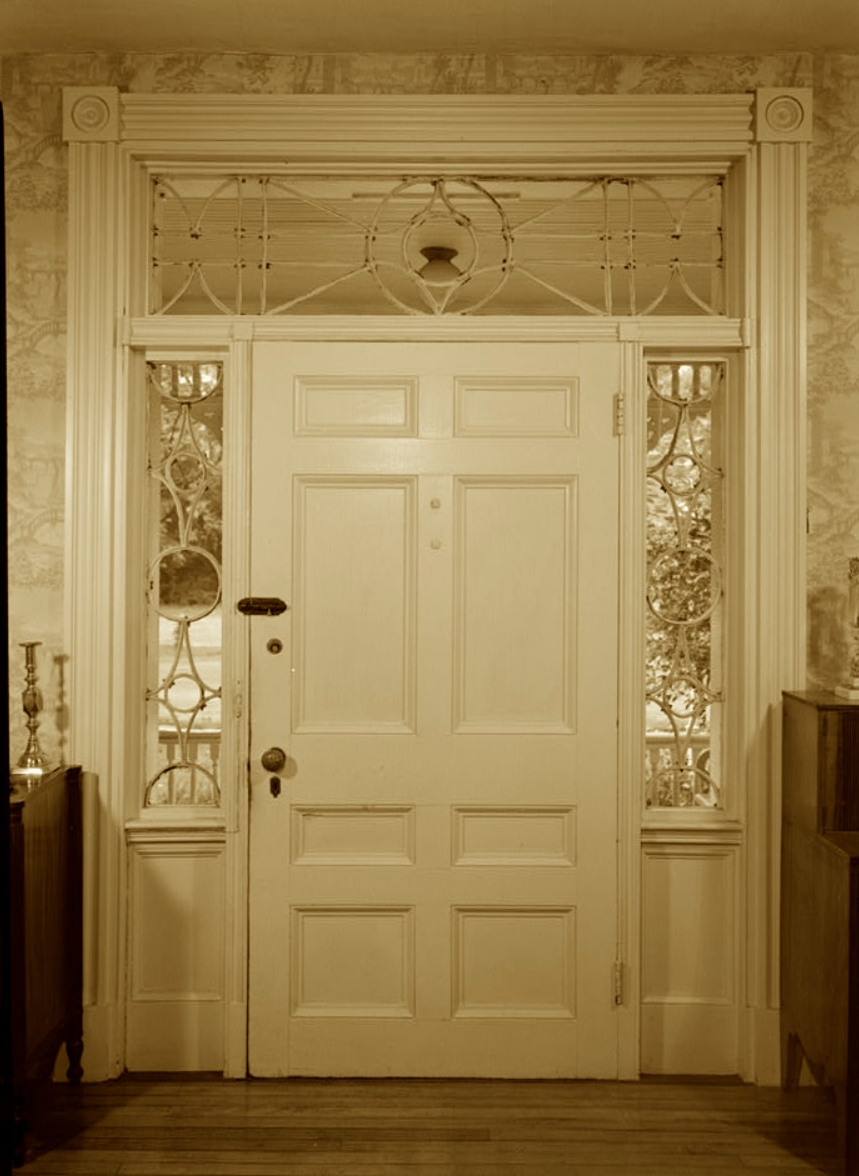
On March 8, 1834, Aaron P. Howland purchased the parcel where he would construct his home from George Huntington, a local tavern owner. Howland built the house that stands on the property today. On August 31, 1844, he sold the property to Anson Dale of Boston, Massachusetts. Following the sale, Howland built another residence nearby at the corner of Elm and Pleasant Streets, incorporating elements of both the Classical and Gothic Revival styles into its design.
Who was George Huntington?
According to George Aldrich in Walpole As It Was and As It Is, containing the Complete Civil History of the Town from 1749 to 1879, George Huntington (1803-1876) was born to impoverished parents, and spent his early years with Josiah Bellows III. Upon reaching adulthood, he had just $75 to his name. Shortly after turning of age, he secured a position as a clerk in the village tavern owned by Nathaniel Holland. As Mr. Holland’s health declined, he was compelled to sell the establishment, which was purchased by Mr. Huntington. On 16 April 1833, Holland sold the three acres containing the tavern to Mr. Huntington, and Huntington sold off the lots along Westminster Street and north of the tavern on Main Street.
In a few years, Huntington managed to pay off the tavern’s debts, and the business thrived, becoming a key stop for stage passengers seeking meals or accommodations. At the time, a meal cost thirty-three cents, which many considered exorbitant.
Alongside Otis Bardwell (a later owner of the property) and Peletiah Armstrong, Huntington controlled all the stage routes in the area and even managed to secure the transportation of mail at favorable rates. In 1837, he leased the tavern to Reuben Brown and shifted his focus entirely to the staging business, continuing in this venture until the arrival of the railroad in 1849-50, and for some time afterward on lateral routes.
In his middle years, Huntington was one of the most distinguished and best-dressed men in town, standing over six feet tall and maintaining a straight posture. His community recognized his leadership qualities, electing him to represent them in the State Legislature and appointing him to various town offices. He served as Sheriff of the County and later became a director of the Cheshire Railroad and a bank in Keene. At one point, his friends even proposed him as a candidate for the National Legislature.
In the years that followed, he amassed considerable wealth, becoming one of the town’s richest residents, and he paid the highest taxes. However, late in life, despite enjoying many comforts and luxuries, he, like many others, ventured heavily into tobacco cultivation. Holding his crops for better prices while also purchasing from others at inflated rates led to significant financial strain. Ultimately, he found himself unable to recover from this predicament, and upon his death, his estate was found to be heavily insolvent.
Mr. Huntington was known for his genial nature, being a kind neighbor and a respected citizen.
Construction Date of the House
Several sources give a construction date of the house as 1833, a date which first appeared in A History of Walpole, New Hampshire, by Martha McDanolds Frizzell (Vermont Printing Co.: Town of Walpole, 1963) (Two Volumes), and adhered to in subsequent publications, including Historic Homes of Cheshire County, New Hampshire, by Marjorie Whalen Smith (Griswold Offset Print: Brattleboro, VT, (Vol. I, 1968; Vol. II, 1971; Vol. III, 1979).
In Frizzell, Volume I, Section II, Homesteads and Land Records, at pp. 120-121, we have this summary of the chain of title:
“In 1833 George Huntington sold this lot to Aaron P. Howland, a skillful carpenter and cabinet-maker who built this brick house and sold it in 1842 to Anson Dale. Otis Bardwell, who had lived in Mabel Cole’s house #27 on North Main Street for 25 years, bought the house in 1844 and moved here with his second wife. In 1886 his heirs sold to Alfred W. Burt; George F. Burt inherited the property, after which it was sold to Jennie M. Spaulding (Mrs. Frank A.) in 1895. Their son Russell S. Spaulding sold in 1938 to Guy Bemis.”
The land records show that the sale from George Huntington to Aaron P. Howland is dated March 8, 1834 and recorded March 10, 1834 (Deed Book 121, page 385), with the following legal description:
“A certain tract of land situate in said Walpole & bounded & described as follows, to wit, Beginning at the south east corner of Mrs. Robeson’s house lot, thence easterly on the road eighty-one feet thence northerly parallel with Mrs. Robeson’s east line to land occupied by Mrs. Lincoln, then on Mrs. Lincoln’s & on Stephen Rice’s lines westerly to Mrs. Robeson’s north east corner thence on Mrs. Robeson’s line to the place of beginning be the same more or less.”
The next conveyance of this lot from Aaron P. Howland and Huldah Howland (joining to release her dower interest) to Anson Dale of Boston, County of Suffolk, Massachusetts, is dated 18 February 1842 and recorded 21 February 1842 (Deed Book 145, page 237), and contains the exact same legal description above, with this addition:
“Also seven undivided twelfth parts of all the right conferred & assured to me, my heirs & assigns, to draw water from the aqueduct of George Huntington’s tavern stand, by said Huntington’s bond to me, bearing date the eighth day of March AD 1834.”
Apparently Mr. Howland acquired rights to draw water from an aqueduct serving George Huntington’s tavern stand the same date as the deed conveying the property to Howland. Subsequent deeds (starting with Bardwell’s heirs to Alfred W. Burt in 1886) include a parenthetical reference that George Huntington’s tavern stand was “now the Dinsmore House”. Reference to this right to draw water from this aqueduct survives in deeds to the present.
The “Tavern Lot” is on the northwest corner of Westminster Street and Main Street, now occupied by the Irving Oil filling station. A filling station has occupied the corner since 1950, when Gulf Oil Corporation leased the property from Bernard P. O’Connor of Rockingham, Vermont, who purchased the property in 1949.
Purchase and Sale of Adjoining Lots
Why did Ms. Frizzell get this date wrong? It may be because she conflated this transaction with another between Huntington and Howland, for George Huntington sold another lot to Aaron P. Howland on 8 November 1833 for $500.00; that deed was recorded 9 November 1833 in Deed Book 120, page 537. This is the parcel adjoining 20 Westminster Street to the east, and including the current commercial buildings to the east towards Main street.
“A certain piece of land, situate in the village of said Walpole bounded and described as follows, to wit: Beginning on the north side of the road leading from the main street to Walpole Village Bridge at a point eighty-one feet easterly from the southeast corner of Mrs. Robeson’s house lot; thence running northerly parallel with Mrs. Robeson’s east line to land now occupied by Mrs. Lincoln; thence on Mrs. Lincoln’s south line easterly eighty-one feet; thence on a line parallel with Mrs. Robeson’s east line to a point forty-five feet distant from the north side of said road; thence on a line parallel with the north side of said road one hundred & fourteen & a half feet; thence on a line parallel with Mrs. Robinson’s east line forty five feet to the north side of said road; thence on the north side of said road one hundred & ninety-five & a half feet to the place of beginning, be the same more or less — Also a right of carriage way eighteen feet in width on said Huntington’s land adjoining the easterly part of said granted premises, Beginning at said road & thence running northerly along the east end of said granted premises, being forty-five feet & thence westerly along the north side of the easterly part of said granted premises being one hundred & fourteen & a half feet to the east line of the westerly part of said granted premises.”
Curiously, the same day Howland purchased his house lot from Huntington, he re-conveyed part of the 1833 purchase to Huntington for $300.00, reserving the eastern part of the lot fronting on Westminster Street. This transaction is recorded in Deed Book 119, page 459, dated 8 March 1834, recorded 10 March 1834:
“Know all men by these presents that I, Aaron P. Howland of Walpole in the County of Cheshire & State of New Hampshire for & in consideration of the same of three hundred dollars to me paid by George Huntington of said Walpole, the receipt whereof I do hereby acknowledge, have remised, released & forever quitclaimed & do by these presents remiss, release & forever quitclaim unto the said Huntington his heirs & assigns forever.”
“A certain tract of land situate in the Village in said Walpole & bounded & described as follows, to wit: Beginning at a point on the north side of the road leading from the main street to Walpole Village Bridge eighty-one feet easterly from the south east corner of Mrs. Robeson’s house lot, thence running northerly parallel with Mr.s Robeson’s east line to land now occupied by Mrs. Lincoln, thence on Mrs. Lincoln’s south line easterly eighty-one feet, thence on a lie parallel with Mrs. Robeson’s east line southerly to a point forty-five feet distant from said road, thence easterly parallel with said road six feet thence parallel with Mrs. Robeson’s east line forty-five feet to said road, thence on said road eighty-seven feet to the place of beginning, be the same more or less. Reserving a right of carriage way from said road on the west did of said last named line twelve feet in width & extending northerly sixty three feet. To have & to hold the same together with all the privileges & appurtenances thereunto belonging to him the said Huntington his heirs & assigns forever. And I hereby engage to warrant & defend the same against all claims arising by, form or under me.”
Huntington subsequently conveyed the lots adjoining Howland to Jonathan Weymouth, a tailor.
Deed from George Huntington to Jonathan Weymouth, recorded Deed Book 121, page 558, dated 14 April 1834, recorded 15 April 1834:
“A certain tract of land situate in said Walpole & bounded and described as follows, to wit: Beginning at the southwest corner of land of Aaron P. Howland thence running north 22 degrees east nine rods & four links to a stake and stones thence north 73 degrees west four rods and 22 links to a stake and stones thence south 22 degrees west nine rods one and a half links to a stake and stones on the road then south 72 degrees east four rods & twenty-two & a half links on said road to the place of beginning, be the same more or less. Reserving a right of carriage way six feet in width from the north side of said road on the east line of said premises for the distance of fifty-three feet & also reserving so long as I shall occupy my present tavern stand a right of carriage way seven feet in width from the north end of the aforesaid way to the north line of said premises.”
George Huntington conveyed an additional parcel to Weymouth, completing the parcel at 16 Westminster Street as it exists today.
Deed from George Huntington to Jonathan Weymouth, recorded Deed Book 126, page 445, dated 22 April 1835, recorded 28 April 1835:
“A certain tract or parcel of land situate in said Walpole and bounded and described as follows: to wit, beginning at the northwest corner of said Weymouth’s house lot in Walpole village; thence running north 18 degrees east six rods & four & a half links on Aaron P. Howland’s land to Mrs. Lincoln’s land; thence south 83 1/4 degrees east four rods and nine links on Mrs. Lincoln’s to a stake and stones, thence south 18 degrees six rods and twenty-three links to said Weymouth’s land; thence north 74 degrees west four rods and six links on said Weymouth’s land to the place of beginning; containing twenty-six and a half rods be the same more or less.”
This is now 16 Westminster Street. This property became known as The Griswold Place for Henry Griswold, s later owner who purchased it in 1874.
The westernmost part of the remainder of the lot that Howland had retained was conveyed to Susan Jones in 1835. That transaction is recorded in Deed Book 126, page 250, dated 16 June 1835, recorded 22 June 1835. This is now 14 Westminster Street:
“A certain tract or parcel of land with the building thereon situate in the village in said Walpole & bounded and described as follows, to wit, beginning on the north side of the street leading by said Howland’s House at the south east corner of the passageway reserved between said Howland’s Tin Shop lot & Jonathan Weymouth’s house lot, thence running east on said street nineteen feet, thence northerly parallel with said passageway forty-five feet, thence westerly parallel with said street nineteen feet; thence southerly on said passageway to the place of beginning, be the same more or less.”
In 1842, Howland conveyed the remainder of his Westminster Street property to William G. Sherman and Amherst K. Maynard, recorded in Deed Book 145, page 629, dated 13 April 1842, recorded 2 May 1842.. He had already conveyed his house lot to Anson Dale; hence the reference to Mr. Dale’s land in the legal description.
“A certain tract of land situate in the Village of said Walpole & bounded & described as follows, to wit, Beginning on the road to the the Walpole Village Bridge at the South East corner of Mrs. Susan Jones’ lot, thence northerly on Mrs. Jone’s east line forty-five feet to George Huntington’s line, thence Easterly on said Huntington’s line & parallel with the North line of said road to the corner, thence southerly on said Huntington’s line parallel with Mrs. Susan Robeson’s east line to the road at a point distant 195 1/2 feet from Anson Dale’s South East corner, thence westerly on the North line of said road to the place of beginning, being all that part of the tract conveyed to me by said Huntington’s deed. Recorded in Liber 120 Folio 537 which lies East of the East line of Mrs. Susan Jones’s lot. Together with a right of carriage way eighteen feet in width adjoining said tract in its East & North sides as conveyed to me by said Huntington’s deed aforesaid.” This is now 10 Westminster Street.
It’s unlikely that Mr. Howland would have built the house at 20 Westminster Street prior to acquiring title to the land, and further, likely would not have built the house without access to potable water. Given these two data points, a construction date of circa 1834 makes the most sense, assuming he was able to complete construction before the end of that year.
Biography of Aaron P. Howland
Aaron Prentiss Howland (1801-1867) is a direct descendant of John Howland (1593-1673) and Elizabeth Tilley (1607-1687), who came over in the Mayflower and landed at Plymouth in 1620. John Howland’s name is the thirteenth on the compact signed on board the vessel, at which time he was 28 years old. John Howland was Lieutenant in Miles Standish’s troops. He married Elizabeth Tilley, daughter of John Tilley who with his wife Joan (Hurst) Roger had lived in Henlow, Bedfordshire, England. John, Joan and Elizabeth were on the first voyage, but Elizabeth was the only member of the family to survive the first winter. Thereafter she lived in the household of Governor John Carver, leading to the erroneous conclusion that Elizabeth was a daughter of John Carver (this error was later corrected in the historical record) .
One of John Howland’s great-great-grandchildren, another John Howland, was born 13 February 1720, graduated Harvard College in 1741, and was ordained 24 September 1746 a minister of the second church in Carver, Massachusetts. He remained a minister there for fifty-eight years, until his death on 17 November 1804.
From an obituary of John Howland, we can infer that he was a man of great force of character, distinguished for learning and piety, and well known throughout Massachusetts. He left a family of eleven children: six sons and five daughters, two of whom, James and Charles, came to Walpole between 1790 and 1800, the former on a farm owned by William W. Guild, and had two sons : James, born 9 February 1799, who died unmarried, and John, born 19 December 1795, who married Sophia Snow, and moved to Woodstock, Vermont, and had a large family. John, Snr. was a soldier in the Revolutionary war and was at the surrender of Burgoyne’s army.
George Aldrich’s Walpole As It Was and As It Is, containing the Complete Civil History of the Town from 1749 to 1879 gives an acount of Howland’s family.
“Rev. John Howland’s salary was inadequate to support and educate so large a family, hence they had to learn trades or become farmers. Charles Howland, the father of Aaron P., was an ingenious mechanic, a cabinet-maker by trade; and settled in the Valley, where he lived, and died Nov. 28, 1826, aged 62, soon after the majority of his son Aaron P. He married Elizabeth Crease, of Boston, by whom he had one or two children that died in infancy, and Aaron Prentiss, who was born in 1801. His wife, Elizabeth, died May 28, 1830, aged 67.”
“Aaron P. married Huldah Burke of Westminster, Vt., whose mother was a cousin of Silas Wright, of New York, and who is a second cousin of Hon. Edmund Burke of Newport, N. H. Mr. Howland was early in life thrown upon his own resources for a livelihood, and learned the trade of a carpenter, to which he applied himself with diligence, never letting an opportunity slip where he could turn his labor or a penny to his advantage. Possessed of more than ordinary natural abilities, he early commenced doing business by contract, rather than laboring by the day for others. In his multifarious undertakings his sound judgment was seldom at fault. He exercised for many years a marked influence in the affairs of the town, and was entrusted with much of its business. One peculiar trait in his character was that he would work for others with as much diligence as he would for himself. He represented the town in the General Court in 1853-4 ; and was United States District Assistant Assessor during and after the war till his death, which occurred July 9, 1867.”
“Mr. Howland’s education was limited, it being only what was obtained at our common schools, in the rural districts, seventy years ago; a matter which he keenly felt during life, and which prompted him to give his children a good education, which was a matter of concern to him paramount to all others during their nonage. With the Puritan religious views of his ancestors, he was a firm pillar of support to the Congregational church and society in town. Under different circumstances, with his native comprehensive ability, he might have achieved a name and fortune with the more highly favored of the land. But as it was, with his practical mind, by industry and economy, he left at his death a handsome property. “
“Ch. 1st. Elizabeth, d. June 10, 1832, aged 4 years. 2d. Charles P., d. Oct. 5, 1832, aged 1 year and 11 mo. 3d. Fred L, d. June 30, 1836, aged 3 years. 4th. Henry E., b. June 30, 1845; graduated at Yale College, July 26, 1854, and studied the profession of law: m. Louise Miller, of N. Y. city, Oct. 5, 1865, and is now doing a prosperous business at 49 Nassau St., New York, under the firm name of Anderson & Howland. 5th. Alfred C, b. Feb. 12, 1838 ; m. Clara Ward, of N. Y. city, Jan. 26, 1871. He is a landscape painter; his headquarters are New York city. He received his professional instructions in various schools on the continent of Europe, during the American Rebellion. 6th. Katherine H. W., b. Jan. 29, 1841; m. Josiah Grahm Bellows, Esq.”
Aaron P. Howland and his wife Huldah are interred at the Walpole Village Cemetery, as are all former owners (as of 1998) of the Aaron Howland House. Correspondence between Aaron Howland, his wife Huldah and their children are among the Charles Prentice Howland family papers at Yale University.
Sources
George Aldrich, Walpole As It Was and As It Is, containing the Complete Civil History of the Town from 1749 to 1879 (Claremont, NH: The Claremont Manufacturing Co., 1880), pp. 287-289; pp. 291-293.
Martha McDanolds Frizzell, A History of Walpole, New Hampshire (Two Vol.) (Vermont Printing Co.: Town of Walpole, 1963), pp. 120-121..
Marjorie Whelen Smith, Historic Homes of Cheshire County, New Hampshire (Griswold Offset Print: Brattleboro, VT, Vol. I, 1968; Vol. II, 1971; Vol. III, 1979).
Cheshire Co. NH Deed Book 118, p. 531 (Holland to Huntington).
Cheshire Co. NH Deed Book 119, p. 459 (Howland to Huntington).
Cheshire Co. NH Deed Book 121, p. 385 (Huntington to Howland).
Cheshire Co. NH Deed Book 120, p. 537 (Huntington to Howland).
Cheshire Co. NH Deed Book 126, p. 250 (Howland to Jones),
Cheshire Co. NH Deed Book 126, p. 445 (Howland to Weymouth).
Cheshire Co. NH Deed Book 145, p. 237 (Howland to Dale).
Cheshire Co. NH Deed Book 145, p. 629 (Howland to Sherman & Maynard).
The Pilgrim John Howland Society
Photograph Credit: Library of Congress, Historic American Buildings Survey (1959).
 Aaron Howland House