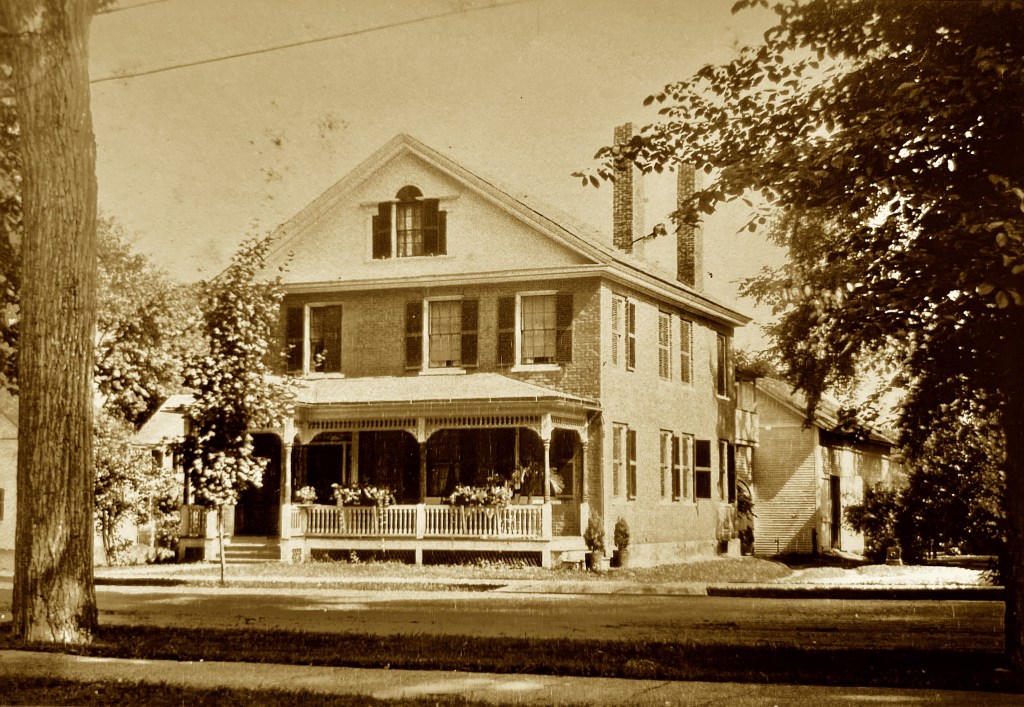
On 30 April 1938, Russell S. Spaulding, then living in Holden, Massachusetts, was joined by his wife Grace F. Spaulding to convey the property to Guy H. Bemis. On 4 January 1962, Mr. Bemis executed a deed conveying the property to himself and his wife, Marion K. Bemis, as tenants by the entirety, then on 16 September 1970, the two conveyed the property to Mrs. Bemis as sole owner. Marion died in 1991, and Guy followed her in 1998. Their daughter sold the property to the next owneers in 1998. The Bemis family owned the property for 60 years, longer than any other.
Guy H. Bemis (1900-1996) was known locally as “Mr. Walpole” for his devotion to the town and his commitment to the preservation and celebration of the place. A lifelong resident of Walpole, known for his deep commitment to the community and his contributions to local agriculture and civic life. Born in 1900, Guy grew up in a small-town environment that valued hard work, close family ties, and a strong sense of community. He carried these values throughout his life, becoming an integral figure in Walpole’s agricultural and social circles.
Bemis worked primarily as a farmer, maintaining and cultivating his family’s farmstead, which was a hallmark of the rural economy in Cheshire County. His knowledge of farming techniques and dedication to the land helped sustain his farm through much of the twentieth century, during a time when small-scale farms were increasingly challenged by economic changes and larger agricultural enterprises.
In addition to his work in agriculture, Guy was active in local governance and community organizations. He served on various town committees, helping to maintain Walpole’s historic charm while also promoting practical improvements that benefited the town’s residents. He was known for his fair and balanced approach to town issues and was respected for his willingness to listen to different perspectives.
Bemis also had a strong interest in local history and preservation. He was a member of the Walpole Historical Society, where he contributed to the preservation of the town’s heritage, sharing his own stories and knowledge of local events, landmarks, and families. Guy Bemis was a living repository of Walpole’s history, and his contributions were instrumental in maintaining the town’s cultural fabric.
Guy H. Bemis passed away in 1996 at the age of 96, leaving behind a legacy of community service, agricultural stewardship, and a deep love for Walpole. His life spanned nearly the entire twentieth century, making him a witness to, and a participant in, the town’s evolution. His memory is cherished by those who knew him and his impact remains visible in the community he helped shape.
Remarks Mr. Bemis delivered to a gathering in 1977 gives voice to his love of Walpole, and provides an excellent summary of the early history of the town. His remarks are transcribed below in full.
NEWCOMERS PARTY – WALPOLE, N. H.
SEPTEMBER 13, 1977
Madam Chairman and Friends
I am pleased to be here this evening to meet the newcomers, and also those that are not newcomers.
This gathering is to honor those who have come to make this town their home, and I hope you don’t think you have to live here for years before you feel you are one of us.
I will try and tell you some things about Walpole that may be of interest, and if I mention things that many of you know or have read about in the history — forgive me, but I know some of you are from other states and have not yet had time to learn much of the history of the town.
In 1724 there was a fort built in Vernon, — near Brattleboro, and that was as far north as the Conn. River Valley was settled. It is hard to imagine all the land north of there was a dense forest with noon space and only Indian trails through the woods.
Benning Wentworth was made the first Governor of New Hampshire in 1741, in the interest of King George II of England. He assigned the task of surveying up the Conn. River Valley to Col. Benjamin Bellows, and also have him determine the boundary line between Mass. and N. H.. After this was done Gov. Wentworth wanted to develop some land, and having faith in Bellows gave him the opportunity to help with the project, giving the choice of any township up the valley, and he chose Walpole.
Gov. Wentworth being a religious man reserved 500 acres of the land for the benefit of the church of England. At that time there was a bountiful supply of salmon and shad in the Conn. river, and particularly near the falls at North Walpole. Probably for that reason Gov. Wentworth thought the area of the Fall Mountain would be a good place to reserve. To confirm his belief he used Col. Bellows if he agreed. Bellows being the honest man he was, said, “No, it would be good only for a calf pasture.” The Gov. thinking Bellows wanted it for himself, took it anyway. The land went over the top of the mountain, which is now in the town of Langdon.
With the aid of a group of men Col. Bellows cleared some land and built his Fort near the spot where the Homestead Restaurant now stands. Fort #1 was at Vernon, Fort #2 at Putney, Fort #3 Walpole and Fort #4 at Charlestown.
Col. Bellows, Theodore Atkins, Col. Blanchard, and 67 others bought the town and obtained the charter in 1752. Bellows had the most, Atkins had the sought-west part and Col. Blanchard had the Blanchard Brook area.
John Kilburn was the first settler in 1749, but apparently did not obtain as good a title as did Bellows. Fortunately there are Kilburn’s in town now, and it is also fortunate there are descendants of the Bellows family that have summer homes here now.
Bellows began selling blocks of land and one parcel was sold to John Graves in 1761. This property has been in the Graves family since that time making it the only Bicentennial Farm in town, and one of only two such farms in Cheshire County. It is now owned and operated by Robert and “Peggy” Graves — The eighth generation. I hope there will be a Graves here for the Tricentennial in 2076. They have been good citizens and held many town offices.
Bellows proved to be an able and capable man and had much to do in getting the town started in the right direction. There was some trouble with Indians when the town was first settled and an heroic battle was fought by John Kilburn and his family against them in 1755. He was successful in defending his cabin. There was not much trouble with them after that.
The first house built in town, after 12 log cabins, was the one on North Main Street now owned by Mr. and Mrs. John Vandervliet. This was built in 1760-62. It has Indian shutters to pull over the windows for protection and to keep the Indians from looking in. The main house where the Homestead Restaurant is was built by Col. Bellows in 1762. Much of the materials and goods came up the river from Hartford, Conn. on scows.
That is some of the background history. The town has grown and prospered due to a great extent to the rich farm land. By the year 1875, according to Fogg’s Gazetteer, Walpole was third in value of produce in the state; sheep 9219, hogs 441, horses 408, cattle 1278, wheat, rye, barley, corn, beans, potatoes, cheese and wool. There was 50,000 lbs. of butter. This seems like a lot of butter, but when we were in the store farmers brought in hundreds of lbs. of butter to trade for merchandise. There were many farms with a few cows, now there are about twelve farms with 100 – 200 cows. I could tell of many other changes.
In 1793 there was a famous book store and print shop in town, carried on by Isaiah Thomas and David Carlisle, Jr. where they did an extensive business in book publishing. Here was printed and published the first American novel in this country, which was honored with publication in England. It was written by Royal Tyler of Brattleboro, but was printed in Walpole. A paper called “The Farmers Museum” was published here for several years, also the “N. H. Journal.” The. “Farmers Museum” — weekly paper — enjoyed a degree of popularity unprecedented of any paper published in a country village. This as a very literary town at that time.
Our Librarian, Virginia Putnam, has compiled a bibliography of books printed in Walpole.
Several of the fine houses in Walpole were built by the Bellows family, which perhaps set a precedent for some of the others. Eight houses in town are listed int he Library of Congress in Washington, and the Historical Society building has been designated a National Historic Place. There were several taverns in town, some are still standing — Johnsons Tavern in the village; Dodge Tavern in Walpole Valley; Robinson Tavern, Christian Hollow; and the Hooper Golf house was the Watkins Tavern, and the original tavern sign hangs in the hall.
The first train through here was in the year 1849, and there were fourteen district schools. In 1935 one of our very fine houses was destined to be demolished to be replaced with a gasoline station, and a planning board was set up and the village precinct was zoned.
In my opinion Walpole has been fortunate in having able and dedicated Selectmen to manage town affairs which has helped to keep Walpole the fine town it is.
Town affairs have not always been managed by men. In past years the business of the Village District was managed by three Village Commissioners, which were elected each year. Often the same Commissioners were reelected and the interest for the election and the business at the precinct meeting did not have the keen interest it should, and only a few voters attended. It often happens in most towns that a few young people imbibe too much and cause authorities problems. This was the case in 1925, over fifty years ago, and before the days of woman’s lib. I recall going to the meeting, and the boys were there and nominated three Spinsters, whose interests were not along the line of managing town affairs. They were duly elected and served their respective term of office. There was not much sidewalk built that year, but I noticed the meetings were taken more seriously and better attended after that.
I remember two of the young men mentioned above were engaged in a fight in front of my house and one of them had the other down in the snow, and the one on the bottom in desperation to inflict some damage on his opponent bit his little finger about half off. I separated them and while looking to see how badly the finger was hurt, he said to me, “Guy, you should do this sort of thing once in a while, it would good for you.” I do not know how he thought I would benefit, but I did not take his advice.
Now I will go back to the population of the town and its growth since th beginning.
In 1749 — there was on family — Kilburn’s.
In 1759 — there were 6 families
In 1763 — there were 15 families
In 1763 — census, 308 people — 1 over 60 — Keene 430
In 1775 — census 658
In 1790 — census 1245
In 1800 — census 1743
From the year 1800 population varied only 200 to 300. The 1970 census was 3000 — this includes North Walpole and Drewsville.
We have a number of societies in town, some or all of which you may want to join. In 1816 a society was organized for the purpose of bringing to justice Horse Thieves and Pilferers. This is said to be the second oldest society of its kind in the country and has been continually in force since that date. Any male inhabitant of Walpole may join by paying $2.00 and signing the book. This makes him a life member. There are no annual dues. It is a good deal as there is over $2400.00 in the treasury and every other year a banquet is put on, along with a speaker and music, for members and guests, which is partially paid for with interest money earned on the savings account.
Other societies are the Grange; N. P. Club; American Legion; D.A.R.; Lions Club; Friends of Library; Hooper Golf Club and a Historical Society which I hope you will want to join. It is an interesting and valuable collection of furniture, documents, paintings, gowns and many things o interest that were used in the past. Family member is $5.00, Single $3.00 and life membership $50.00 or more. We have original documents of commissions given to a Walpole resident signed by five different Presidents, including two by Abraham Lincoln. They are in the bank vault.
There are four churches in this end of town to accommodate the faith of your choice.
As you may know, Mrs. Bemis and I owned and operated the I.G.A. store for many years. We were in business during the 1929 depression, the bank holiday, when all the banks were closed. People were frightened, and we were operating on a cash basis at the time, but let the bars down and charged anything they wanted to buy, never did get back to a cash basis. These were interesting times and I have the feeling we enjoyed the best type of customers a merchant ever had.
I have met many of the people that have recently come to make this town their home, and you are delightful. I hope you enjoy Walpole as much as I do — Thank you very much.
Sources
Cheshire Co. NH Deed Book 472, p. 402 (Spaulding to Bemis).
Cheshire Co. NH Deed Book 689, p. 553 (Bemis to Bemis).
Cheshire Co. NH Deed Book 815, p. 488 (Bemis to Bemis).
Cheshire Co. NH Deed Book 689, p. 553.
Marjorie Whalen Smith, “Home of the Month”, New Hampshire Profiles (Vol. XVII, No. 7, July 1968), pp. 35-42 (a profile of Guy and Marion Bemis, with extensive descriptions of the house and its decor).
Photograph of house c. 1935 courtesy of Jane Cahalane Woodard.
 Aaron Howland House
Leave a comment