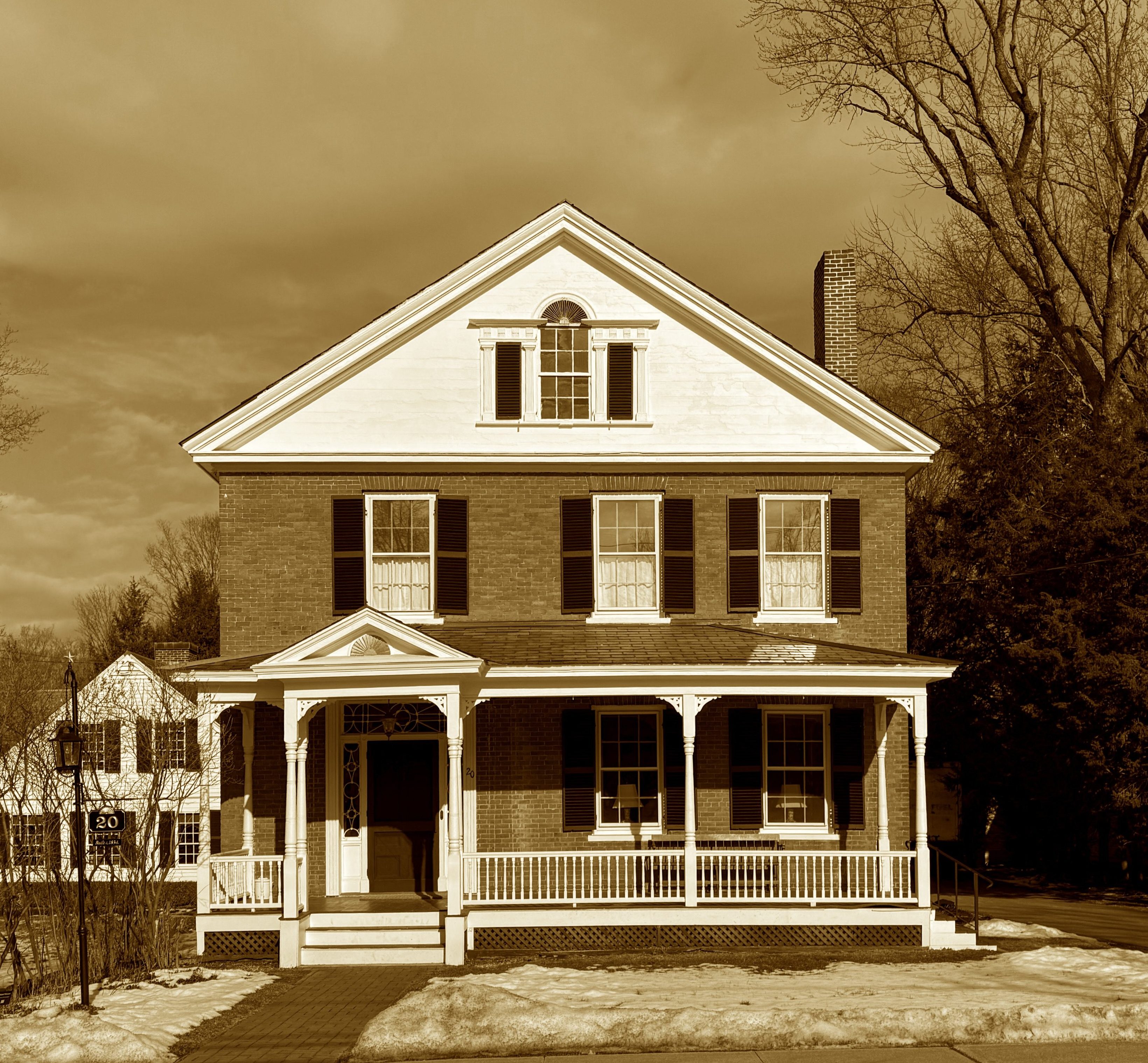
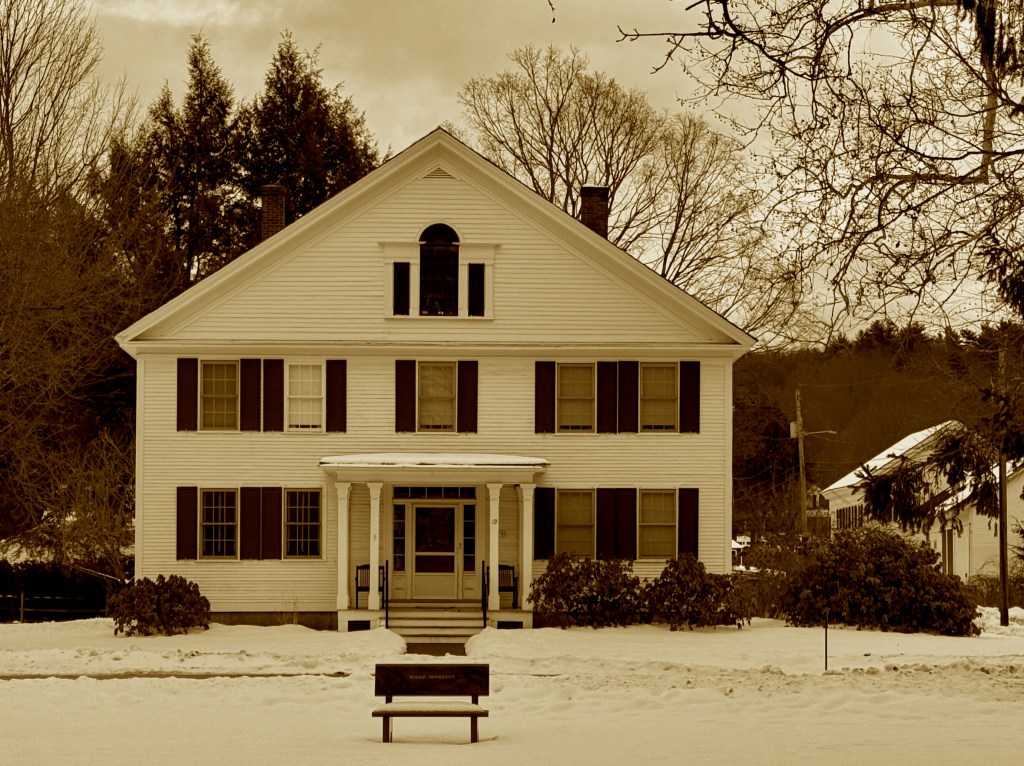
This house, now used as the Congregational Church parsonage, is a distinguished example of late Federal–early Greek Revival architecture, likely built in the 1790s. It is a large, symmetrical, two-and-a-half-story, wood-frame dwelling with a side-gabled roof, twin brick chimneys, and white clapboard siding—features typical of substantial New England village houses of the period.
One of its most notable architectural features is the arched attic window centered in the gable, a refined detail derived from Palladian design. The centered entrance, now sheltered by a Greek Revival porch with square columns, reflects later nineteenth-century improvements while maintaining the building’s formal balance. The evenly spaced multi-pane windows and dark shutters reinforce its orderly, classical character.
The house was likely built by Nicanor Townsley (1755-1830), a local cabinet-maker who acquired the property before 1795. Its careful proportions and fine details suggest the hand of a skilled craftsman. By the early nineteenth-century, it passed through several owners, including members of the Dana family.
In 1827 the property came to Submit Dana (1764-1836), the widow of Samuel B. Dana (d. 1825). Her daughter, Sarah Sumner Dana (1792-1867), lived here with her husband, Thomas Bellows II (1779-1825), and later raised her daughter, Sarah Isabella Bellows (1820-1866) in the house.
Sarah Isabella Bellows married George W. Grant (1812-1881), who came to Walpole in the 1840s after business reverses in Boston. Grant enlarged and improved the house and became known locally for his wit, humor, and literary talent. Evenings here were remembered as lively and stimulating, marked by conversation and playful verse.
After the deaths of members of the Grant family, the house declined until 1883, when it was given to the Congregational Church for use as a parsonage. Since then, it has remained a prominent and dignified presence in the village, embodies both Walpole’s architectural traditions and its religious heritage.

