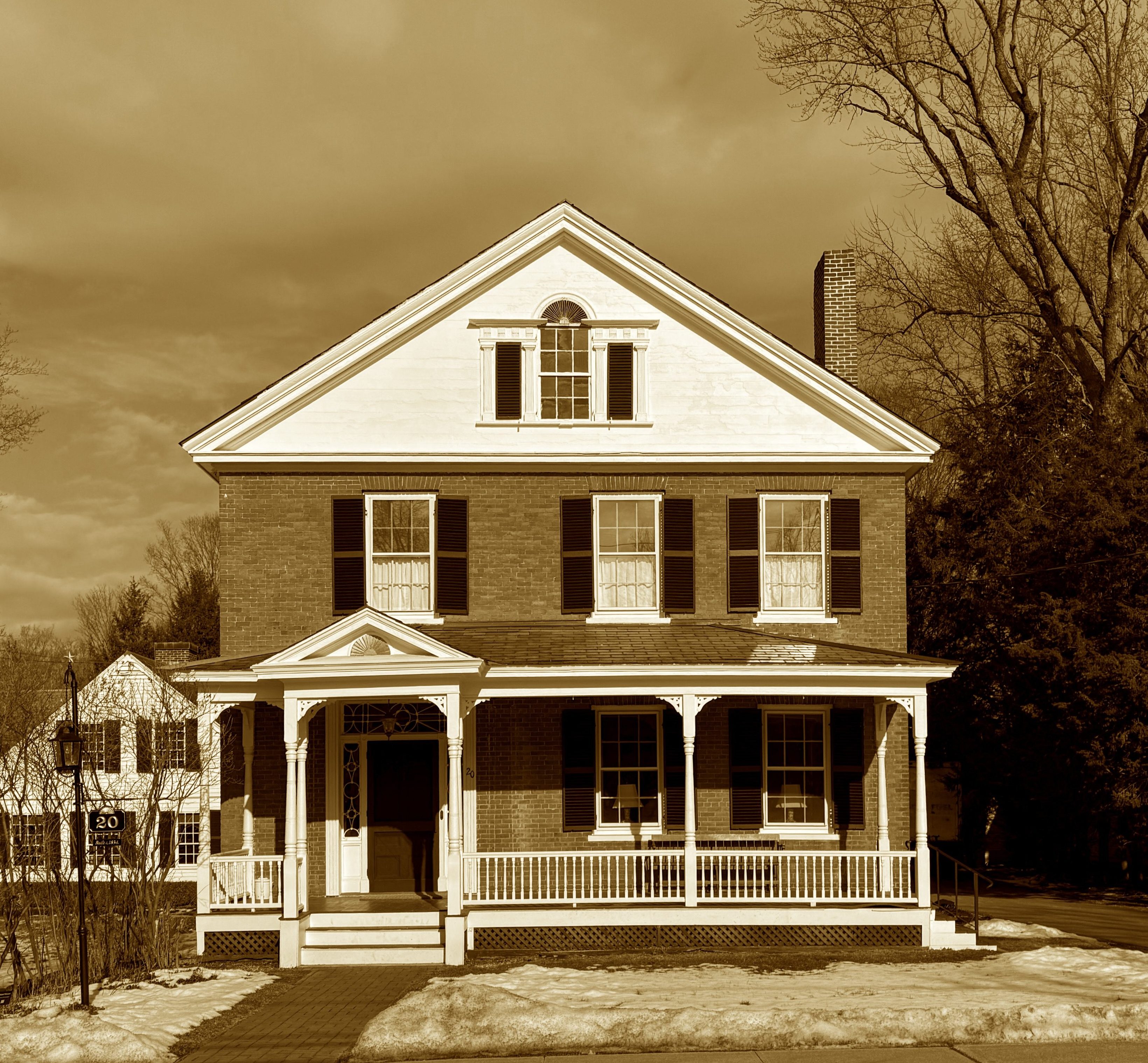
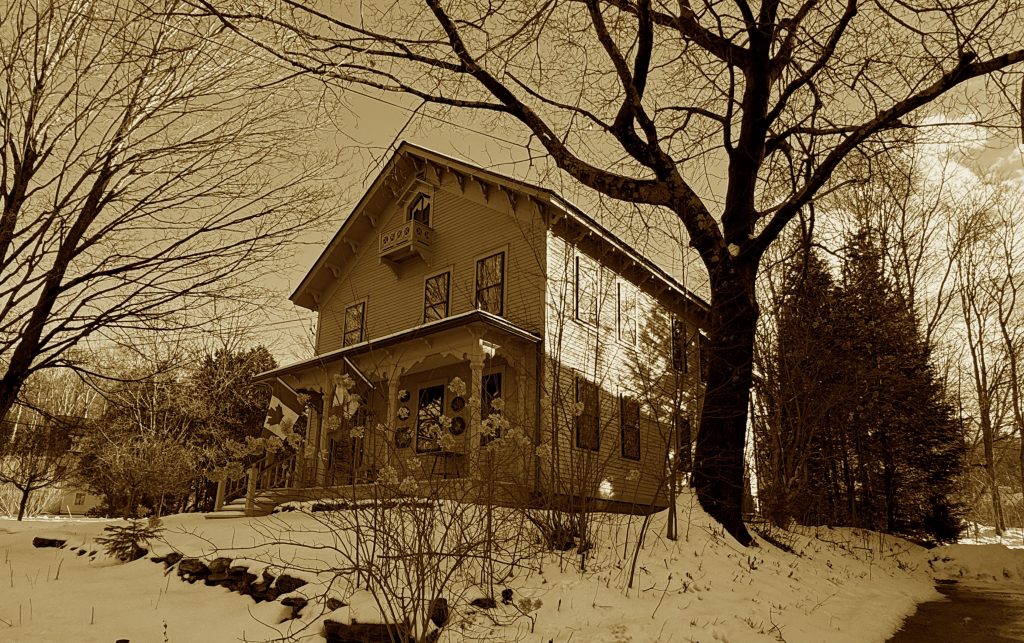
Set slightly back from the street beneath mature trees, the parsonage presents a dignified yet domestic presence, its tall, rectangular form and broad front porch signaling both respectability and welcome.
The exterior reflects a thoughtful blend of Greek Revival and Italianate influences, a combination well suited to a mid-nineteenth-century minister’s house. The building’s overall symmetry, wide clapboards, and strong cornice line recall the Greek Revival, while Italianate details soften the form: deeply overhanging eaves with decorative brackets and a small Juliet balcony tucked into the front pediment, an unusual and elegant feature that adds vertical emphasis and visual interest. The full-width porch, supported by slender posts and trimmed with delicate detailing, wraps the house in shade and reinforces its role as a place of hospitality within the village.
In 1848, the ladies of the Unitarian Ladies Society and Sewing Group of the Walpole Unitarian Church set out to provide a permanent home for their ministers, who until then had boarded in private homes or rented rooms around the village. Finding suitable housing had become increasingly difficult, so the women undertook the project themselves. A verse written at the time praised their efforts; the source is unknown, but it is quoted in Martha M. Frizzell’s A History of Walpole, New Hampshire:
“Have stitched on the clapboards and quilted the roof,
And run every crack with a seam water-proof.
And who would have thought, that a house, barn and shed,
Could be all put together with needle and thread.”
With their work, and with contributions from the congregation, the parsonage was completed in the autumn of 1850. The minister moved in just before Christmas and held a housewarming on Christmas Eve.
The interior retains a sweeping curved staircase, double parlor, a formal dining room, and coffered ceilings. The building served as the church’s parsonage for more than 160 years, until it was sold by the congregation in 2011. It is clearly recognizable as a house built to express care, stability, and community purpose.

