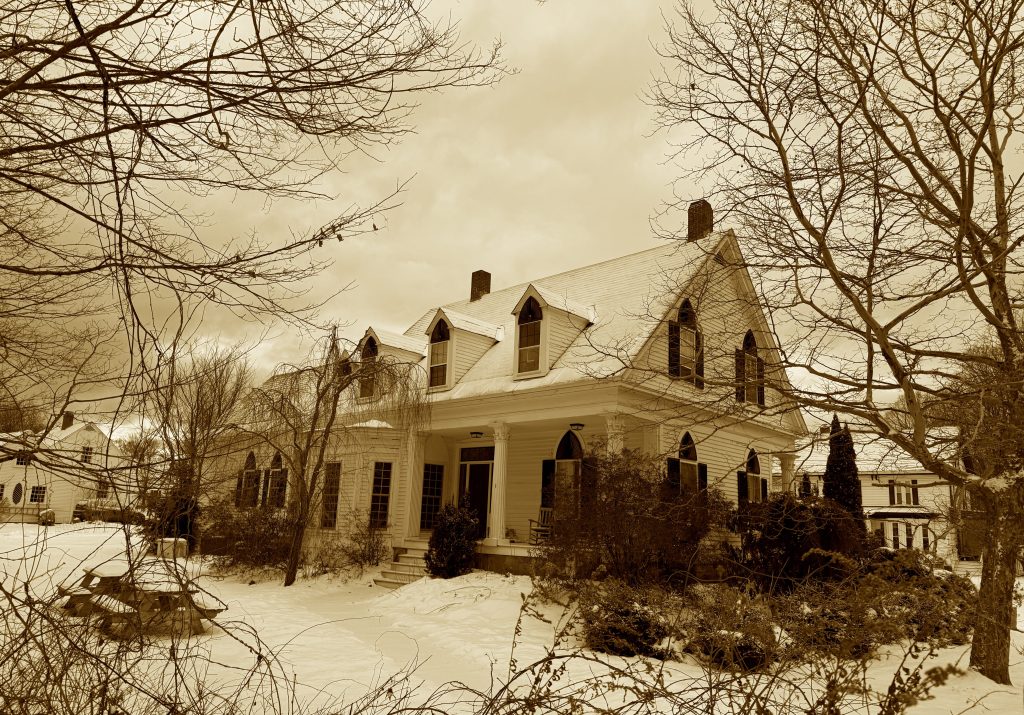
Dating from 1844, the Howland–Schofield House is one of Walpole’s most architecturally distinctive residences, reflecting the creative range of local builder Aaron P. Howland. This 1½-story home blends elements of both the Greek Revival and the Gothic Revival, two styles that were coming into vogue in New England during the mid-nineteenth-century. The result is an eclectic design that demonstrates Howland’s willingness to combine tradition with emerging tastes.
The house’s double front portico, supported by ornate Corinthian columns, showcases the classical influence. These columns closely follow the plates published by architectural pattern-book author Asher Benjamin, whose guidebooks were widely used by New England builders seeking to reproduce fashionable Greek Revival details. In contrast to these classical features, the house also incorporates unmistakable Gothic Revival motifs. Most striking are the pointed-arch Gothic pediments repeated above the portico and echoed across the numerous windows and dormers. This rhythmic use of pointed arches gives the house a picturesque, vertical emphasis, softening the classical symmetry with a touch of romantic flair.
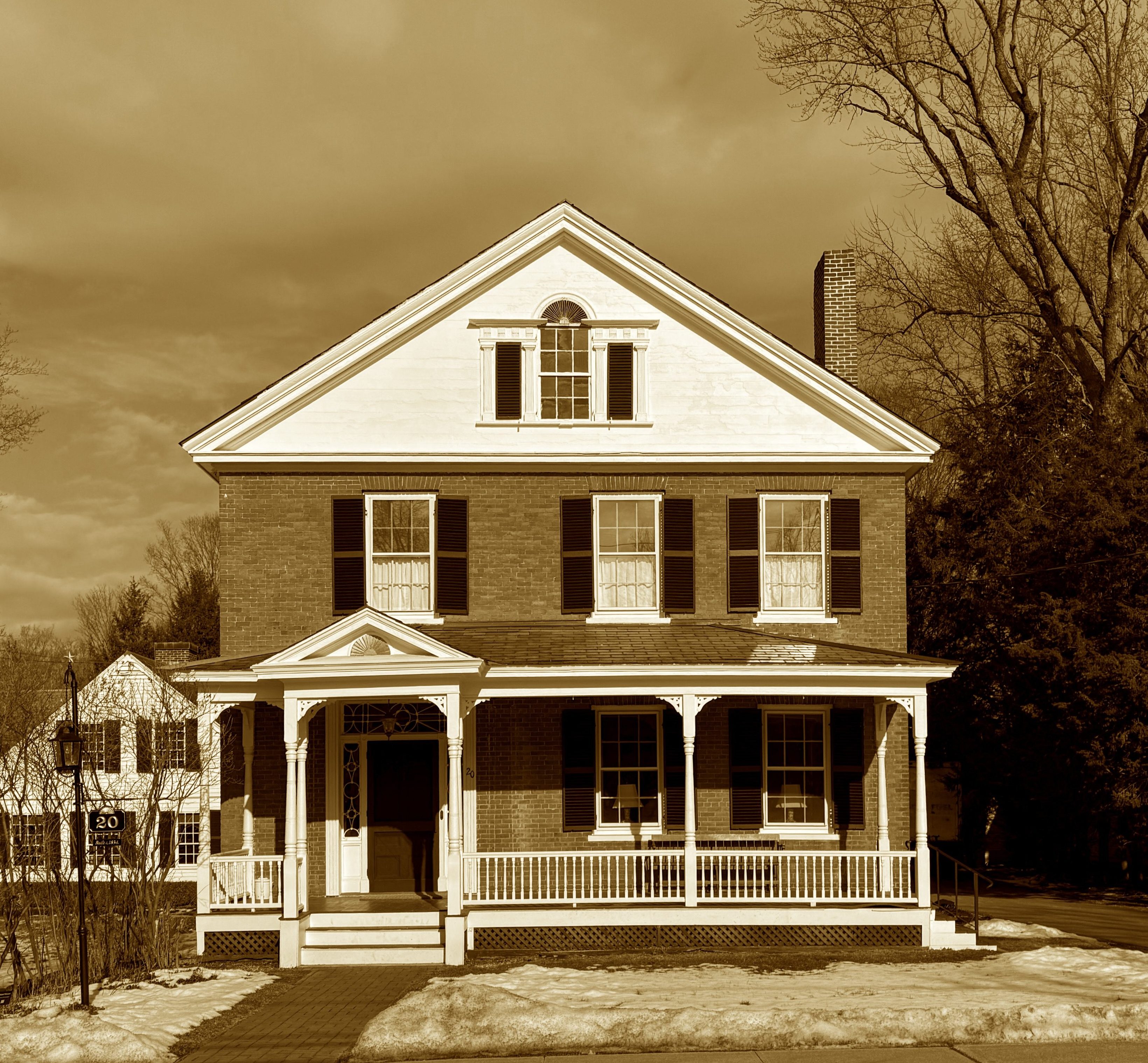
The main entrance door bears a strong resemblance to the doorway at 20 Westminster Street, the Aaron Howland House, suggesting that Howland favored the design enough to adapt it here. Aaron P. Howland and his family lived in the Elm Street house for many years before his widow sold the property in 1884 to George P. Porter (1834-1923). A later owner, Norman Schofield (1908-2002), lends his name to the house’s modern designation among the records of the Library of Congress, Historic American Buildings Survey. Schofield had purchased the property from P. Lucile Tucker (Hawley) Bragg, who noted:
It was the superior and unusual construction of the house with its attractive Gothic windows and detail that tempted me to see just what I could make of it. The fact that the house was built by Aaron P. Howland for his own family undoubtedly accounted for its superior construction. The cellar walls are unusually thick and the cellar itself is divided into three separate rooms. The outside walls of the house are of brick covered over with wood, while the chimney at the back of the house has built into it on the second floor a complete outfit for smoking meat.
This historic residence has taken on a new and notable role: it serves as the offices and production studio of Florentine Films, the documentary film company led by Ken Burns, whose work has brought national attention to American history and culture. The building’s preservation and active use add a contemporary chapter to its long and varied story.
The Howland–Schofield House can be compared with three mid-nineteenth-century residences in nearby Bellows Falls, Vermont: 9 School Street (built circa 1852), 107 Atkinson Street (built circa 1847) and 126 Atkinson Street (built circa 1849), which together display a strikingly consistent architectural vocabulary. Among other features, the most notable is the repeated use of Gothic Revival pointed-arch louvered transoms applied to the window heads, a highly distinctive motif that appears in virtually identical form on all four buildings. These pointed-arch louvered transoms, with their sharply peaked arches and radiating fan-shaped infill, are not common stock trim but appear to be purpose-designed elements, suggesting a single builder or designer rather than coincidental stylistic borrowing.

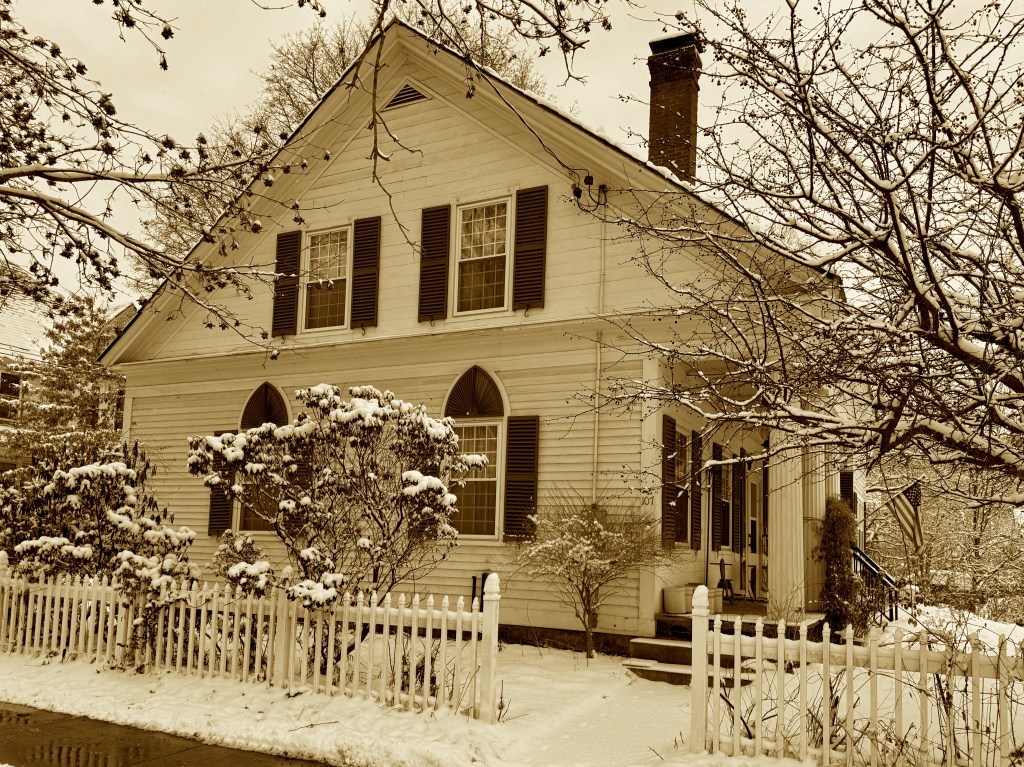

Beyond this signature detail, the buildings share closely related massing and proportions: two-story, gable-front or gable-dominant forms; symmetrical façades; narrow clapboard siding; flushboard tympanum; and restrained classical trim combined with Gothic accents. Window placement and scale are consistent across the group, as is the careful balance between vertical emphasis and domestic restraint. Porches are modest and subordinate to the main block, reinforcing the primacy of the gabled form.
These similarities strongly suggest that all four houses were designed and constructed by Aaron P. Howland. The repetition of such a specific ornamental feature across multiple buildings in close geographic proximity points to a recognizable stylistic signature rather than a generalized fashion. Assuming Howland was the builder, these houses collectively help define his body of work and underscore his role as one of the most accomplished and stylistically confident nineteenth-century builders in the Connecticut River Valley.

