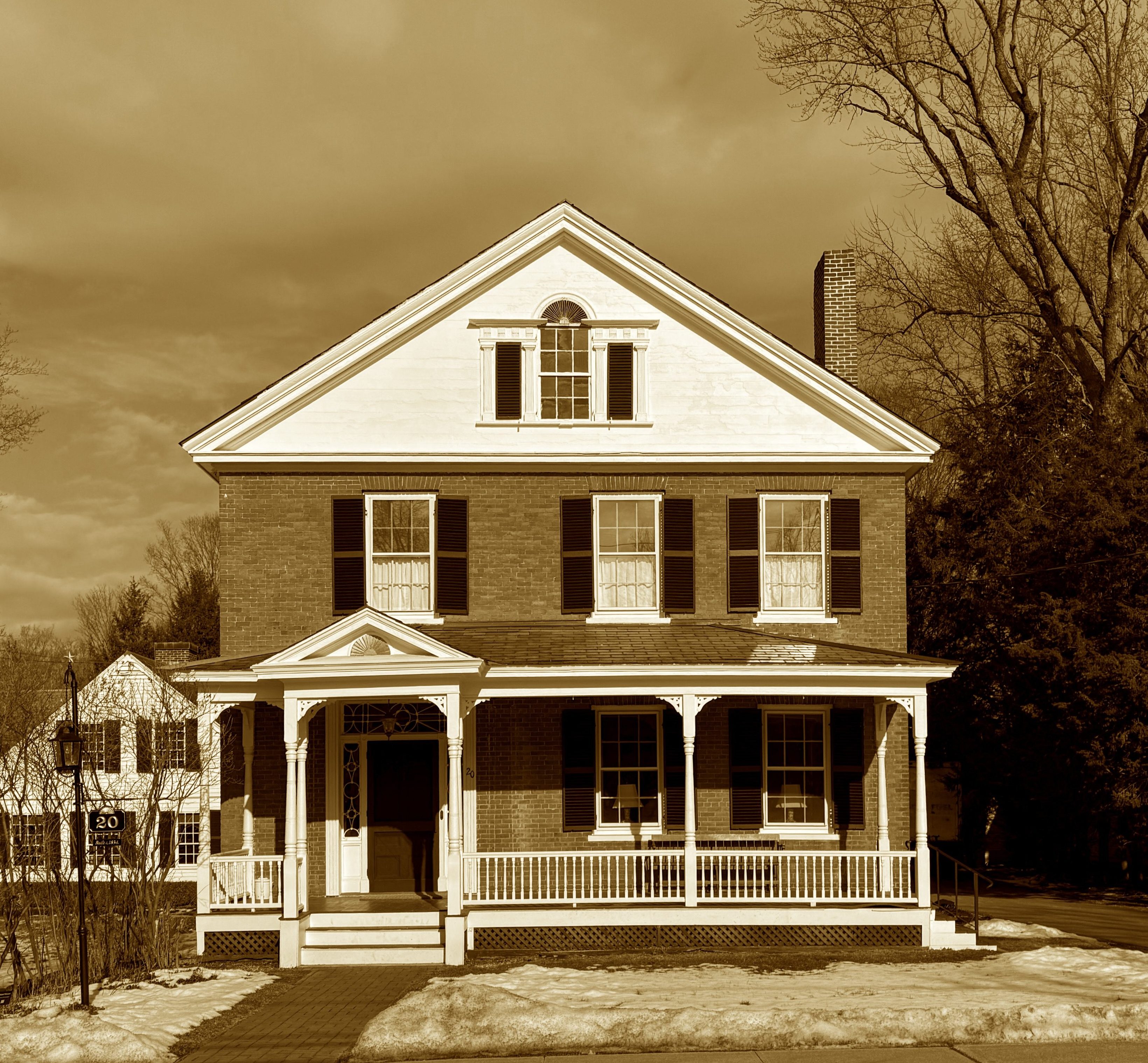

Built about 1793 for David Stevens, a Walpole tanner, this house originally stood on Main Street, on the site now occupied by 27 Main Street. Stevens acquired the lot in 1792 from Gen. Benjamin Bellows, and it is likely that he erected a dwelling soon afterward. Within a few years Stevens left Walpole, beginning a long chain of ownership that reflects the commercial life of the village in the early republic.
By the early nineteenth century, the property passed through the hands of traders and merchants, including David Stone, Levi Pierce of Boston, and Joseph Bellows Jr. In 1812 it was purchased by William Cochran, whose family owned the house until 1839. That year, following Cochran’s death, the house was moved back from Main Street to its present site on Middle Street, an action that reshaped both the building and its setting. Philip Peck, who acquired the property soon afterward, is credited with relocating the structure and constructing the present house on the lot.
Architecturally, the house presents a refined Georgian-inspired façade, closely related to the nearby William Buffum House at 25 Main Street. Shared features include corner quoining, molded window caps, pilasters framing the entrance, a five-bay elevation with a central-hall plan, and a five-light transom over the front door. The building retains its original hipped roof, while a later Colonial Revival porch spans the façade, illustrating how nineteenth- and early twentieth-century owners adapted earlier forms to changing tastes.
Beyond architecture, 12 Middle Street is remembered for its association with Capt. John Cole (1806–1875), a retired sea captain who lived here in the mid-1840s and early 1850s. Born in nearby Westmoreland, Cole operated the general store Cole & Wyman on Main Street. According to Frank T. Cole’s The Early Genealogies of the Cole Families in America (1887), Cole was deeply engaged in Walpole’s civic and reform life. A committed member of the “Free Soil”* movement, he attended the 1848 convention that nominated Martin Van Buren (1782-1862) (former president of the U.S., serving 1837-1841) as the party’s presidential candidate and was an outspoken advocate for human rights.
Most notably, Cole belonged to a local network that assisted runaway slaves traveling north to Canada, and tradition holds that this house served as a place of refuge along that route. He was also active in temperance work and local benevolent societies. One often-repeated story recalls that Cole and his wife survived a shipwreck, each believing the other lost, only to be reunited later on a street in New York City.
Today, 12 Middle Street stands as a reminder of Walpole’s layered past—its early village development, its architectural continuity, and the moral courage of residents who connected this small New Hampshire town to the broader currents of nineteenth-century reform.
*The Free Soilers (1848–1854) were members of the Free Soil Party, a national political movement opposing the expansion of slavery into western U.S. territories under the slogan “Free Soil, Free Speech, Free Labor, and Free Men.” The movement eventually merged with the Republican Party.

