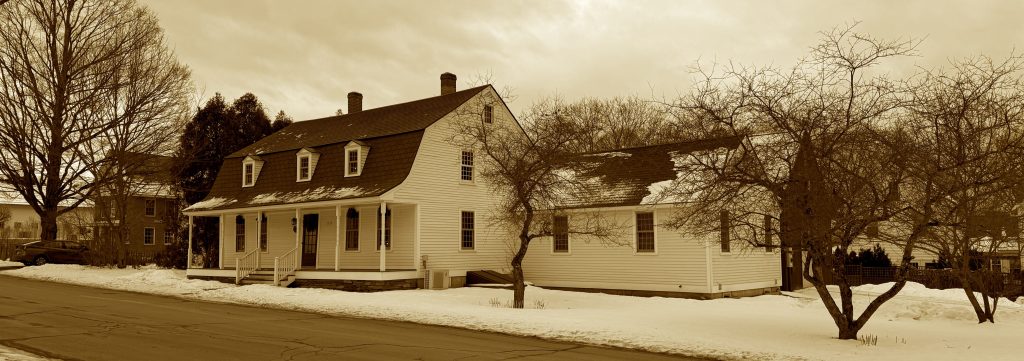
The oldest surviving dwelling in the village of Walpole, the so-called “Historic House” was built around 1761 by Asa Baldwin and remains one of the most remarkably intact examples of mid-eighteenth-century domestic architecture in the region. Over its long life it has sheltered a succession of owners, including Otis Bardwell, who lived here for roughly twenty-five years during the height of his success as a stagecoach operator. Bardwell prospered in that line of work, running coaches that connected Walpole with surrounding towns, and his years in this modest but sturdy house marked the period before he eventually purchased the Aaron Howland House. His association links the building to an important era in the town’s early transportation and commercial history.
The house’s survival was nearly cut short in 1930, when an oil company sought to purchase the property, demolish the building and replace it with a filling station. Alarmed at the prospect of losing Walpole’s earliest dwelling, a group of concerned residents quickly organized, secured a loan, and bought the property themselves. Their successful effort not only preserved the structure but also provided a home for the newly established Walpole Historical Society, which used the house as its headquarters and museum until 1948.
The house is characteristic of its mid-eighteenth-century origins, with a saltbox form, a gambrel roofline, and the simplicity and sturdy craftsmanship typical of early New England homes. Yet one feature distinguishes it from its regional peers: the unusual pulvinated (convex) overhang that curves across the front façade. This gently bulging projection is far more commonly found in the Hudson River Valley and in parts of southern New England than in New Hampshire, suggesting that the builder may have been influenced by traditions from outside the Connecticut River Valley, or that the overhang was added slightly later as stylistic tastes evolved. Whatever its source, the overhang gives the house a distinctive presence rare in northern New England architecture.
The house also bears witness to a more complicated aspect of Walpole’s early past. Shortly after its construction it became the parsonage of Rev. Jonathan Leavitt (1731–1802), the town’s first minister. His tenure ended abruptly in 1764 after an incident that remains one of the more troubling episodes in local history. Leavitt was “detected in leading home a runaway slave of his, a woman, by a rope round her neck and attached to the pommel of his saddle.” On hearing of the outrage, Col. Bellows declared “That such cruelty should not be tolerated” and “that he settled parson Leavitt and he would unsettle him.” The event is a stark reminder that slavery was practiced in New England, including here in Walpole. This moment, preserved in local history, adds a sobering human dimension to a house often admired for its age and architectural charm.
The Historic House stands not only as Walpole’s earliest surviving structure but also as a layered record of the town’s experience: its early settlement, its religious beginnings, its participation in regional trade and travel, and its evolving commitment to preservation and historical truth. Its well-crafted eighteenth-century frame speaks to the skill of the town’s first builders, while the stories of the people who lived here invite a fuller understanding of Walpole’s complex and often challenging past.
Seen together, these intertwined histories make the Historic House a rare and valuable touchstone, offering visitors a deeper sense of the people, ideals, struggles and aspirations that shaped the village from its earliest days.

