Walpole
A Sketch of Walpole, New Hampshire.
Situated just east of the Connecticut River—which partly serves as the boundary between Vermont and New Hampshire—Walpole, New Hampshire, covers 37 square miles and is home to nearly 4,000 residents, The town is characterized by its picturesque landscape, with rolling hills and lush greenery that attract both outdoor enthusiasts and those seeking tranquility. It comprises three villages: Walpole, North Walpole, and Drewsville, each contributing to the unique charm of the area, where local events and gatherings foster a sense of belonging among residents.
In 1736, the town of Walpole, New Hampshire, was originally known as “Number 3” in recognition of its position as the third fort town established to defend against Native American attacks along the Connecticut River. Its history also includes being granted independently to three different parties by three separate British Colonial royal governors. Ultimately, New Hampshire Governor Benning Wentworth’s authority prevailed when he granted the land to Colonel Benjamin Bellows, a land surveyor.
In grateful recognition of the friendly First Lord of the Treasury, Chancellor of the Exchequer, Leader of the House of Commons, First Earl of Orford, and Whig party member of Parliament, the town was named in 1752 (and reaffirmed in 1781) in honor of Sir Robert Walpole. Known for his rare and appreciated non-repressive stance towards those in “new” England, Sir Robert Walpole is often considered Britain’s first prime minister, although that title was not officially used during his tenure. He was also the first resident of 10 Downing Street in London, which would later become the permanent residence for future prime ministers.
The home of Colonel Bellows, which has served as the Stage Coach Inn, Homestead Inn, and a nursing home since his time, has been expanded and restored to its current capacity as The Walpole Inn. High on the hillside of the Walpole Village Old Cemetery, located a mile or two from the town center, rests Colonel Bellows, who passed away in 1777. Beside him lie his first wife, Abigail Stearns Bellows, whose grave from 1757 is the oldest known burial there, and his second wife, Mary Hubbard Bellows, who outlived him by 17 years until her death in 1794. Here you will also find all the former owners of 20 Westminster Street.
Located in the Great Falls Region, which includes several villages in Vermont and New Hampshire along the Connecticut River, Walpole is notable for being the site of the first bridge to span a section of the 410-mile river. Built in 1785 by Colonel Enoch Hale, this bridge linked the related towns of Walpole, New Hampshire, and Bellows Falls, Vermont — the latter named after Walpole’s founder, Colonel Benjamin Bellows. In time the bridge and was weakened by decay, and in 1840 a replacement was constructed upriver, at which point Colonel Hale’s bridge was cut down and the remains carried away by the river.
The Village of Walpole
The village of Walpole, home to nearly 600 people (2020 federal census), offers a charming, small-town atmosphere while staying connected to modern amenities. There are no corporate convenience stores (except Jake’s in the village center) or fast-food chains competing for attention; no movie theaters or nightclubs. Yet, the town’s residents don’t feel a sense of lacking—instead, they enjoy a fulfilling, close-knit community life.
Walpole’s charm extends beyond its strong ties to dairy, agriculture, and farming; it also fosters a creative spirit that has attracted notable literary and media figures. Henry David Thoreau, author of Walden and Civil Disobedience, reportedly hiked the Falls Mountain range in the Great Falls Region in 1865. Louisa May Alcott, during the 1850s, lived in Walpole with her family, where she wrote Under the Lilacs. She also drew inspiration from her local experiences for Little Women and performed with her sister, Annie B. Alcott, in the Walpole Amateur Dramatic Company.
James A. Michener, known for his epic novels such as Hawaii, Centennial, Texas, and the Pulitzer Prize-winning Tales of the South Pacific, which inspired the Broadway and film adaptation South Pacific, also has ties to the area. Ken Burns, a resident for many years, continues this legacy of creativity in Walpole. Through his production company, Florentine Films, he has produced acclaimed documentaries like The Civil War, Jazz, Baseball, The Vietnam War, and the Academy Award-nominated The Brooklyn Bridge and The Statue of Liberty.
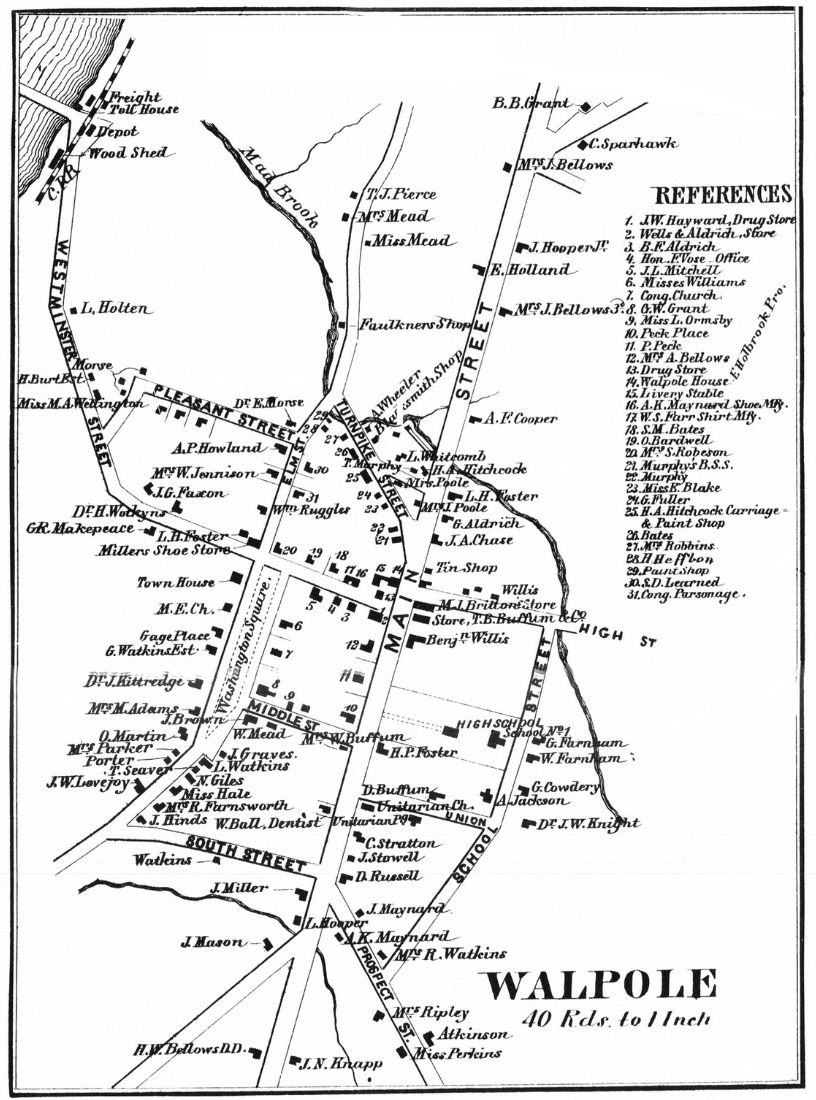
The Town Common is the heart of the village, framed by the parallel roadways of Main Street and Elm Street, and is bisected at either end by Westminster Street and South Street. These four streets create a cozy, walkable enclave where everything is within easy reach.
While there is no official “Entering Walpole” or “Welcome to Walpole” signage, there is an antique-looking clock halfway down Westminster Street, bearing the town’s name above its face. One of the central gathering spots in town is the old Independent Grocers Alliance (IGA) Building in the town center (once owned by Guy H. Bemis, a former owner of The Aaron Holland House). This building, occupies a site originally known successively as “The White Store,” the “Brick Block,” and “Davis’s Block” in the early 1800s (having burned and been re-built twice in the nineteenth century), the site hosted a variety of businesses over the years, including a hatter’s shop, a dry goods store, law offices and the like. Since the departure of the IGA, the building now houses the town’s post office, L.A. Burdick’s café, restaurant, and fine chocolate shop, a real estate office, and Walpole Grocery—a store that features many local and international products. This spot is a hub for picking up the newspaper, mail, groceries, or a meal, enjoying a conversation, indulging in a sweet treat, or even posting a bill or announcement on the large corkboard outside.
Directly across the street since 1891 is the Bridge Memorial Library, a small yet densely filled space named after its benefactor, Hudson E. Bridge. The stone-built library houses nearly 26,000 volumes and retains a former working fireplace, adding to its cozy charm. Just east of the library is a salon and apartments situated within a brick building, alongside a cluster of local shops, a bank, and several residences.
A few doors south of the Bridge Memorial Library on Main Street stands the Walpole Historical Society Museum and Gift Shop. Set back from the street and perched high on a hill with a sprawling, manicured lawn, the grand former Walpole Academy building has served as the historical society’s home since 1950. Built in 1831 by Aaron P. Howland, this four-column Greek Revival landmark, complete with a bell tower and welcoming porch, was originally a private and boarding school, with multiple grades split between its floors. From 1853, it also served as Walpole High School for nearly a century.
The museum’s exhibits, some of which rotate frequently, include a permanent display of a historic classroom, complete with wrought-iron and wooden desks, chalkboards, and period-appropriate teacher’s attire. Other exhibits showcase period furniture, wardrobes, dishes, and household wares, along with displays that recreate “scenes” depicting families, events, and adventures from Walpole’s early history. The museum’s gift shop is stocked with a variety of local items and informative literature.
At the corner of Main and Westminster lies Fountain Square, named for the New York architects Delano & Aldrich-designed Memorial Fountain “for horses and human beings”, constructed of Branford Red Granite from the quarry at Stoney Creek, Connecticut and donated by Charles P. Howland, a grandson of Aaron P. Howland, in 1905. Along Westminster Street, you’ll find a restaurant space in the red-brick 1833 Leslie S. Hubbard Block (now occupied by Rancho Viejo Mexican Food and Cantina). Across Westminster Street is the Dartmouth-Hitchcock Clinic and a branch of the Savings Bank of Walpole, which has been a presence in town since 1892.
Walpole Town Hall, located at the intersection of Westminster and Elm Streets, was rebuilt a year after the 1917 fire sparked by lightning that destroyed the original building. The original town hall had been moved from its first location on Prospect Hill in the 1820s. Today, it serves as the heart of the community, housing essential town offices like the Selectboard, town clerk, tax collector, and water and sewer departments. In addition to hosting local, state, and national elections, the annual Town Meeting, and various public hearings and lectures, the Town Hall is a hub for community activities. Regular meetings are held by the Walpole Selectboard, as well as groups like the Boy Scouts, Girl Scouts and 4-H Club. The hall also serves as a venue for dances, town suppers, bingo nights, and other social events, and since 1987 the home to The Walpole Players, a theatrical troop.
The Town Hall anchors the Town Common, surrounded by historic residences and several churches, including River Valley Church, St. John’s Episcopal Church, and the First Congregational Church United Church of Christ. The Walpole Unitarian Church is nearby on Main Street.
Also on the Common, directly across from the Town Hall, is the inviting and contemplative granite Walpole Veterans Memorial. Built in 2007 and dedicated on Memorial Day of that year, it occupies the site of the previous memorial and retains the two military cannons that were part of the original, smaller version. The memorial’s curved, granite slabs bear the names of nearly 1,200 Walpole veterans who served in the U.S. Army, Navy, Air Force, Marines, Coast Guard, and Merchant Marine from the Revolutionary War to the conflicts in Iraq and Afghanistan. A star is engraved next to the names of those who gave their lives. At the center of the memorial stands a tall flagpole, enhancing the solemn and respectful atmosphere.
The Granite State town of Walpole is a vibrant and productive community. It is home to proud, hard-working New Englanders who embody the spirit of tradition and resilience, welcoming of newcomers, but always mindful of the town’s history.
Sources
George Aldrich, Walpole As It Was and As It Is, containing the Complete Civil History of the Town from 1749 to 1879 (Claremont, NH: The Claremont Manufacturing Co., 1880).
Paul Clerici, Tale of two towns: A Walpole, Mass. native’s look into Walpole, NH (29 December 2011) Wickedlocal.com.
Martha McDanolds Frizzell, A History of Walpole, New Hampshire (Two Vols.) (Town of Walpole: Vermont Printing Co., 1963).
Alan F. Rumrill, “A Moment in Local History: The First Connecticut River Bridge,” The Keene Sentinel (14 February 2020) p. 1.
The Walpole Clarion, Vol. 7, Issue 5 (May 2017) p. 12.
 Aaron Howland House